
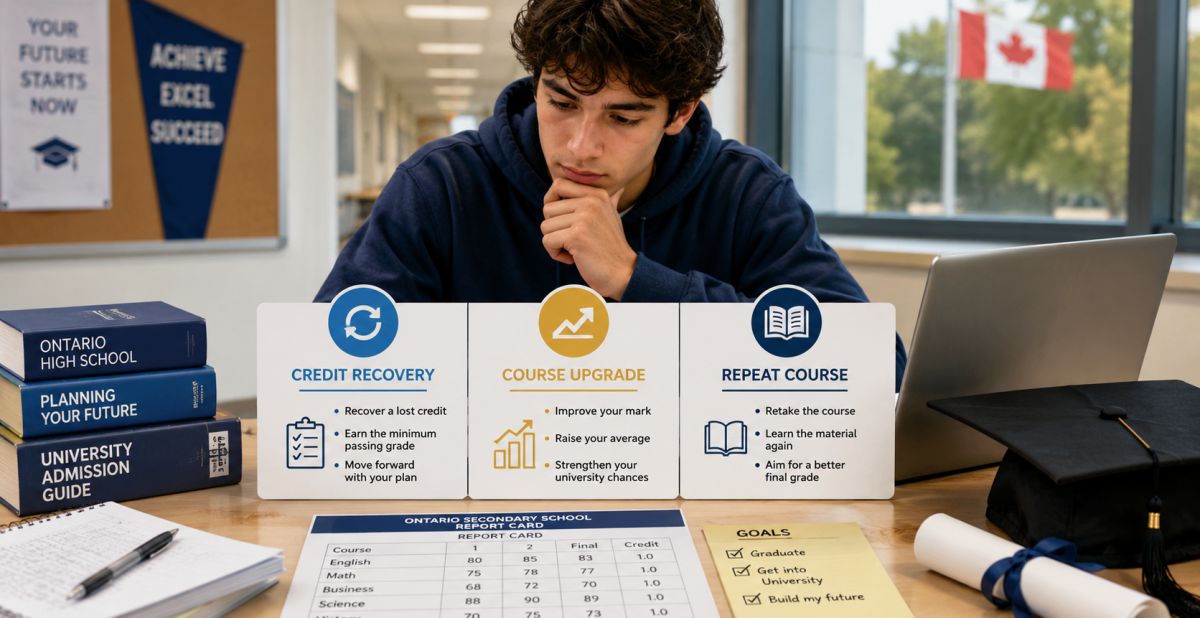
If you are weighing credit recovery vs course upgrade Ontario options, the real question is not which one is easier. It is why you are retaking the course. Credit recovery is for a course you failed or are close to failing. A course upgrade is for a course you already passed and already hold the credit for, taken again just to raise the mark. Repeating a course means starting the entire course over from the beginning. Each path changes your transcript differently, and each one fits a different student in a different situation.
Quick Answer
Credit recovery is for students who failed or are at serious risk of failing a course and need the specific missing skills addressed, not a full re-teach. A course upgrade is for students who already passed a course and want a higher mark for university admission averages, common in Grade 12 courses like SPH4U, MCV4U, and ENG4U. Repeating a course means retaking the entire course from the start, usually because the gaps are spread across most of the curriculum. For Grade 11 and 12 courses, both attempts appear on the Ontario Student Transcript (OST), with an “R” placed beside the lower mark. Only the higher mark counts toward your Ontario Secondary School Diploma (OSSD) credit total.
Key Highlights of Credit Recovery vs Course Upgrade vs Repeating a Course
• Credit recovery targets specific unmet learning expectations, not the whole course, and is often delivered through a shorter, modified program.
• A course upgrade means retaking a course you already have credit for, usually to raise a Grade 12 mark before OUAC (Ontario Universities’ Application Centre) submission deadlines.
• Repeating a course restarts the entire course, recommended when a student did not substantially complete it or needs a full reset before a prerequisite course.
• For Grade 11 and 12 courses, both attempts show on the OST with an “R” beside the lower mark, and only the higher mark earns the credit.
• You only ever earn one credit per course code, no matter how many times you take that course.
• Universities generally use the higher mark for admission average calculations, but individual programs may review both marks under full disclosure.
• USCA Academy offers credit recovery, course upgrade, and repeat options through its night school and summer school programs in Mississauga.
Why This Comparison Matters Before You Choose
Guidance counsellors hear the same question every semester. A student is struggling in a course, or already passed it but wants a better mark, and the family wants the fastest fix. The honest answer is that “fastest” depends on which category the student falls into.
Picking the wrong path wastes time and can create a messier transcript than necessary. A student who needs a full reset but only does a short credit recovery module will likely still be missing key skills.
This post lays out all three options side by side, what each involves, what it costs in time, and what it looks like on your transcript. If your course was dropped in time and never showed up on your OST at all, that is a different decision covered in USCA Academy’s guide on dropping a course before the full disclosure date.
What Credit Recovery Actually Means
Credit recovery is for a student who failed a course, or who is far enough behind that failing is the likely outcome. It does not mean retaking the whole course from day one. Instead, it targets only the specific learning gaps or expectations the student has not yet met.
Because credit recovery is scoped to what is missing rather than the entire curriculum, it is often delivered through a shorter, modified program. A student might spend a few weeks closing gaps in two or three units instead of sitting through a full semester again. This makes credit recovery faster than repeating the course in most cases.
Credit recovery works best when the gaps are contained. If a student failed because they missed one unit due to illness, or struggled with two specific skills, credit recovery is built for exactly that situation.
What a Course Upgrade Actually Means
A course upgrade is a completely different situation from credit recovery. It applies to a student who already passed the course and already holds the 1.0 credit for it. The student is retaking it purely to raise the percentage mark.
This is most common in Grade 12 university-level (U) courses in the run-up to OUAC applications. A student who earned 72% in SPH4U (Grade 12 Physics) but needs a stronger mark for an engineering program’s admission average might upgrade that course. The same logic applies to MCV4U (Calculus and Vectors) or ENG4U (Grade 12 English), both frequently used in top-6 admission average calculations.
Because the student already understands the material well enough to have passed it once, a course upgrade is generally about polishing performance, not learning from scratch. It is a strategic move for competitive admission averages, not an academic rescue.
What Repeating a Course Actually Means
Repeating a course means retaking the entire course from the beginning, covering every unit again as if it were the first attempt. This is different from credit recovery’s narrower, gap-focused approach.
Repeating the whole course makes sense when the gaps are spread across most of the curriculum rather than contained to one or two units. It also makes sense when the course was not substantially completed, for example if a student withdrew partway through the semester.
A full repeat is also the right call before a course that depends heavily on the one before it. Moving from MCR3U (Grade 11 Functions) into MHF4U (Grade 12 Advanced Functions) with major gaps in functions concepts sets a student up to struggle again. A full reset closes that gap before the next course starts.
Credit Recovery vs. Course Upgrade vs. Repeat: Side-by-Side Comparison
Use this table to see how the three paths compare across the factors that actually matter when you are deciding.
| Factor | Credit Recovery | Course Upgrade | Repeating the Course |
| Who it is for | A student who failed or is at serious risk of failing | A student who already passed and holds the credit | A student with gaps spread across most of the curriculum, or an incomplete attempt |
| Starting point | Course not yet passed | Course already passed | Course may have been passed, failed, or withdrawn from |
| Scope of work | Targeted, only the unmet expectations | Full course content again, focused on performance | Full course content again, from the beginning |
| Typical time commitment | Shorter, modified program, often a few weeks | A full semester or a compressed summer term | A full semester or a compressed summer term |
| Credits earned | 1.0 credit if the recovered mark passes | Still only 1.0 credit total for that course code | Still only 1.0 credit total for that course code |
| What shows on the OST (Grade 11-12) | Both attempts appear, if the failed attempt was not dropped in time | Both attempts appear, with the lower one marked “R” | Both attempts appear, with the lower one marked “R” |
| Effect on GPA-style admission average | Recovered pass replaces the missing credit needed for graduation | Higher mark generally used for admission average calculations | Higher mark generally used for admission average calculations |
| Best timed for | As soon as the risk of failing becomes clear | Grade 12, ahead of OUAC submission deadlines | Before a prerequisite-dependent course, or after an incomplete attempt |
| Common delivery option at USCA | Night school or summer school | Night school, in-person credit course, or summer school | Night school, in-person credit course, or summer school |
Where the Full Disclosure Rule Fits In
Ontario’s full disclosure policy shapes what shows up on the transcript for all three paths. According to the Ontario Ministry of Education’s policy document “Ontario Schools, Kindergarten to Grade 12,” full disclosure requires that every Grade 11 and 12 course a student attempts be recorded on the OST, whether it was completed, failed, or withdrawn from after the drop deadline.
This rule only applies to Grade 11 and 12 courses. Grade 9 and 10 course changes never appear on the transcript, regardless of timing, so credit recovery, upgrades, or repeats at those grade levels do not carry the same transcript weight.
For Grade 11 and 12, this means a first attempt that was failed or under-completed does not disappear once you recover the credit, upgrade the mark, or repeat the course. It stays on record next to the newer attempt.
What Shows Up on Your Transcript for Each Path
The transcript mechanics work the same way whether you are doing credit recovery, a course upgrade, or a full repeat, as long as the course is at the Grade 11 or 12 level.
Both attempts appear on the OST with both percentage marks listed. An “R,” for Repeat, is placed in the credit column next to the lower of the two marks. Only the higher mark earns the 1.0 credit toward your OSSD, and you still only earn one credit total for that course code no matter how many times you take it.
This applies whether the original attempt was a fail being recovered, a pass being upgraded, or a course being fully repeated after a withdrawal. The transcript does not distinguish between your reason for retaking the course. It only records both attempts and flags the lower one.
For a full worked example with sample marks showing exactly how the “R” notation looks on a real transcript, see USCA Academy’s detailed breakdown of the R notation and what happens when you retake a course.
How Universities Read a Repeated or Upgraded Mark
Universities calculating admission averages, typically the top 6 Grade 12 university or university/college (U/M) courses, generally use the higher of the two marks for that course code. That is the mark carrying the 1.0 credit, so it counts toward graduation and, in most cases, the admission average.
That said, individual programs can review both marks if full disclosure shows a repeat or upgrade. The retake stays visible on the transcript regardless of which mark a university’s formula uses. Some competitive programs, particularly in health sciences or engineering, may factor that visibility into a holistic review.
Do not assume every program treats this identically. Confirm directly with the admissions office of each program you are applying to, since practice can vary even within the same university. OUAC’s own guidance is a good starting point, but program-level policies are not standardized across Ontario.
Honest Tradeoffs: What Each Path Actually Costs You
None of these three options is free of downsides, and pretending otherwise does not help a student make a good decision.
Credit recovery is fast, but it only works if the gaps are genuinely narrow. If a student’s understanding is weak across most of the course, a short recovery program will not fix that, and the student risks struggling again in the next course in the sequence. Credit recovery also does not erase the original failed attempt from the transcript if it was not dropped before the full disclosure deadline.
A course upgrade costs time and tuition for a mark improvement that may only move an admission average by a point or two. It is worth asking whether that time would be better spent on a new course or an OUAC supplementary application instead.
Repeating a full course is the most time-intensive option of the three. It means redoing content the student may have partly understood already, which can feel discouraging, plus a full semester or summer term of tuition and scheduling.
Across all three paths, the original lower mark and the “R” notation stay on the OST permanently once it is issued for a Grade 11 or 12 course. Retaking a course improves your credit and your usable mark, but it does not delete the history. Families should weigh that visibility honestly against the benefit of the improved mark before committing to any of the three routes.
How to Decide Which Path Is Right for You
Start with where the student stands in the course right now. A student who is failing or about to fail is in credit recovery or repeat territory, not upgrade territory, since an upgrade only applies once a credit is already earned.
Next, look at how widespread the gaps are. Contained gaps in one or two units point toward credit recovery. Gaps spread across most of the course, or an incomplete attempt, point toward a full repeat.
If the course is already passed and the goal is a stronger mark for admission, a course upgrade is the option built for that. This is most common with Grade 12 U courses feeding directly into OUAC applications.
Finally, consider what comes next in the sequence. A student moving from MCR3U into MHF4U with major gaps usually benefits from a full repeat over a narrower credit recovery, even if recovery alone would technically restore the credit.
A guidance counsellor who knows the student’s full academic history is best placed to confirm the right call. USCA Academy’s guidance team works with class sizes of 5 to 15 students specifically so this kind of one-on-one course planning is possible every semester.
How USCA Academy Supports Credit Recovery, Upgrades, and Repeats
USCA Academy is an Ontario Ministry-inspected international private school in Mississauga, offering all three paths through flexible scheduling built around the 2026-27 school year. Students working through any of these options do not have to choose between catching up and staying on track with their regular course load.
USCA’s night school program in Mississauga is a common route for credit recovery and course upgrades during the regular school year, since evening scheduling lets students keep their daytime timetable intact. For students who want a faster, condensed timeline, USCA’s summer school program runs two intakes in July and August 2026, with summer credit courses priced at $750 each.
Regular credit courses, available online and in person, run $490 to $574 per course depending on grade and year, and can also be used for a repeat or upgrade outside the summer window. USCA’s full Grade 11 and Grade 12 course listings, along with the complete our courses catalogue, show which specific courses are available for recovery, upgrade, or repeat.
Students planning an upgrade specifically for OUAC purposes can also lean on USCA’s University Preparation Program and OUAC application guidance to make sure the timing lines up with submission deadlines. If a student needs support with the actual course content rather than just a scheduling option, USCA’s tutoring program can run alongside night school or summer school.
If credit recovery specifically is your main question, USCA Academy’s existing post comparing credit recovery vs summer school looks at delivery timing and format in more depth. This post focuses on a different comparison, choosing between recovery, upgrade, and a full repeat, so the two are meant to be read together rather than as duplicates.
Frequently Asked Questions
1.Can I do a course upgrade for a Grade 9 or 10 course?
Yes, but it will not show on your OST either way, since full disclosure only applies to Grade 11 and 12 courses. Most students save upgrade decisions for Grade 12 U courses that feed into admission averages.
2.Does credit recovery guarantee I will pass?
No. Credit recovery targets your specific gaps, but you still need to demonstrate you have met the missing expectations. Talk to your guidance counsellor about what a realistic timeline looks like for your situation.
3.Will a university see that I repeated or upgraded a course?
Yes, if it is a Grade 11 or 12 course. Full disclosure means both attempts appear on your OST with an “R” beside the lower mark, though universities generally use the higher mark for admission average calculations.
4.How many times can I attempt the same course?
There is no fixed provincial cap on attempts, but you only ever earn one credit per course code. Repeated attempts beyond a second try are uncommon and usually signal a need for a different intervention, like tutoring.
5.Is credit recovery cheaper than repeating the whole course?
It is often faster because the scope is narrower, which can also make it less costly depending on the delivery format. Confirm exact program costs and timelines directly with your school, since they vary by course and term.
6.Should I ask my guidance counsellor before choosing a path?
Yes. A counsellor who knows your full transcript history, current course load, and university targets is best positioned to confirm whether credit recovery, an upgrade, or a full repeat fits your situation