
MCF3M – Grade 11 Functions and Applications Online Course course
Send Us A Message
MCF3M – Grade 11 Functions and Applications Online Course
| Course Code: | MCF3M |
| Course Type: | Mixed – University/College Preparation |
| Credit Value: | 1.0 |
| Prerequisite: | None |
MCF3M Course Description
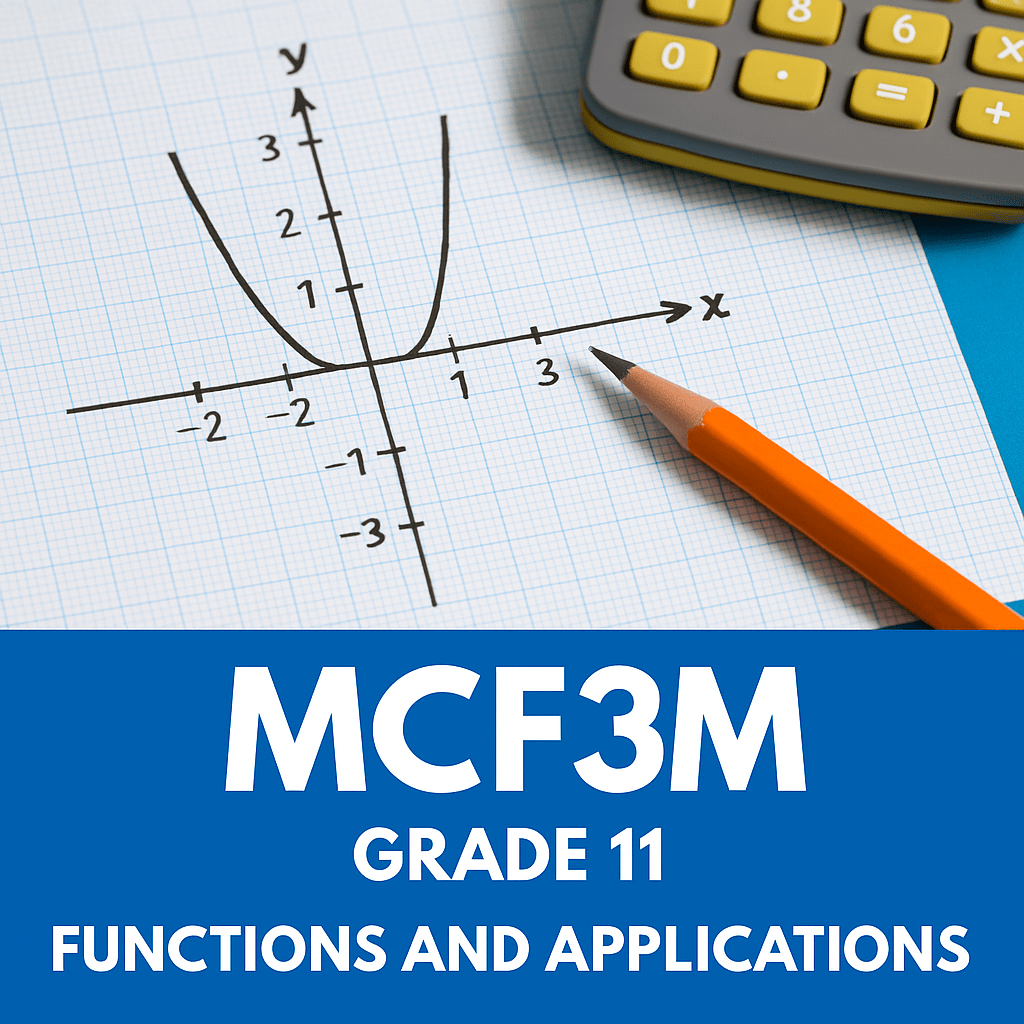
This course introduces basic features of the function by extending students’ experiences with quadratic relations. It focuses on quadratic, trigonometric, and exponential functions and their use in modelling real-world situations. Students will represent functions numerically, graphically, and algebraically; simplify expressions; solve equations; and solve problems relating to applications. Students will reason mathematically and communicate their thinking as they solve multi-step problems. Contact us to know more.
Outline of Course Content
Unit
Titles and Descriptions
Time and Sequence
Unit 0
Prerequisite Review of Concepts
Students will review previous and applicable concepts discussed in grade 10 math to well equip then for the upcoming course. Such topics include linear functions, graphing, and other topics.
3 hours
Unit 1
Introduction to Functions
Students will begin with a review of arithmetic and other mathematical skills acquired in prior grades. They will study polynomials, with particular attention to operations performed on polynomial equations. Building on their knowledge of relations, they will explore the concept of functions. Finally, they will solve problems pertaining to rational expressions, drawing upon the skills acquired in the previous modules.
20 hours
Unit 2
Algebraic Expressions
Through this unit, students will learn to simplify expressions; solve equations; and solve problems relating to applications. They will reason mathematically and communicate your thinking as you solve multi-step problems.
20 hours
Unit 3
Quadratic Functions
Students will study one family of functions, quadratics, in detail. They will explore the various forms of the quadratic equation and use strategies to convert equations to graphs and vice versa. They will explore the significance of the characteristics of quadratic functions. They will make connections between the numeric, graphical and algebraic representations of quadratic functions, and relate the roots of quadratic equations to the corresponding graph. As well as investigate the utility of quadratic functions as models for a variety of real-world applications.
15 hours
Unit 4
Exponential Functions
Students will learn to simplify and evaluate numerical expressions involving exponents, and make connections between the numeric, graphical, and algebraic representations of exponential functions. As well as, identify and represent exponential functions, and solve problems involving exponential functions, including problems arising from real-world applications.
16 hours
Unit 5
Functions & Applications of Trig
Trigonometry, and trigonometric functions, are used extensively in sea and land navigation, survival situations, planning building projects, mixing music and exploring space. By the end of this unit, students will understand how to do all of these things at a basic level, and relate these applications to the numeric, graphical and algebraic representations of sinusoidal functions.
19 hours
Unit 6
Discrete Functions
The unit begins with an exploration of recursive sequences and how to represent them in a variety of ways. Making connections to Pascal’s triangle, demonstrating understanding of the relationships involved in arithmetic and geometric sequences and series, and solving related problems involving compound interest and ordinary annuities will form the rest of the unit.
09 hours
Unit 7
Final Evaluation
The final assessment task is a three-hour exam worth 30% of the student’s final mark.
03 hours
Total
110 hours
Since the over-riding aim of this course is to help students use language skillfully, confidently and flexibly, a wide variety of instructional strategies are used to provide learning opportunities to accommodate a variety of learning styles, interests and ability levels. These include:
Guided Exploration | Problem Solving | Graphing |
Visuals | Direct Instruction | Independent Reading |
Independent Study | Cooperative Learning | Multimedia Productions |
Logical Mathematical Intelligence | Graphing Applications | Problem Posing |
Model Analysis | Group discussion | Self-Assessments |
Assessment is a systematic process of collecting information or evidence about student learning. Evaluation is the judgment we make about the assessments of student learning based on established criteria. The purpose of assessment is to improve student learning. This means that judgments of student performance must be criterion-referenced so that feedback can be given that includes clearly expressed next steps for improvement. Tools of varying complexity are used by the teacher to facilitate this. For the more complex evaluations, the criteria are incorporated into a rubric where levels of performance for each criterion are stated in language that can be understood by students. The assessment will be based on the following processes that take place in the classroom:
Some of the approaches to teaching/learning include
| Assessment FOR Learning | Assessment AS Learning | Assessment OF Learning |
|---|---|---|
During this process the teacher seeks information from the students in order to decide where the learners are and where they need to go. Conversation Classroom discussion Self-evaluationPeer assessment Observation Drama workshops (taking direction)Steps in problem solving Student Products Reflection journals (to be kept throughout the duration of the course)Check Lists Success Criteria | During this process the teacher fosters the capacity of the students and establishes individual goals for success with each one of them. Conversation Classroom discussion small group discussion Post-lab conferences Observation Group discussions Student Products Practice sheets Socrative quizzes | During this process the teacher reports student’s results in accordance to established criteria to inform how well students are learning.Conversation Presentations of research Debates Observation PresentationsGroup Presentations Student Products ProjectsPoster presentations TestsIn Class Presentations |
Strategy | Purpose | Who | Assessment Tool |
Self-Assessment Quizzes | Diagnostic | Self/Teacher | Marking scheme |
Problem Solving | Diagnostic | Self/Peer/Teacher | Marking scheme |
Graphing Application | Diagnostic | Self | Anecdotal records |
Homework check | Diagnostic | Self/Peer/Teacher | Checklist |
Teacher/Student Conferencing | Assessment | Self/Teacher | Anecdotal records |
Problem Solving | Assessment | Peer/teacher | Marking scheme |
Investigations | Assessment | Self/Teache | Checklist |
Problem Solving | Evaluation | Teacher | Marking scheme |
Graphing | Evaluation | Teacher | Checklist |
Unit Tests | Evaluation | Teacher | Marking scheme |
Final Exam | Evaluation | Teacher | Checklist |
Unit Tests | Evaluation | Teacher | Marking scheme |
Final Exam | Evaluation | Teacher | Checklist |
Grade 11 MCF3M: Assessment is embedded within the instructional process throughout each unit rather than being an isolated event at the end. Often, the learning and assessment tasks are the same, with formative assessment provided throughout the unit. In every case, the desired demonstration of learning is articulated clearly and the learning activity is planned to make that demonstration possible. This process of beginning with the end in mind helps to keep focus on the expectations of the course as stated in the course guideline. The evaluations are expressed as a percentage based upon the levels of achievement.
The final grade for this course will be determined as follows:
Beginning in the 2026-2027 school year, most secondary courses will require written exams as a percentage of the final course mark. All written final exams from Grades 9 to 12 will take place during the designated exam period, with the exception of the EQAO Grade 9 mathematics assessment.
In Grades 9 and 10, a student’s final mark will be based on:
- 65% classroom work completed throughout the course
- 20% mandatory final evaluations, broken down as described below
- 15% attendance and participation
Subject | Grade 9 | Grade 10 |
English Mathematics Science | 20% written exam Note: The EQAO Grade 9 Assessment of Mathematics counts as the written exam for the MTH1W course and makes up 20% of the student’s mark. | 20% written exam |
The Arts Computer Studies Health and Physical Education Technological Education | 10% written exam 10% culminating task | 10% written exam 10% culminating task |
Canadian and World Studies | 20% written exam (Geography) | 20% written exam (History, Civics and Citizenship) |
Business Studies Social Sciences and Humanities | 10% written exam 10% culminating task | 10% written exam 10% culminating task |
Classical Studies and International Languages French as a Second Language Native Languages | 10% written exam 10% culminating task | 10% written exam 10% culminating task |
First Nations, Métis, and Inuit Studies | 10% written exam 10% culminating task | 10% written exam 10% culminating task |
Guidance and Career Education | N.A. | Grade 10 Career Studies (GLC2O) students only: – 5% financial literacy graduation requirement – 15% culminating task |
In Grades 11 and 12, a student’s final mark will be based on:
– 65% classroom work completed throughout the course
– 25% mandatory final evaluations, broken down as described below
– 10% attendance and participation
Subject | Grade 11 | Grade 12 |
English Mathematics Science | 25% written exam | 25% written exam |
The Arts Computer Studies Health and Physical Education Technological Education | 10% written exam 15% culminating task | 10% written exam 15% culminating task |
Canadian and World Studies | 15% written exam 10% culminating task | 15% written exam 10% culminating task |
Business Studies Social Sciences and Humanities | 15% written exam 10% culminating task | 15% written exam 10% culminating task |
Classical Studies and International Languages French as a Second Language Native Languages | 10% written exam 15% culminating task | 10% written exam 15% culminating task |
First Nations, Métis and Inuit Studies | 10% written exam 15% culminating task Note: NBE3U and NBE3C require a 25% written exam. | 10% written exam 15% culminating task |
Frequently Asked Questions (FAQ)
Who can enroll in this course?
Grade 11 students who have completed Principles of Mathematics (or equivalent) can take MCF3M.
What major topics are covered?
You’ll focus on quadratic, trigonometric, exponential, and discrete functions, with real-world applications.
How is the final grade calculated?
Seventy percent is from ongoing assessments; thirty percent comes from a three-hour final exam.
Is the final exam mandatory?
Yes, the final exam is mandatory, worth 30% of your mark, and covers material from all units.
What resources will I need?
You’ll use the Nelson Functions 11 textbook, graphing calculators, and various online tools throughout the course.