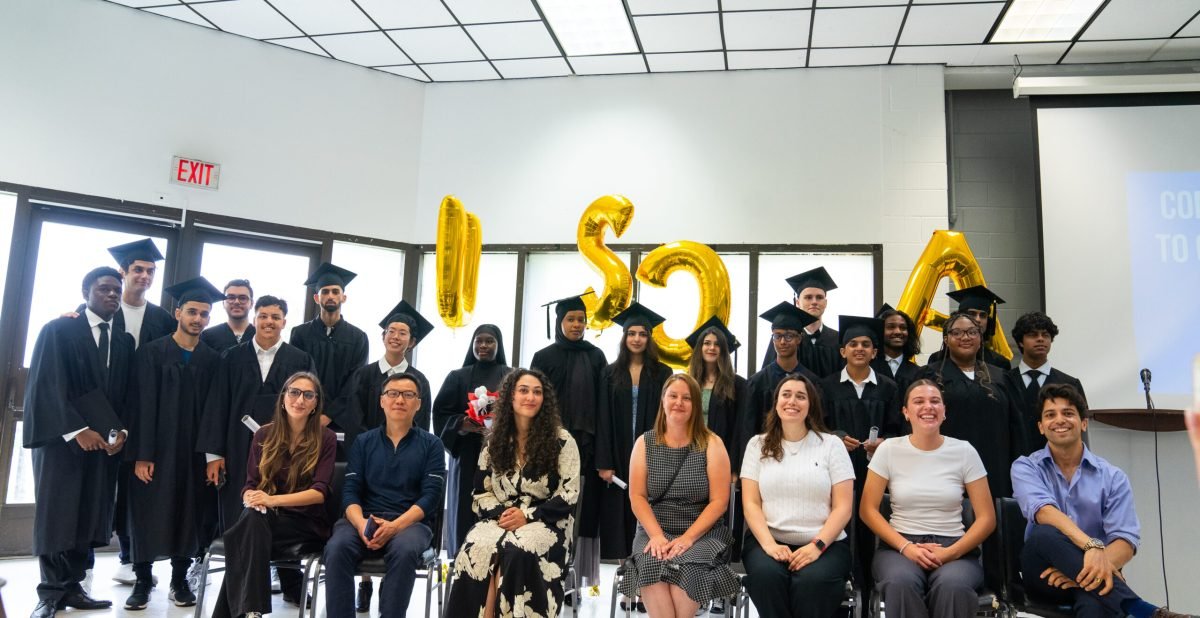
OSSD stands for Ontario Secondary School Diploma. It is the high school graduation diploma of the province of Ontario, Canada, awarded once a student has met every requirement the Ontario Ministry of Education sets. Students earn it at publicly funded schools and at private schools the Ministry has inspected and authorized to grant credits. It is also open to international students and to adults returning to school.
This guide explains what the diploma requires, how credits and the transcript work, the rules that give principals some flexibility, and how the diploma is treated by universities in Ontario and abroad.
Checked against the Government of Ontario’s published policy on 17 November 2026.
What the diploma requires
- 30 credits. Students who started Grade 9 in 2023 or earlier need 18 compulsory and 12 optional credits. Students who started in 2024 or later need 17 compulsory and 13 optional.
- At least two online learning credits, for students who started Grade 9 in 2020 to 2021 or later, unless a parent or the adult student opts out. The rule also applies to adult learners who entered the secondary system in 2023 to 2024 or later.
- 40 hours of community involvement.
- The provincial literacy requirement. Most students meet it by passing the Ontario Secondary School Literacy Test (OSSLT).
- The financial literacy requirement, for students who began Grade 9 in 2025 to 2026 or later. It is completed in the Grade 10 Career Studies course, with a mark of 70 per cent or higher on the financial literacy modules and two attempts during the course.
The full subject list for each cohort is in our guide to OSSD subjects.
How a credit works
A credit is granted when a student completes a course scheduled for at least 110 hours with a final mark of 50 per cent or higher. Credits are granted by the principal on behalf of the Minister of Education. Some courses are half-credits: Grade 10 Career Studies and Civics and Citizenship are worth 0.5 each. A full-time student normally takes eight courses a year, which is how 30 credits fit into Grades 9 to 12 with a little room to spare.
Each course mark is built from 70 per cent work during the course and 30 per cent from a final evaluation, such as an exam or culminating task, near the end.
The Ontario Student Transcript
Every course, mark and credit is recorded on the Ontario Student Transcript (OST), the official record that universities and colleges read. Two rules affect what appears on it:
- Grade 9 and 10: only courses completed successfully are recorded.
- Grade 11 and 12: every attempt is recorded, including failed and repeated courses and courses dropped after the withdrawal deadline. This is called full disclosure, explained in our full disclosure guide.
The transcript also records whether the literacy, community involvement and online learning requirements are complete. When a student moves between Ontario schools, the transcript and this progress move with them.
Community involvement
- Students can start counting hours in the summer before Grade 9 and can complete them at any time during secondary school.
- The activities are unpaid and take place outside class time. Each school publishes a list of eligible activities.
- Students under 18 need a parent or guardian to sign the record of hours.
- Cooperative education and other experiential learning placements do not count toward the 40 hours.
- Students who go well beyond 40 hours can receive a Minister’s Certificate of Recognition for Community Involvement, which starts at more than 50 hours and has a Gold level at 200 or more.
Course types and what they lead to
In Grade 9, core subjects are de-streamed, which means all students take the same course, and other subjects are open courses. Grade 10 offers academic, applied and open courses. The province says students in Grades 9 and 10 are not expected to make binding pathway decisions. The choice that matters most comes in Grades 11 and 12:
- University (U) courses prepare students for university entrance requirements.
- University/College (M) courses are accepted by both universities and colleges for many programs.
- College (C) courses prepare students for college programs.
- Workplace (E) courses prepare students for employment or apprenticeship.
- Open (O) courses suit all students and are not tied to a destination.
Ontario universities usually ask for the OSSD with six Grade 12 U or M courses, including the courses each program requires. See 3U and 3M courses compared and how the admission average is calculated.
Flexibility built into the rules
- Substitutions. A principal may substitute up to three compulsory credits with courses from other subject areas, to tailor a program to a student’s needs or interests. Two half-credit courses can replace one compulsory credit. Substitutions are marked on the transcript.
- Prerequisites. The principal decides whether a prerequisite can be waived for a particular student.
- Specialist High Skills Major. Students who complete a bundle of credits and certifications in one sector, such as business or health, receive the diploma with an embossed Specialist High Skills Major seal.
How the OSSD works for students from outside Ontario
International students follow the same rules as Ontario students. Several points make the path practical:
- Previous schooling counts. The principal of the receiving school assesses earlier study and decides how many equivalent credits to grant and which compulsory credits remain. Ontario’s policy sets minimums of 22 credits still to earn after one year of secondary school elsewhere, 14 after two years, 7 after three years and 4 after more than three years.
- English support counts. Up to three English as a second language or English literacy development credits can be used toward the four compulsory English credits. The fourth must be a Grade 12 compulsory English course.
- Financial literacy. Students who enrol in Grade 11 or 12 from outside Ontario do not have to complete the financial literacy requirement if they are granted their Grade 9 and 10 credits, including Career Studies, through equivalency.
- The literacy requirement applies to everyone, whatever their previous schooling.
More detail is in how OSSD equivalency works.
Adults
Adults returning to school can have prior learning recognized. Through Prior Learning Assessment and Recognition for mature students, an adult can be granted up to 26 of the 30 credits, depending on assessment. See our guide to the OSSD for adults.
Recognition beyond Ontario
Universities across Canada accept the OSSD and publish requirements for Ontario applicants. Many universities abroad do too. In the UK, the University of Manchester asks for an average of 80 per cent in six Grade 12 U/M courses, and UCL asks for six such courses each at 83 per cent or higher for courses with an ABB A-level requirement. Some UK universities attach conditions, such as the diploma having been studied in person in Ontario at an authorized school. Check each university’s own page. Our comparison of the OSSD and A-levels has more.
Recognition for high achievement
A graduate with an aggregate of at least 480 marks over six eligible credits, an 80 per cent average, is designated an Ontario Scholar. See the Ontario Scholar requirements.
How long it takes
Four years from the start of Grade 9 for most students. A student who transfers in needs less time because fewer credits remain. Summer school and night school credits can shorten the timetable, since they meet the same 110-hour requirement.
The OSSD at USCA Academy
USCA Academy is a private school in Mississauga inspected by the Ontario Ministry of Education (BSID 881623) and grants credits toward the OSSD. Program details, start dates and the application process are on our OSSD program page.
Frequently asked questions
Is the OSSD the same as a Canadian high school diploma?
It is Ontario’s high school diploma. Canada has no national diploma, because each province runs its own school system. See what a secondary school diploma means in Canada.
What mark do I need to pass a course?
A final mark of 50 per cent or higher earns the credit. University programs set their own, higher, admission averages.
Can I earn the OSSD at a private school?
Yes, if the school has been inspected by the Ministry of Education and is authorized to grant credits. Ask any private school for its BSID number and check that it is listed by the Ministry.
Do I need the OSSLT if I passed an English exam in another country?
Yes. The Ontario literacy requirement applies to every student working toward the diploma.