

Key Highlights of CLN4U
- Discover the CLN4U Grade 12 law course. This is a university preparation course with a focus on Canadian and international law.
- Learn about key topics like Canada’s legal heritage, global human rights, and environmental law.
- Get to know who should take this legal studies course and what you need before you can sign up.
- Take a look at the CLN4U assessment methods, which use assignments, projects, and a final exam.
- See how this course can help you build your critical thinking skills and get ready for university.
- Find out how CLN4U can help you step into jobs in law, social sciences, and other fields.
Introduction
Are you in Grade 12 and thinking about a future in legal studies, political science, or social justice? The CLN4U Canadian and International Law course might be a good fit for you. This course is a great starting point to learn about law and the rule of law. You will find out how things work in Canada and in other parts of the world. The course can help you think in new ways and understand more about people and the law around us. It will also be useful as you get ready for college and your job in the future.
Understanding the CLN4U Course
The CLN4U course is a full look at law and how people study it. This course will keep you interested. But the CLN4U course difficulty comes from having to use strong critical thinking skills instead of just learning facts. You will get to use the legal inquiry process to help make sense of ideas that can be hard to understand.
The course will show you the main concepts that build up law today. You will look at where the rules of law come from, and see how these work for people in Canada and also in other places. Now, let’s see what you will get to do in this course and who the CLN4U course is made for.
What Is CLN4U?
CLN4U is a Grade 12 university preparation course focused on Canadian and international law. You will explore major legal concepts in social, political, and global contexts. Completing the course earns you a CLN4U OSSD credit, which counts toward your high school diploma. Throughout the year, you’ll study the history and principles of law to understand how the legal system works. The course connects these ideas to current events in Canada and worldwide. As a university preparation class, CLN4U also helps you develop research and critical thinking skills, while learning about justice, rights, and legal responsibilities in various countries.
Who Should Take CLN4U in Ontario
This course is a good fit for students who are interested in legal studies, social justice, political science, or history. If you like to talk about tough topics, look at things from many sides, and find out how Canada and other places are run, you will enjoy CLN4U. The course helps get you ready for university in many fields.
To join CLN4U, you need to finish a Grade 11 or 12 course that helps prepare for university. These courses can be in social sciences and humanities, English, or Canadian and world studies.
This background will help you build the skills you need to do well in the class. It is a good step if you want to learn more about Canada and its role in the world.
CLN4U Ontario Curriculum and Course Outline
The CLN4U curriculum is set up in a way that lets you learn step-by-step. You start with the basics and then move on to bigger, world problems. If you choose a CLN4U online course or go to class in person in Ontario, you will find that the plan is the same. This is because the outline follows the Ministry of Education guidelines to give you a good learning experience everywhere in Ontario.
The course wants to help you get better at legal reasoning skills. You will learn about both Canadian law and international law. In this course, you will see how laws start, how people read laws, and how they use them. The parts below show you how the course is set up and what you will learn first.
How the CLN4U Curriculum Is Structured
The CLN4U Grade 12 law course structure is organized into distinct units, each building upon the last. This approach allows for a thorough study of law, starting with the basics and moving toward more specialized and current legal issues. The course is designed to be completed over approximately 110 hours.
Each unit focuses on a different aspect of the legal landscape, ensuring you gain a well-rounded understanding. The curriculum combines theoretical knowledge with practical analysis of real-world legal challenges.
Here is a typical breakdown of the course units and the suggested time for each:
| Unit Name | Suggested Time |
|---|---|
| Legal Foundations | 25 Hours |
| Rights and Freedoms | 26 Hours |
| Conflict Resolution | 26 Hours |
| International Law | 26 Hours |
| Final Exam/Summative | 2 Hours |
Main Learning Objectives of the CLN4U Course
One of the main goals of CLN4U is to develop your legal reasoning skills. In this course, you go beyond memorizing facts and dates you learn to think like a legal professional. The lessons teach you how to analyze information, make strong arguments, and apply legal concepts to complex situations. CLN4U also serves as a foundation if you want to pursue further legal studies, introducing you to areas like criminal law, human rights, and conflict resolution. By the end of the course, you will be able to:
- Analyze where our laws come from and what thinkers in history said about them.
- Explain the key ideas behind human rights in Canada and around the world.
- Compare what each branch of government does to protect rights.
- Look at how global agreements and treaties help countries work together.
Key Topics Covered in CLN4U
The CLN4U course covers many key topics about law that matter in the world today. In this course, you get to look at a range of contemporary legal issues. You will learn how the legal system works in Canada and also how it connects with international law.
You will study rights that are in the Charter and also learn about rules around environmental law across the world. The course content is made to be current and get you to think. The next parts will show what topics you will learn about in both the Canadian law and international law sections.
Canadian Law Units
The Canadian law units in CLN4U introduce you to the foundations of law in Canada. You’ll begin by exploring Canada’s legal heritage, understanding that laws evolve as society’s values shift. This background helps explain why the rule of law is significant today. The course also examines the justice system, focusing on the development of rights and freedoms since Confederation, especially the Canadian Charter of Rights and Freedoms and its modern impact.
Key topics covered in the Canadian law units include:
- The sources and basic ideas of Canadian law.
- How the Canadian court system and the legal profession are organized.
- How criminal law works and how crime and punishment have changed.
- How human rights and freedoms in Canada started and how they are protected.
International Law Units
The CLN4U course expands beyond Canada, introducing you to the world of international law. These units help you understand how laws enable countries to cooperate and address global challenges. You’ll learn to analyze legal issues in different international situations, focusing on topics like international human rights, workplace law, trade, and environmental law. The course highlights the importance of countries working together and the complexities involved in enforcing international law.
The international law units cover:
- The rules of state sovereignty and why the world needs international law.
- How treaties, conventions, and organizations play a role in international law.
- Legal issues the world faces, such as war crimes, human rights, and dealing with other countries.
- The problems that make it hard to enforce international law.
CLN4U Assignments, Projects & Assessment Methods
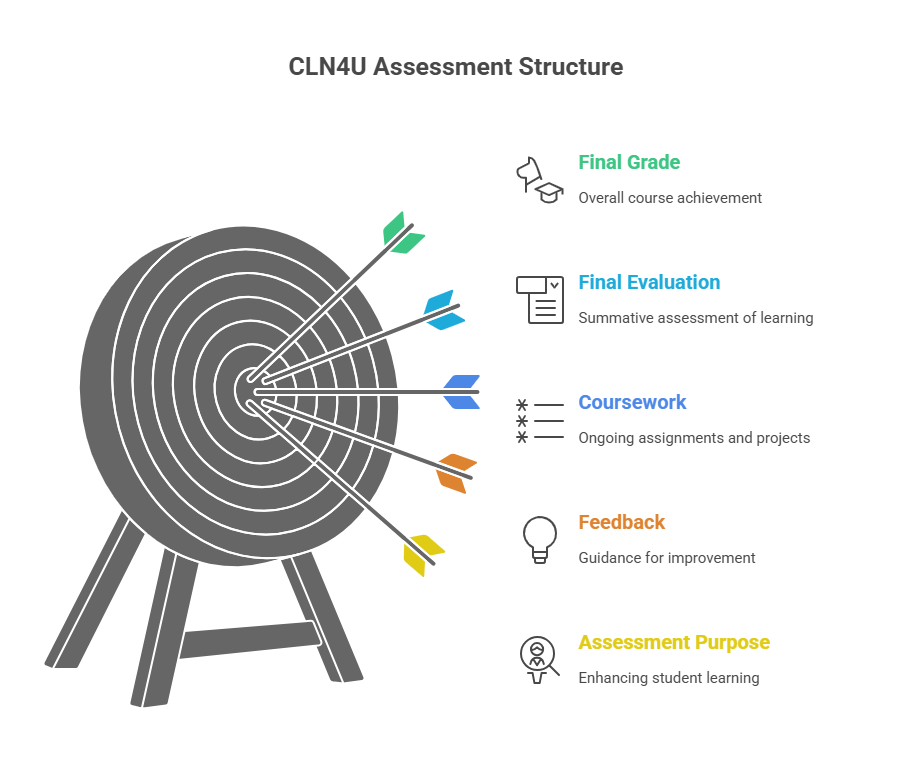
To get your CLN4U OSSD credit, you will show what you know in different ways. The purpose of assessment is to help you be better, not just to give you a grade. Your teacher will use many kinds of tests and projects to check your learning. You have more than one chance to show what you can do through assignments and other work.
Teachers want you to grow. They give you feedback, so you will know your strong points and what you can work on. The final grade will be based on how well you do in all kinds of assignments in this course. Let’s talk about the types of assignments you will see and how your final grade is decided.
Types of CLN4U Assignments and Projects
In CLN4U, you will do many tasks where you will use the legal inquiry process. These tasks are not just for you to remember facts; they ask you to find new information, think about it, and share your ideas about real legal issues.
You will get to study legal issues that matter today. These could be big problems in the world or something close to home. If you have an Individual Education Plan (IEP), there will be help for you. You may get more time for your work or different tasks so everyone can do their best.
Typical assignments and projects in this course include:
- Research essays on legal topics.
- Case study analyses.
- Classroom discussions and debates.
- Presentations on legal concepts.
- A final summative project or exam.
How CLN4U Is Assessed
The main purpose of assessment in CLN4U is to improve student learning. Your teacher will use various methods to check your progress and give feedback so you know how to improve. This helps you understand your current level and what to work on next. Your final grade reflects how well you meet the course’s main goals, focusing on your most consistent work, though recent achievements are also important.
Your final grade is made up of:
- 70% from work done during the course, like assignments, tests, and projects.
- 30% from a final evaluation, such as an exam, long essay, or major project.
Skills and Career Pathways from CLN4U
Taking CLN4U gives you much more than just a school credit. You get important skills from this university preparation course. The legal reasoning skills you learn in this class are useful in many jobs and in other places where you study.
This course helps you make many job connections outside of the classroom. It does not matter if you are sure you want to go into legal studies, or if you just want to see what is out there. CLN4U gives you a useful edge for your future. In the next parts, you will see how this university preparation course gets you ready for school and jobs.
University Preparation
- CLN4U is an excellent university preparation course for students interested in law, political science, criminology, and international relations. It builds critical analysis, research, and argumentation skills, which are essential for first-year university success. You’ll develop legal thinking and academic confidence by working with complex materials, reading challenging texts, and clearly explaining your ideas.
- The course provides valuable insight into legal and global studies, giving you a strong head start with key legal concepts. This foundation will make your transition to higher education smoother and more successful, helping you excel in future legal studies and university life.
Career Connections
While the most clear job path from CLN4U is to be a lawyer, the skills you get can help you in many jobs. When you know about the legal system, conflict resolution, and rules like workplace law, it is good for almost any type of work.
There are many students who take this course and later work in government, public policy, law enforcement, and social work. If you can look at issues from more than one side, it is a skill that companies, newspapers, and non-profit groups value too. What you learn here helps you get ready for any job that needs strong thinking and good talking or writing skills.
Some jobs you can connect to this are:
- Lawyer or Paralegal
- Policy Advisor for Government
- Human Resources Specialist
- Journalist or Political Analyst
- Mediator or a role involving conflict resolution
Study Tips and Useful Resources for CLN4U
To do well in legal studies and your CLN4U online course, you need to start with a clear plan. Set good study habits at the start. This will help you handle all the work and also make the material easier to learn. There are some good tips and resources out there that can help you.
No matter if you take legal studies in a classroom or do a CLN4U online course, you must stay organized and be part of the work. The next parts will give you useful steps and show you some things to help you on your learning path.
Effective Study Strategies
Some of the best ways to study for CLN4U are to stay active while you learn. Don’t just memorize ask questions about each concept, like why a law exists, who benefits, and what the impacts are. This builds your critical thinking skills, which is a key part of the course. Connect class lessons to current events by watching news, reading stories, and discussing legal issues with others. Using what you learn outside school helps you remember it better.
Here are a few more CLN4U study tips:
- Create summary notes or mind maps after each unit.
- Form a study group.
- Practice writing case briefs.
- Speak up during class talks.
Recommended CLN4U Textbooks and Online Materials
There are several textbooks that closely align with the CLN4U curriculum and provide a solid foundation for your studies. These books allow you to explore topics in depth. In addition, teachers often supplement lessons with other resources to enhance understanding.
Enrolling in a CLN4U online course usually gives you access to various digital materials, such as videos, articles, interactive tools, and forums, which make learning about current legal issues more engaging. USCA Academy ensures students receive high-quality resources.
Common resources used in CLN4U classes are:
- Textbooks like All About Law: Exploring the Canadian Legal System and Canadian and International Law by Oxford University Press.
- Official materials from the Ministry of Education of Ontario.
- Trusted online news and legal journals that update you on current legal issues.
Why Choose CLN4U at USCA Academy?
Deciding where to take the CLN4U course is important. At USCA Academy, you receive the support needed to earn your OSSD credit. Our knowledgeable teachers guide you through every step. As a leading private school, we aim for your success. The online CLN4U course allows you to study at your own pace while collaborating with skilled educators. We are recognized as a top choice for international students seeking a world-class education. Our focus on legal studies and readiness for university ensures you build a strong foundation for the future. Signing up is easy, and our team is here to help you start your journey.
Online and In-Person Enrollment Options
At USCA Academy, we know that every student learns in a different way and has their own schedule. That is why we give you choices for how to sign up, so you can earn your cln4u ossd credit in a way that fits your life. Many people like our online enrollment because you can do your work from anywhere. You can also move through the course at your own speed.
If you like to be in a classroom with other students, you can sign up for in-person classes at our campus. This lets you meet with teachers and friends in a set place. The sign-up steps for both ways are made to be easy to follow.
Our enrollment options include:
- Online Enrollment: Learn in a flexible, self-paced way with help from our skilled online teachers.
- In-Person Enrollment: Join a set classroom at our campus, which has everything you need.
- Continuous Intake: You can start the class at different times during the year.
Eligibility and Registration Information
Confirming if you meet the prerequisites for CLN4U is the first thing you need to do before you sign up. These rules come from the Ontario Ministry of Education. They help make sure you are ready for the world studies class. If you are not sure, our admissions team can help. They will work with you to see if you fit the needed requirements.
When you know you are eligible, signing up for USCA Academy is easy. You can register online. You can also talk to our office if you want help. We will guide you at each stage, from sending your papers to starting your first day.
The main prerequisite for CLN4U is that you must have:
- Finished any Grade 11 or 12 university (U) preparation course.
- OR finished any Grade 11 or 12 university/college (M) preparation course in social sciences, english, or Canadian and world studies.
Conclusion
To sum up, the CLN4U course helps you learn about Canadian and international law. The course gives you important knowledge and skills you need in school and future jobs. When you join this course, you do not just learn about the basics of law. You also get to grow important skills like critical thinking, research, and how to look at information clearly. These are things you need to do well in all kinds of legal work. If you think you might want to work in law or you just want to know more about your rights and responsibilities, the CLN4U course is a great starting point. If you want to know more or sign up, you can get in touch with USCA Academy today!
Frequently Asked Questions
1. What makes the CLN4U course challenging or unique?
The CLN4U course is different and can be tough because it puts the focus on critical thinking instead of just having you remember facts. You have to look at complex legal issues and come up with your own ideas about current legal issues, using facts to back them up. In this way, the course in legal studies helps you get strong analytical skills that will be good for your time in university and after that.
2. How does CLN4U help students interested in law careers?
CLN4U helps you get ready for university if you want to study law. The course builds your legal reasoning skills, which you need for legal studies. It lets you learn about different jobs in law, and at the same time, you can earn the important CLN4U OSSD credit. This class gives you a good start and can help you stand out when you go on to more school.
3. What are the prerequisites for taking CLN4U in Ontario?
The main prerequisite for CLN4U is you need to pass any Social Sciences and Humanities, English, or Canadian and World Studies course at Grade 11 or 12 level. It can be either a university (U) or university/college (M) course. These CLN4U prerequisites help make sure that students have the English and analysis skills needed to do well in the class.