
CLN4U – Grade 12 Canadian and International Law Online Course
Send Us A Message
CLN4U - Grade 12 Canadian and International Law
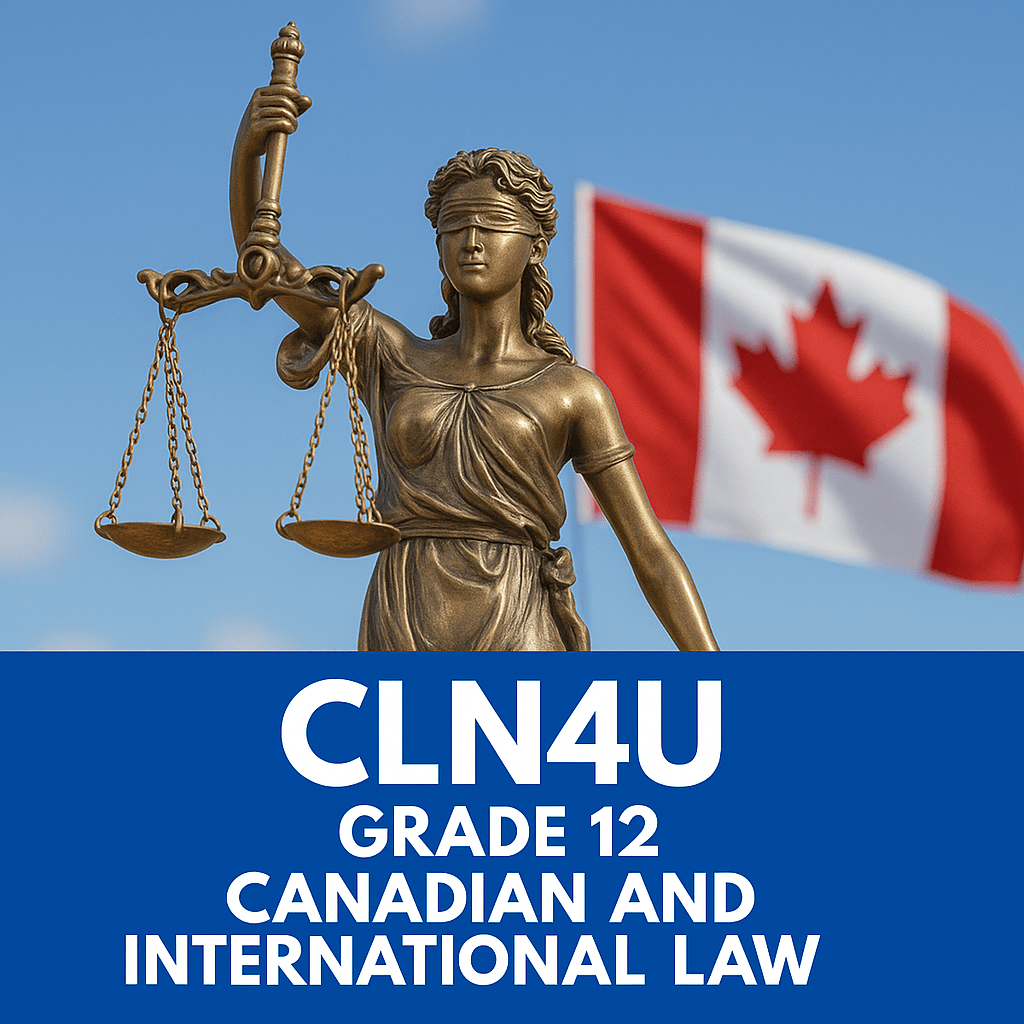
Course Code: CLN4U
Course Type: University Preparation
Credit Value: 1.0
Prerequisite: Any Grade 11 or 12 university (U) or university/college (M) preparation course in Social Sciences and Humanities, English, or Canadian and World Studies
Tuition Fee (CAD): $490
Course Description For CLN4U Grade 12 Canadian and International Law Online Course
Canadian and International Law (CLN4U): This Grade 12 course explores many current legal issues. It looks at how these problems are handled in both Canadian and international law. Students will learn about important legal ideas related to human rights, conflict resolution, and various types of law, such as criminal, environmental, and workplace law. These topics are examined in both Canadian and global settings.
Moreover, students will practice legal thinking and the inquiry process used in legal studies. This approach helps improve their legal reasoning skills. As a result, they will learn more about these vital subjects. The course offers an engaging way to grasp the complexities of law. Therefore, it is a strong choice for those interested in CLN 4U or considering further studies in legal fields.
summary Of Units And Timelines For Grade 12 Canadian and International Law CLN4U
Unit
Titles and Descriptions
Time and Sequence
Unit 1
Legal Foundations
Students will learn of the basic concepts of law and take into consideration their significance. They will also study how legal theories and procedures have influenced Canadian and international legal systems. And, the influences of individuals and groups on the development of law will be analyzed.
24 hours
Unit 2
Rights and Freedoms
The factors and principles that form the foundation of human rights laws will be studied at the beginning of this unit. And the legal significance of those law will be focused on. Analysis of issues related the development of human rights law will be done. A comparison of the roles of the legislative and judicial branches of the government and how they protect human rights and freedom shall be conducted. Lastly, an analysis of contemporary issues and their impacts on human rights law will be made.
21 hours
Unit 3
International and Legal Issues
An analysis of important concepts, legal systems, and issues in criminal law will serve as the first part of this unit. Students will also analyze factors that influence environmental legislation. They will also analyze legal principles, systems and processes used to protect parties’ interests. And they will study global issues and their implications for international law.
30 hours
Unit 4
Foundations of International Law and Dispute Resolution
Students will explain the legal importance of various key principles and issues in international law; analyze how various factors have influenced the development of international law; analyze how various agreements, treaties, and conventions in international law influence international conflict and cooperation.
21 hours
Unit 5
Summative Project
The overall goal of this unit is for students to bring together their skills and knowledge learned throughout this course to write a well-argued, MLA-style, academic essay on an individually-selected topic through independent research. Students will choose their own topic and form their thesis and form their arguments based on the content of this course. They are encouraged to consider the historical, cultural, political, and sociological contexts of their issue while maintaining a legal perspective.
20 hours
Total
110 hours
Effective instruction is key to student success. To provide effective instruction, teachers need to consider what they want students to learn, how they will know whether students have learned it, how they will design instruction to promote the learning, and how they will respond to students who are not making progress.
When planning what students will learn, teachers identify the main concepts and skills described in the curriculum expectations, consider the contexts in which students will apply the learning, and determine students’ learning goals.
Instructional approaches should be informed by the findings of current research on instructional practices that have proved effective in the classroom. For example, research has provided compelling evidence about the benefits of the explicit teaching of strategies that can help students develop a deeper understanding of concepts. Strategies such as “compare and contrast” (e.g., through Venn diagrams and comparison matrices) and the use of analogy give students opportunities to examine concepts in ways that help them see what the concepts are and what they are not. Although such strategies are simple to use, teaching them explicitly is important in order to ensure that all students use them effectively.
A well-planned instructional program should always be at the student’s level, but it should also push the student towards his or her optimal level of challenge for learning, while providing the support and anticipating and directly teaching the skills that are required for success.
An understanding of students’ strengths and needs, as well as of their backgrounds and life experiences, can help teachers plan effective instruction and assessment. Teachers continually build their awareness of students’ learning strengths and needs by observing and assessing their readiness to learn, their interests, and their learning styles and preferences. As teachers develop and deepen their understanding of individual students, they can respond more effectively to the students’ needs by differentiating instructional approaches – adjusting the method or pace of instruction, using different types of resources, allowing a wider choice of topics, even adjusting the learning environment, if appropriate, to suit the way their students learn and how they are best able to demonstrate their learning. Unless students have an Individual Education Plan with modified curriculum expectations, what they learn continues to be guided by the curriculum expectations and remains the same for all students.
Effective lesson design involves several important elements. Teachers engage students in a lesson by activating their prior learning and experiences, clarifying the purpose for learning, and making connections to contexts that will help them see the relevance and usefulness of what they are learning. Teachers select instructional strategies to effectively introduce concepts, and consider how they will scaffold instruction in ways that will best meet the needs of their students. At the same time, they consider when and how to check students’ understanding and to assess their progress towards achieving their learning goals. Teachers provide multiple opportunities for students to apply their knowledge and skills and to consolidate and reflect on their learning. A three-part lesson design (e.g., “Minds On, Action, and Consolidation”) is often used to structure these elements.
Instruction in Grade 11 and 12 Canadian and world studies should help students acquire the knowledge, skills, and attributes they need in order to achieve the curriculum expectations and to be able to think critically throughout their lives about issues related to economics, geography, history, law, and politics. Effective instruction motivates students and instils positive habits of mind, such as curiosity and open-mindedness; a willingness to think, question, challenge, and be challenged; and an awareness of the value of listening or reading closely and communicating clearly. To be effective, instruction must be based on the belief that all students can be successful and that learning in Canadian and world studies is important and valuable for all students.
Students’ views of and attitudes towards Canadian and world studies can have a significant effect on their achievement of expectations. When students believe that these subjects simply represent a body of preordained knowledge about certain topics, they may question the relevance of their studies or may not approach their investigations with an open and inquiring mind. Students must be given opportunities to see that inquiry is not just about finding what others have found, and that they can use the inquiry process not only to uncover knowledge but also to construct understandings and develop their own positions on issues. Learning should be seen as a process in which students monitor and reflect on the development of their knowledge, understandings
Assessment in CLN4U follows the Ontario Ministry of Education’s Growing Success policy. Throughout each unit, teachers use assessment for learning and assessment as learning to give students feedback and next steps, and assessment of learning to evaluate achievement of the course expectations.
How USCA Academy assesses and evaluates students, including final evaluations, attendance and missed or late work, is explained in our Assessment and Evaluation Policy.
From the 2026-2027 school year, the final mark for CLN4U follows Ontario’s provincial rules for Grades 11 and 12:
- 65% classroom work completed throughout the course
- 25% mandatory final evaluation, made up of a written final exam and a culminating task
- 10% attendance and participation (excused absences do not lower the mark)
A credit is granted and recorded for CLN4U when the student’s final mark is 50% or higher. Full details are in our Assessment and Evaluation Policy.
Frequently Asked Questions (FAQ)
What topics does CLN4U cover?
CLN4U explores contemporary legal issues in both Canadian and international law, including human rights, criminal law, environmental law, and conflict resolution.
How is the course structured?
The course is divided into units focusing on legal foundations, rights and freedoms, international legal issues, foundations of international law, and a summative project.
What skills will students develop?
Students will enhance their legal reasoning, critical thinking, and research skills, preparing them to analyze complex legal issues both locally and globally.
What are the prerequisites for CLN4U?
Students need to have completed any Grade 11 or 12 university preparation course in Social Sciences and Humanities, English, or Canadian and World Studies.
How is student performance assessed?
Assessment includes a variety of methods such as quizzes, projects, presentations, and a final exam, focusing on knowledge, thinking, communication, and application skills.