

Assessment and Evaluation Policy
Send Us A Message
Assessment and Evaluation Policy
The primary purpose of examination, assessment, and evaluation is to improve student learning. Information gathered through evaluation and examination helps teachers to identify students’ difficulties as well as to detect weaknesses in programs. Examination and assessment are important tools for adapting curriculum and instructional approaches to students’ needs and for determining the overall effectiveness of programs and classroom practices.
Assessment is the process of gathering information from a variety of sources (including assignments, demonstrations, projects, performances, and tests) that accurately reflects how well students are achieving the curriculum expectations. As part of assessment, teachers provide students with descriptive feedback that guides their efforts towards improvement.
Evaluation is the process of judging the quality of the student’s work on the basis of an established achievement criterion, and assigning a value to represent that quality. In Ontario secondary schools, the value assigned will be in the form of Levels 1-4 culminating in conversion of a percentage grade. Examination and evaluation will be based on the provincial curriculum expectations and the achievement levels outlined in the secondary curriculum policy documents.
- Ontario’s mandatory Assessment and Evaluation Requirements
Ontario’s mandatory assessment and evaluation requirements for secondary students are intended to provide a more consistent approach to assessment and evaluation for students in Grades 9 to 12, while continuing to support all students to reach their full potential, prepare students for their pathways after high school, and support student well-being.
The evaluation of this course is based on the four Ministry of Education achievement categories of knowledge and
understanding (25%), thinking (25%), communication (25%), and application (25%). The evaluation for this course is based on the student’s achievement of curriculum expectations and the demonstrated skills required for effective learning.
The percentage grade represents the quality of the student’s overall achievement of the expectations for the course and reflects the corresponding level of achievement as described in the achievement chart for the discipline.
A credit is granted and recorded for this course if the student’s grade is 50% or higher.
Percentage Mark Range | |
2+ | 67-69 |
2 | 63-66 |
2- | 60-62 |
1+ | 57-59 |
1 | 53-56 |
1- | 50-52 |
Achievement Level | Percentage Mark Range |
4+ | 95-100 |
4 | 87-94 |
4- | 80-86 |
3+ | 77-79 |
3 | 73-76 |
3- | 70-72(Provincial standard) |
The final grade for this course will be determined as follows:
Beginning in the 2026-2027 school year, most secondary courses will require written exams as a percentage of the final course mark. All written final exams from Grades 9 to 12 will take place during the designated exam period, with the exception of the EQAO Grade 9 mathematics assessment.
In Grades 9 and 10, a student’s final mark will be based on:
- 65% classroom work completed throughout the course
- 20% mandatory final evaluations, broken down as described below
- 15% attendance and participation
Subject | Grade 9 | Grade 10 |
English Mathematics Science | 20% written exam Note: The EQAO Grade 9 Assessment of Mathematics counts as the written exam for the MTH1W course and makes up 20% of the student’s mark. | 20% written exam |
The Arts Computer Studies Health and Physical Education Technological Education | 10% written exam 10% culminating task | 10% written exam 10% culminating task |
Canadian and World Studies | 20% written exam (Geography) | 20% written exam (History, Civics and Citizenship) |
Business Studies Social Sciences and Humanities | 10% written exam 10% culminating task | 10% written exam 10% culminating task |
Classical Studies and International Languages French as a Second Language Native Languages | 10% written exam 10% culminating task | 10% written exam 10% culminating task |
First Nations, Métis, and Inuit Studies | 10% written exam 10% culminating task | 10% written exam 10% culminating task |
Guidance and Career Education | N.A. | Grade 10 Career Studies (GLC2O) students only: – 5% financial literacy graduation requirement – 15% culminating task |
In Grades 11 and 12, a student’s final mark will be based on:
– 65% classroom work completed throughout the course
– 25% mandatory final evaluations, broken down as described below
– 10% attendance and participation
Subject | Grade 11 | Grade 12 |
English Mathematics Science | 25% written exam | 25% written exam |
The Arts Computer Studies Health and Physical Education Technological Education | 10% written exam 15% culminating task | 10% written exam 15% culminating task |
Canadian and World Studies | 15% written exam 10% culminating task | 15% written exam 10% culminating task |
Business Studies Social Sciences and Humanities | 15% written exam 10% culminating task | 15% written exam 10% culminating task |
Classical Studies and International Languages French as a Second Language Native Languages | 10% written exam 15% culminating task | 10% written exam 15% culminating task |
First Nations, Métis and Inuit Studies | 10% written exam 15% culminating task Note: NBE3U and NBE3C require a 25% written exam. | 10% written exam 15% culminating task |
Courses exempt from mandatory written exams:
The following courses are exempt from mandatory written exam policy:
– Grades 9 and 10 locally developed compulsory credit courses (LDCC)
– Grades 11 and 12 workplace preparation courses (E courses)
– Grades 11 and 12 open courses (O courses)
Subject areas exempt from mandatory written exams:
– Guidance and Career Education, except for Grade 10 Career Studies (GLC2O)
– Co-operative Education
– Interdisciplinary Studies
– American Sign Language as a Second Language
These courses require a final evaluation (worth 20% for Grades 9-10 and worth 25% for Grades 11-12) that do not require mandatory written exams but may include in-class written evaluations or other final evaluations such as projects, presentations and portfolios.
Exams for remote learning and online courses offered through school boards will be written in person at each student’s home school location or another location if required, unless the school board is able to provide online proctoring with security and integrity.
Private schools and TVO’s Independent Learning Centre may continue to proctor exams online for students.
1. 2 Attendance and Participation
To recognize the impact that student presence in class has on achievement, final student grades will reflect attendance and participation. Excused absences do not negatively affect a student’s mark. Excused absences are absences from school that are permitted under legislation or school policy, as outlined in Ontario’s enrolment register instructions. These may include illness or other unavoidable circumstances, such as inclement weather or approved absences such as cultural days and holy days.
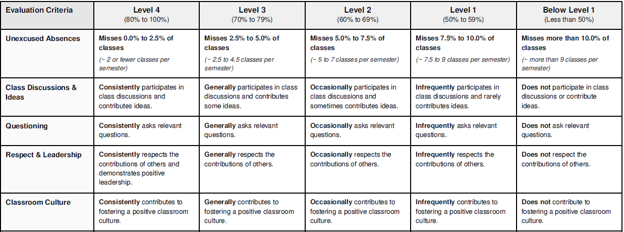
Assessment criteria for On-Site Attendance and Participation:
Level 4 (80% to 100%)
The student misses 0.0% to 2.5% of classes for unexcused absences
– approximately 2 or fewer classes per semester
The student consistently:
– participates in class discussions and contributes ideas
– asks relevant questions
– respects the contributions of others and demonstrates positive leadership
– contributes to fostering a positive classroom culture
Level 3 (70% to 79%)
The student misses 2.5% to 5 % of classes for unexcused absences
– approximately 2.5 to 4.5 classes per semester
The student generally:
– participates in class discussions and contributes some ideas
– asks relevant questions
– respects the contributions of others
– contributes to fostering a positive classroom culture
Level 2 (60% to 69%)
The student misses 5% to 7.5 % of classes for unexcused absences
– approximately 5 to 7 classes per semester
The student occasionally:
– participates in class discussions and sometimes contributes ideas
– asks relevant questions
– respects the contributions of others
– contributes to fostering a positive classroom culture
Level 1 (50% to 59%)
The student misses 7.5% to 10% of classes for unexcused absences
– approximately 7.5 to 9 classes per semester
The student infrequently:
– participates in class discussions and rarely contributes ideas
– asks relevant questions
– respects the contributions of others
– contributes to fostering a positive classroom culture
Below level 1 (less than 50%)
The student misses more than 10% of classes for unexcused absences
– more than 9 classes per semester
The student does not:
– participate in class discussions or contribute ideas
– ask relevant questions
– respect the contributions of others
– contribute to fostering a positive classroom culture
Rubric for Attendance:
1.3 Reach-ahead
Under exceptional circumstances, a student in Grade 8 may be given permission to “reach ahead” to take secondary school courses, either during the school year or in the summer before Grade 9.
The decision on whether reaching ahead would be in the student’s best interest is made on a case-by-case basis by the principals of the elementary and secondary schools involved. The decision is also subject to parental consent. The principal of the secondary school will be responsible for evaluating the student’s achievement and for granting and recording the credit.
Students in Grade 8 may also reach ahead to start earning community involvement hours in the summer before Grade 9. At USCA Reach-ahead is not available.
1.4 Online and Remote Learning
For the Grade 10 Career Studies course delivered in an online or remote learning format, the Financial Literacy Graduation Requirement is to be administered in person at the student’s home school location, or another school location identified by the student’s school board if required, unless the course includes online proctoring with security and integrity.
School boards will coordinate amongst online and/or remote educators and principals to determine the timing and location of in-person administrations of the Financial Literacy Graduation Requirement and communicate this to students and parents at the start of the course.
It is the responsibility of the parent/guardian to ensure their child is able to attend in person on the days the Financial Literacy Graduation Requirement is being administered.
TVO’s Independent Learning Centre and inspected private schools may administer the Financial Literacy Graduation Requirement through online proctoring.
1.5 Attendance and accommodations
Use the Ministry’s current attendance-and-participation criteria, distributed with course information. Maintain dated evidence and distinguish excused from unexcused absences. Excused absences do not reduce marks. Students may request correction of records. Use actual course schedules rather than fixed semester absence counts; explain online engagement expectations.
Provide documented accommodations for disabilities, learning needs and English language learners across courses. Participation opportunities must be accessible. Accommodations do not change expectations. Before modifying expectations, the principal determines and communicates credit implications. Contact students and families, as appropriate, when support is needed.
1.6 Examinations and missed evaluations
Publish examination periods for every applicable term, including courses ending outside January and June. Final evaluations assess overall course expectations and follow prescribed formats and weights. The principal reviews exams, marking guides and accommodations. Verify identity, supervise completion, secure materials and document incidents; online proctoring must preserve integrity and privacy.
Students must remain available during published examination periods. Exceptional scheduling requires principal approval. Report a missed or interrupted evaluation promptly, or as soon as reasonably possible. The teacher and principal consider the reason, supporting information, accommodations, and an equivalent, secure opportunity to complete the evaluation. A medical certificate is not automatically required in every case.
An excused absence does not automatically produce a zero. For unresolved non-completion, document follow-up, the decision and its effect on the mark or credit under current Ministry policy. Do not remove or reweigh required evaluations without authority. Explain the decision and review route.
1.7 Late work and academic integrity
For late or missing work, establish the reason, communicate with the student and consider support, staged submissions, reasonable extensions or equivalent tasks. Record significant interventions. Do not use automatic percentage deductions or incident-count rules that prevent consideration of individual circumstances. Justify any deduction, including a permitted zero, and do not let it misrepresent achievement; significant consequences require principal review.
Students submit authentic work, acknowledge sources and follow communicated collaboration, device and AI rules. Investigate suspected misconduct and allow an explanation. Consider grade level, maturity, incident history and individual circumstances. Responses may include instruction, supervised replacement work or a permitted mark consequence. A detection-tool result alone does not establish misconduct. Document findings and the review route.
1.8 Reporting and oversight
Issue reports at course midpoint and completion, plus any additional required reports. Communicate concerns early and provide required final reports to the OSR-holding school. Apply current reporting rules for insufficient evidence, including “I” only, which was permitted in Grades 9–10. Students may seek teacher explanation and principal review of marks; retain reasons for decisions and corrections.
Keep assessment evidence and records securely under applicable retention rules. Before implementation, the principal reconciles related policies, approves course calculations and briefs staff. Sample records each term and review this policy annually or when Ministry direction changes.
1.9 Attendance and participation implementation
USCA will use the Ministry’s attendance and participation criteria as one combined component, assessed out of 100 and weighted as follows: Grades 9–10, 15%; Grades 11–12, 10%. Learning skills remain separately reported.
Procedure | USCA implementation |
Communicate criteria | Before delivery, the principal approves a common Ministry-aligned rubric. Teachers explain expectations, accessible participation options and the review process. |
Record attendance | Keep dated records distinguishing excused and unexcused absences. Unexcused absence rate = unexcused classes missed ÷ scheduled classes × 100. Use the actual course timetable. Excused absences must not lower marks. |
Assess participation | Use dated observations of contributions, questions, respect for others and classroom culture. Allow discussion, written responses, collaborative work and conferences, with required accommodations. |
Apply Ministry criteria | Use the current Ministry attendance bands and participation descriptors together. Document the combined mark; refer mixed evidence or unclear boundary cases to the principal. Avoid automatic per-absence deductions or an invented attendance/participation split. |
Support online learning | Publish scheduled engagement requirements and retain evidence of meaningful interaction. A login alone does not demonstrate participation. The principal checks any asynchronous adaptation against Ministry direction. |
Review and report | Communicate concerns early and arrange support. Explain the component mark, correct record errors, and allow the principal to review: the principal samples records, evidence, accommodations, and calculations before final reporting. |
2. Assessment Strategies
Assessment is the process of gathering information from a variety of sources (including assignments, demonstrations, projects, performances, and tests) that accurately reflects how well students are achieving the curriculum expectations. As part of assessment, teachers provide students with descriptive feedback that guides their efforts towards improvement.
Assessment is embedded within the instructional process throughout each unit rather than being an isolated event at the end. Often, the learning and assessment tasks are the same, with formative assessment provided throughout the unit. In every case, the desired demonstration of learning is articulated clearly and the learning activity is planned to make that demonstration possible. This process of beginning with the end in mind helps to keep focus on the expectations of the course as stated in the course guideline. The evaluations are expressed as a percentage based upon the levels of achievement.
Assessment FOR Learning | Assessment AS Learning | Assessment OF Learning |
During this process the teacher seeks information from the students in order to decide where the learners are and where they need to go. | During this process the teacher fosters the capacity of the students and establishes individual goals for success with each one of them. | During this process the teacher reports students’ results. accordance to established criteria to inform how well students are learning. |
Conversation | Conversation | Conversation |
Classroom discussion Self-evaluation Peer assessment | Classroom discussion Small group discussion Post-lab conferences | Presentations of research Debates |
Observation | Observation | Observation |
Drama workshops (taking direction) Steps in problem solving | Group discussions | Presentations Group Presentations |
Student Products | Student Products | Student Products |
Reflection journals (to be kept throughout the duration of the course) | Practice sheets | Projects |
The assessment will be based on the following processes that take place in the classroom:
Some of the approaches to teaching/learning include
Strategy | Who | Assessment Tool |
Class discussion | Teacher | Observation Checklist |
Response Journal | Teacher | Anecdotal Comments |
Student Chosen Song | Teacher | Observation Checklist |
Narrative Poem/Song | Teacher | Rubric and Anecdotal Comments |
Character Sketch | Self | Checklist |
Journal Responses | Self/teacher | Anecdotal comments |
Short Story Analysis | Teacher | Rating scale |
Short Story Outline | Teacher | Rating scale |
Anecdote | Teacher | Direct Observation |
Found poem | Teacher | Direct Observation |
Journal Entries | Teacher | Anecdotal |
Research Notes | Self/Teacher | Checklist |
Non-fiction Report/Presentation | Teacher | Rubric |
Presentation to group | Self/Peer | Self and peer assessment rubric |
Sight passage | Teacher | Marking scheme |
Narrative piece | Teacher | Rubric |