

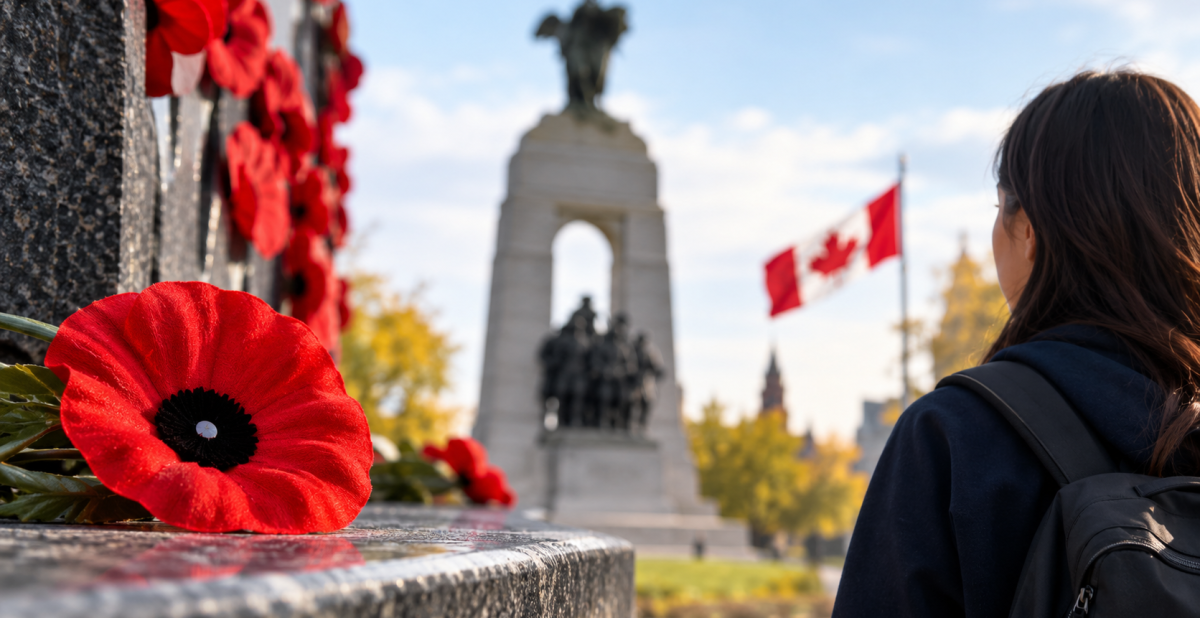
Remembrance Day in Canada falls on November 11 every year. In Ontario, it is not a statutory school holiday, so classes stay open. The Remembrance Day Act still requires schools to hold a moment of observance. Schools across the province pause for two minutes of silence at 11:00 a.m.
The poppy campaign, run by the Royal Canadian Legion, usually starts in late October. Many Ontario schools hold a short ceremony with readings such as “In Flanders Fields.” USCA Academy follows Ontario’s observance expectations, but the exact ceremony format can vary by year. Contact the school directly for the specific schedule, and read on for the full history and etiquette guide.
Key Highlights of Remembrance Day in Canada
- Remembrance Day falls on November 11 every year and is not a statutory school holiday in Ontario, so classes remain in session.
- Schools observe a two-minute moment of silence at 11:00 a.m., a tradition dating back to King George V’s 1919 request to the British Commonwealth.
- The Royal Canadian Legion’s National Poppy Campaign typically launches on the last Friday of October and runs through November 11.
- The poppy symbol traces to John McCrae’s 1915 poem “In Flanders Fields,” written after a fellow soldier’s death during the Second Battle of Ypres.
- Canada officially adopted the name Remembrance Day in 1931, and over 2.3 million Canadians have served in uniform since Confederation.
What Remembrance Day Actually Marks
Remembrance Day in Canada honours the men and women who served and died in war. The date comes from one specific historical moment. At 11:00 a.m. on November 11, 1918, the guns fell silent on the Western Front as the armistice ending the First World War took effect.
That single hour is why the date stuck. Canada later expanded the day to remember service members from the Second World War, the Korean War, and peacekeeping missions since then. Over 2.3 million Canadians have served in uniform since Confederation, according to the Government of Ontario.
The day also carries a specific symbol tied to it. A red poppy, worn on clothing, represents the flowers that grew over soldiers’ graves in Europe after the First World War. You will see this symbol everywhere in Canada during late October and early November.
If you are new to Canada’s school system, think of it less like a festive holiday. It is closer to a national pause than a celebration. Nothing about the day is loud or festive by design.
You may also hear the older name “Armistice Day” used in historical readings. Canada officially adopted the name Remembrance Day in 1931. Some other countries use different names, such as Veterans Day or Armistice Day, for similar observances on or near the same date.
Is November 11 a School Holiday in Ontario?
No, it is not. Remembrance Day is not a statutory holiday in Ontario, which means schools, most workplaces, and stores stay open. This surprises some newcomers, since a few other provinces do close schools for the day.
Ontario instead requires schools to mark the day through observance rather than closure. The provincial Remembrance Day Act sets out that requirement directly. You can read the government’s own explanation on the Government of Ontario Remembrance Day.
For a student at USCA Academy, this means November 11 is a regular instructional day. A scheduled pause is built into that day. Classes run as normal before and after the observance itself.
The Two Minutes of Silence at 11 A.M.
The centrepiece of the day is a two-minute silence starting at 11:00 a.m. local time. This tradition traces back to King George V. He asked the British Commonwealth to observe silence at that hour starting in 1919.
Ontario’s Remembrance Day Act formalizes this practice for the province’s schools and public institutions. During those two minutes, students, teachers, and staff typically stop what they are doing. No talking, phone use, or movement happens during that window.
The Association of Municipalities of Ontario also publishes guidance for local governments on how the observance works. You can see that guidance on the AMO Remembrance Day. If your class is mid-lesson at 11:00 a.m., expect the teacher to pause first.
This two-minute window is short, but it is treated seriously across Ontario. Some schools mark the start and end of the silence with a bell, a bugle recording, or an announcement over the intercom. You do not need to memorize any specific cue in advance.
The Poppy Campaign: What It Is and When It Starts
You will likely see red poppy pins on jackets and backpacks starting in late October. This is the Royal Canadian Legion’s National Poppy Campaign. It typically launches on the last Friday of October and runs through November 11.
The poppy comes from the 1915 poem “In Flanders Fields,” written by Canadian physician and soldier John McCrae. The poem describes poppies growing across soldiers’ graves in Belgium. The flower became the international symbol of remembrance after the First World War.
Poppies are usually available for a small donation at Legion tables and grocery stores. Many students at schools across the Mississauga private school pick one up in late October. Most wear it on the left side, close to the heart, until November 11 or the day after.
Money raised through the campaign supports veterans and their families across Canada. This is run entirely by the Royal Canadian Legion, not by individual schools. Schools simply make poppies available or remind students that Legion volunteers are collecting nearby.
What a Typical Ontario School Ceremony Looks Like
Most Ontario schools build some kind of short assembly or classroom ceremony around November 11. Common elements include a reading of “In Flanders Fields” and a moment of silence at 11:00 a.m. Some schools also invite a guest speaker, such as a veteran or a community member connected to the military.
Other common elements include a bugle recording of the “Last Post” or a small wreath-laying moment. These elements appear across the province, but they are not identical everywhere. Every school builds its own format around the province’s minimum observance requirement.
Some schools hold one large assembly for every grade. Others run shorter observances inside individual classrooms instead. Both approaches satisfy the same provincial requirement, so neither format is more correct than the other.
USCA Academy follows Ontario’s general observance expectations, as required under the Remembrance Day Act. The exact structure of this year’s ceremony can differ from year to year. If you want the specific schedule, reach out through the school’s contact or ask your homeroom teacher directly.
Families exploring school activities and student life at USCA can also ask admissions staff how seasonal observances fit into the calendar. It is a fair question to raise during a campus visit or an admissions call. Staff can also explain how the ceremony connects to the wider school activities calendar for that term.
Once the ceremony ends, the school day continues as normal. Students return to their regular classes and schedule right after the moment of silence. There is usually no extended assembly or long disruption to the rest of the day.
Why This Day Matters More in Some Communities
Remembrance Day carries particular weight in communities with strong military history. Many Canadian families have a grandparent, great-grandparent, or relative who served. That family connection is part of why the tradition has lasted over a century.
Some students in your class may have a personal connection to the day. A classmate might have a family member who served in the Canadian Armed Forces. Keeping this in mind helps explain why the ceremony is treated with such care, even though it is brief.
For international students, the day can feel unfamiliar at first. Your home country may mark military history on a different date. It might use a different kind of ceremony altogether, and that is completely normal.
What matters most is showing quiet respect during the ceremony itself. Nobody expects a newcomer to arrive already knowing every historical detail. Canadian classmates will not expect you to understand every layer of the tradition on day one.
Teachers often use the day as a starting point for classroom discussion rather than a test of prior knowledge. Some classes talk about the history behind the poppy before the ceremony happens. This context usually makes the moment of silence feel less unfamiliar once it arrives.
How to Take Part Respectfully as a New Student
You do not need a deep background in Canadian military history to participate appropriately. A few simple habits go a long way on and around November 11. Most of this comes down to quiet attentiveness rather than active involvement.
First, if you choose to wear a poppy, pin it on the left side of your jacket. Keep it close to the heart, and avoid using tape or glue to hold it down. Wearing one is optional, not required.
Second, during the two minutes of silence, stop talking and put your phone away. Stand or sit quietly with the rest of the group. Third, if a ceremony includes a reading like “In Flanders Fields,” listen attentively rather than talking or moving around.
If your school holds an assembly, follow the lead of teachers and older students. Watch for cues on when to stand, sit, or applaud. Students living in boarding accommodations may also notice a quiet poppy display in common areas during this period.
If you are unsure about anything, asking a teacher a simple question is always welcome. Most staff expect newcomers to have questions about a tradition like this one. There is no such thing as a question that is too basic here.
A Short Timeline of How the Day Developed
Understanding the sequence of events helps explain why November 11 looks the way it does today. Here is a simplified timeline.
- 1915: Canadian physician John McCrae writes “In Flanders Fields” after the death of a fellow soldier during the Second Battle of Ypres.
- 1918: The armistice ending the First World War takes effect at 11:00 a.m. on November 11.
- 1919: The tradition of a moment of silence at that hour begins across the British Commonwealth.
- 1931: The Canadian Parliament formally establishes November 11 as Remembrance Day.
- Present day: Ontario’s Remembrance Day Act requires schools and public bodies to observe the day, including the two-minute silence at 11:00 a.m.
This history is why the poppy, the silence, and the 11:00 a.m. timing all appear together every year. None of these elements developed separately from the others.
Quick Facts About Remembrance Day in Canada
Use this list as a fast reference before November 11 arrives.
- Remembrance Day in Canada always falls on November 11, regardless of the day of the week.
- Ontario schools stay open, but the Remembrance Day Act requires a moment of observance.
- The moment of silence lasts exactly two minutes, starting at 11:00 a.m.
- The Royal Canadian Legion’s poppy campaign generally begins on the last Friday of October.
- The poppy is worn on the left side of clothing, close to the heart.
- “In Flanders Fields” was written in 1915 by Canadian physician John McCrae.
- Wearing a poppy or joining a school ceremony is respectful, but never mandatory.
These facts cover almost every question a new student typically has about the day. Keep them in mind, and the rest of this guide fills in the reasoning behind each one.
Where Else You Might See Remembrance Day Observed
Beyond school, Remembrance Day shows up across Canadian communities in visible ways during early-to-mid November. Local cenotaphs, often a stone monument in a park or town square, host public ceremonies. These events draw veterans, families, and elected officials.
The largest national ceremony happens at the National War Memorial in Ottawa. It is broadcast on Canadian television every year. The Governor General and other federal officials typically attend in person.
Major Canadian news networks pause regular programming to air the Ottawa ceremony live around 11:00 a.m. Some classrooms stream part of this broadcast as part of their own observance. This gives students a direct view of the national tradition beyond their own school building.
Many municipalities across the Greater Toronto Area, including Mississauga, hold their own public ceremonies near local cenotaphs. Families are welcome to attend these events outside of school hours. Some students choose to go with a parent or host family as a way to see the tradition firsthand.
Grocery stores, banks, and municipal buildings often display poppy collection boxes through late October and early November. If your family is exploring what daily life looks like at a private high school in Mississauga, this is one small example of the civic rhythm woven into a typical school year.
How Remembrance Traditions Differ Around the World
If you have moved to Canada from another country, you may already have your own tradition of honouring military history. Many nations hold similar observances on different dates, using different symbols and ceremonies.
What makes the Canadian version distinct is the specific date and time. November 11 at 11:00 a.m. ties directly to the 1918 armistice. The poppy symbol is also more visible in Canada than in many other countries during this particular season.
There is no need to compare traditions or decide which one is more meaningful. Treating the Canadian ceremony with the same respect you would show your own country’s traditions is the simplest approach.
You also do not need strong English skills to take part respectfully. The moment of silence requires no speaking at all. Standing quietly with your classmates communicates respect on its own, regardless of your comfort level with the language.
How USCA Academy Supports Students New to Canadian Traditions
Adjusting to unfamiliar customs is a normal part of moving to a new country for school. Observances like Remembrance Day are one small piece of a much larger adjustment period for international students.
USCA Academy’s teachers regularly work with students who are encountering Canadian traditions for the first time. Programs such as English preparation also help build the classroom vocabulary and confidence needed to follow a ceremony or a class discussion about it.
Support does not stop at academics. USCA’s tutoring program and before and after school program give students extra structure during a busy fall term. That structure can make cultural adjustment easier alongside coursework.
If you want a sense of how other newcomer families describe their first year, the student reviews is a useful starting point. It offers a broader picture beyond a single seasonal observance.
What This Means If You Are Applying to a Canadian School
If you are researching the application process for a Canadian private high school, seasonal observances offer a useful window into student life. They show how a school balances academics with community and civic learning.
Prospective families sometimes ask how these observances fit around core programming like the Ontario Secondary School Diploma coursework or grade-specific programs. The short answer is that a ceremony like this typically takes up a single class period or assembly slot.
You can also read about how graduation ceremonies and other school traditions work in Ontario. This can give you a broader sense of the cultural rhythm of the school year before you commit to registration.
Some families also research a school’s accreditation status alongside its traditions and calendar. You can review USCA’s accreditation details and its scholarship policy as part of that broader research process.
Conclusion
Remembrance Day in Canada is a quiet but meaningful part of the November school calendar. It centers on a poppy worn from late October, a two-minute silence at 11:00 a.m., and a short in-school ceremony that varies from school to school.
As a new or prospective student, you are not expected to arrive already knowing this history. Showing quiet respect during the moment of silence is exactly the right approach. Asking questions when you are unsure is always welcomed.
Understanding the poppy, the 11:00 a.m. silence, and the general shape of a school ceremony puts you ahead of most newcomers. The rest comes naturally once you have been through the day once. Every following November 11 will feel far more familiar than the first.
If you want to know how USCA Academy structures its Remembrance Day observance this year, the admissions team can walk you through it directly. Reach out through the contact information or explore school activities and student life for a broader look at USCA’s traditions. If you are still choosing a school, learn more about USCA Academy or start the application process today.
FAQs
1.Is Remembrance Day a day off school in Ontario?
No. Ontario schools stay open on November 11, unlike in some other provinces. The province requires a moment of observance rather than a school closure, under the Remembrance Day Act.
2.What time is the moment of silence?
The moment of silence happens at 11:00 a.m. and lasts two minutes. This timing marks the exact hour the First World War armistice took effect in 1918, and it has been observed ever since.
3.When does the poppy campaign start?
The Royal Canadian Legion’s National Poppy Campaign generally starts on the last Friday of October. It continues through November 11 each year and is run by Legion volunteers, not by schools.
4.Do I have to wear a poppy?
No, wearing a poppy is a personal choice, not a requirement. Many students choose to wear one out of respect, but nobody is required to, and no school will penalize you for not wearing one.
5.What ceremony will USCA Academy hold for Remembrance Day?
USCA Academy follows Ontario’s general observance expectations for the day. For the exact schedule and format this year, contact the school directly rather than assuming a fixed routine, since details can change year to year.
6.I am new to Canada and do not know much about this history. What should I do during the ceremony?
Simply stay quiet and attentive during the two minutes of silence and follow your teacher’s lead. No prior background knowledge is expected of you, and asking questions afterward is always welcome.