
Key Highlights of Ontario High School Courses
- To get an Ontario Secondary School Diploma, students must finish 30 credits.
- Your child must have 18 compulsory credits and 12 elective credits. If they start Grade 9 in 2024 or later, it will be 17 compulsory credits and 13 elective credits.
- The Ontario Ministry of Education says students have to meet a literacy requirement. They must also finish 40 hours of community involvement.
- Students need to complete at least two online learning credits before they graduate secondary school.
- The Ontario secondary school system helps students get ready for university, college, or the workforce.
Introduction
Finishing high school in Ontario might seem challenging initially, but understanding the requirements simplifies the process. The Ontario Secondary School Diploma (OSSD) is recognized globally, aiding your child in college admissions or future employment. This guide will explore the Ontario high school courses, focusing on the compulsory subjects your child must complete and some engaging electives they can choose.
By understanding the Ontario secondary school curriculum, you can help your child navigate their educational journey effectively, ensuring they earn their diploma and are well-prepared for the next steps in their academic or career pursuits.
Ontario High School Courses Overview
The high school curriculum in Ontario operates on a credit system. Students earn credits by completing courses across various subjects, allowing them to blend required learning with personal interests. This flexibility is a key feature of the Ontario Secondary School Diploma (OSSD) program, which aims to provide a well-rounded education tailored to diverse learning styles and future aspirations.
To understand course offerings and prerequisites, the school’s course calendar serves as an essential resource. Familiarizing yourself with this system is crucial for effectively planning a secondary school program. In the following sections, we will explore the types of courses available, the credit system, and the requirements for graduating high school.
What Are Ontario High School Courses?
Ontario high school courses are the building blocks of your child’s secondary school education, following the Ontario curriculum set by the Ministry of Education. Each subject area has specific learning goals, and passing a course earns your child a credit toward their high school diploma. There are two main types: compulsory courses, which cover core subjects like English, math, and science, and elective courses, which let students explore interests such as business, technology, arts, or social sciences. This combination allows students to create a personalized learning plan, helping them prepare for future education, careers, or other pathways after graduation.
The Ontario Credit System
The Ontario credit system is straightforward: to graduate, students must earn a total of 30 credits. One credit is typically equivalent to a course that involves 110 hours of instruction. The school board oversees the implementation of this system, ensuring standards are met.
The number of compulsory credits and optional credits (also known as electives) depends on when your child started Grade 9. This distinction is important for academic planning. Students can also earn an additional credit by taking the Ontario Secondary School Literacy Course if they are eligible.
Here is a simple breakdown of the credit requirements:
| Student Group | Compulsory Credits | Optional Credits | Total Credits |
|---|---|---|---|
| Started Grade 9 in 2023 or earlier | 18 | 12 | 30 |
| Started Grade 9 in 2024 or later | 17 | 13 | 30 |
Additional OSSD Requirements
Besides earning 30 credits, students must meet other key OSSD requirements to graduate. These help students build literacy skills and encourage community involvement. A main requirement is the literacy graduation requirement, usually met by passing the Ontario Secondary School Literacy Test (OSSLT). If a student does not pass, they can take the Ontario Secondary School Literacy Course (OLC4O) instead.
Students must also complete:
- 40 hours of community involvement activities: Encourages civic responsibility and helping the community.
- Two online learning credits: Prepares students for learning and working in a digital world. Parents or guardians can request an exemption.
These requirements support student success after graduation.
Compulsory Courses in Ontario High Schools
Compulsory courses are the ones that all high school students have to take. These are not optional. To meet the compulsory credit requirement for graduation, every student must pass a set number of these classes. Compulsory courses make sure all students in the province get the same basic skills and information.
Finishing these graduation requirements helps your child be ready for many choices after high school. Let’s look at which compulsory credit subjects your child will have to take.
Core Academic Subjects
Core academic subjects are very important for the Ontario high school system. These courses help every student improve in reading, math, and science.
The compulsory English course is needed every year, giving students four credits once they finish high school. For math, students need three credits, and at least one must be taken in Grade 11 or 12. Science classes give students two credits. Every student must also earn one credit from health and physical education.
Other compulsory credits for high school in Ontario are:
- 1 credit in Canadian History (Grade 10)
- 1 credit in Canadian Geography (Grade 9)
- 0.5 credit in Civics and Citizenship
- 0.5 credit in Career Studies
Language and Arts Requirements
- Ontario students must earn one credit in French as a second language; alternatively, a native languages course can count if taken in elementary school instead of French.
- The compulsory English course is required, and students may also choose an international language as an elective. For the arts, one credit is needed, which can be earned in music, drama, or visual arts.
- The Grade 9 Expressions of First Nations, Métis, and Inuit Cultures course uniquely fulfills the arts credit, allowing students to explore Indigenous perspectives while meeting graduation requirements.
Understanding Course Codes
- Ontario high school courses use codes like “ENG4U” to quickly show key details.
- The first three letters/numbers reveal the subject (e.g., “ENG” for English), the fourth indicates the grade (1 for Grade 9, 2 for Grade 10, etc.), and the last letter shows the course type: “U” for university prep, “C” for college prep.
- For a full explanation, check the school’s course calendar it lists all courses and codes, helping students and parents choose the best options for their academic goals.
Popular Elective Courses in Ontario High Schools
Elective credits give your child a way to make their high school time special just for them. These 12 or 13 optional credits let students pick classes that fit what they like and what jobs they might want later. Your child can try out all sorts of things, like technological education, business studies, and the arts. The choices are big, so there is something for everyone.
These classes are not only fun. They also give students the chance to learn new skills that are very useful, too. Some electives, like cooperative education, even let students get hands-on experience. This is a lot like what they do in community involvement activities, where people go out and help in real places. Now, let’s take a look at some top elective categories you can choose from.
Business and Computer Studies
For students interested in commerce or computers, business studies and computer studies electives are valuable choices. These courses teach practical skills and important knowledge for almost any future job. In business studies, you’ll explore accounting, marketing, and entrepreneurship, gaining insight into how organizations work and inspiring you to consider running your own business. Starting Grade 9 in 2024, students must take a technological education credit in Grade 9 or 10. From September 2026, financial literacy will be required in Grade 10 math, making business education even more relevant. Popular elective courses include:
- Information and Communication Technology
- Financial Accounting
- International Business
Social Sciences and Humanities
- Social sciences and humanities electives help students learn about people, cultures, and societies, building skills in thinking, research, and communication.
- Course options include world history, philosophy, law, anthropology, and specialized classes like Grade 11 English: Understanding Contemporary First Nations, Métis and Inuit Voices, which can count as required English credits.
- Other classes, such as Expressions of First Nations, Métis, and Inuit Cultures, may count toward arts credits, giving students flexibility to pursue their interests while meeting graduation requirements.
STEM Electives
- STEM electives allow students to explore science and technology beyond the basics, supporting careers in medicine, engineering, computer science, or research.
- After completing core science and math requirements, students can choose advanced courses in biology, chemistry, physics, advanced functions, calculus, or data management in Grades 11 and 12.
- Technological education electives provide hands-on experience in robotics, building, and communication technology. Starting in Grade 9 in 2024, students must take a new STEM-related course group credit, highlighting the growing importance of STEM subjects in Ontario high schools.
Arts and Media Options
- Arts and media electives let students be creative while building communication, problem-solving, and self-expression skills. Every student needs one arts credit, but many take extra courses for more experience.
- Ontario high schools offer choices like visual arts, music, drama, and media arts, including digital photography and filmmaking. Special electives in native languages and cultures are also available.
- These classes benefit everyone by boosting confidence and creative thinking, skills useful in any career. Exposure to arts and culture helps students develop a broader perspective, making arts and media a popular elective option in Ontario schools.
Course Pathways by Grade Level
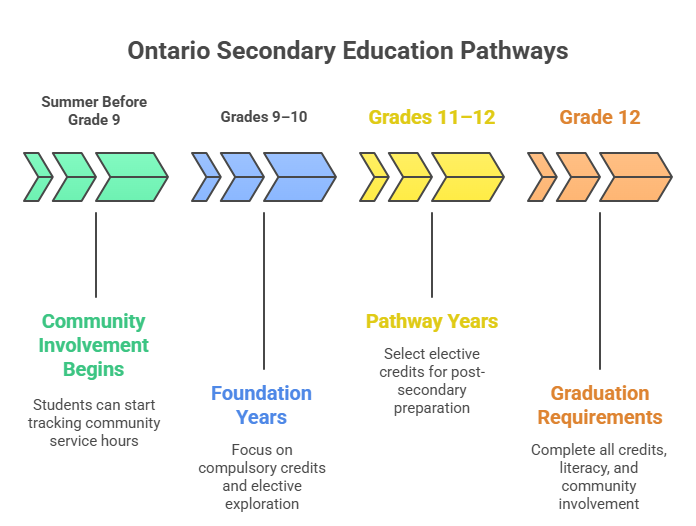
The path through Ontario secondary education takes students from Grade 9 up to Grade 12. At the start, students work on key courses that build a solid base. In the later years, they can choose more focused classes that help get ready for what comes after high school.
Knowing how this process works helps you plan your study period well. The first couple of years make sure you have the base you need. The last two years give students a chance to pick courses that fit with plans for university, college, or getting a job. This makes high school a good way to get ready for the next step in life.
Grades 9–10 (Foundation Years)
Grades 9 and 10 mark the start of high school, focusing on completing most compulsory credits to build a strong academic base. Students take subjects like English, math, science, geography, history, and French. These years also allow students to explore electives, helping them discover interests and plan future courses. Additionally, students can begin fulfilling graduation requirements, such as starting community involvement hours as early as the summer before Grade 9. Key tasks during these foundation years include:
- Completing courses like Grade 9 Geography and Grade 10 History.
- Trying out different electives.
- Starting to track their community service hours.
Grades 11–12 (Pathway Years)
Grades 11 and 12 are crucial for preparing for college, university, or entering the workforce. During these years, students should carefully select elective credits to meet post-secondary admission requirements. It’s important to use the school’s course calendar and consult with a guidance counsellor to ensure the right courses are chosen for desired programs. The choices made now will impact future opportunities. Here is what to do:
- Pick elective credits that match the entrance needs of university or college.
- Take the needed Grade 12 ‘U’ or ‘M’ level courses for college or university spots.
- Finish all credit, literacy, and community involvement you need to graduate.
Specialized and Enriched Course Options
For high school students who want more of a challenge or a jump on their job path, Ontario has a few special programs you can join. Some options, such as Advanced Placement (AP), International Baccalaureate (IB), and dual credit courses, let you study deeper and also learn by doing things.
These courses do more than just the normal school plan. They let students who are eager to learn earn credits for university or get papers that show they have certain work skills while still in high school. Look at the options to see how they can help make your child’s schooling even better.
Advanced Placement (AP) and IB Programs
- Advanced Placement (AP) and International Baccalaureate (IB) programs are challenging options at select Ontario high schools, offering university-level coursework.
- AP allows students to study subjects in-depth and take standardized exams; high scores may earn university credits. The IB Diploma Programme is a two-year course promoting critical thinking and interdisciplinary learning.
- Both programs are valued by universities in Canada and abroad, showcasing a student’s academic ability and helping them stand out during the application process.
Specialist High Skills Major (SHSM)
- The Specialist High Skills Major (SHSM) is a ministry-approved program that lets students focus on one economic sector while meeting Ontario Secondary School Diploma (OSSD) requirements.
- SHSM students group their compulsory credits and electives to specialize in areas like health and wellness, arts and culture, or information technology, with schools outlining specific courses and experiences.
- Participants earn industry-recognized certifications and gain practical experience through cooperative education placements; completing SHSM adds a special seal to their diploma to highlight their expertise.
Dual Credit and Co-op Programs
Dual credit and cooperative education programs let students learn by doing, connecting high school with college, university, and careers to give you a real advantage.
Dual credit courses are made with local colleges and universities, earning you both a high school and college credit at once. You can use up to four dual credit courses as optional high school credits.
Cooperative education lets you work at a job connected to a course, helping you explore careers, gain skills, and make contacts.
- Get your credits while working and learning on the job.
- Use what you study in the classroom at work.
- Count up to two co-op credits toward compulsory graduation requirements.
These programs prepare you for life after high school.
Choosing the Right Ontario High School Courses
Choosing the right courses is a big part of the secondary school experience. The classes that your child picks now will shape what they learn and also affect what options they have after they finish school. Careful planning is key for them to do well.
You do not have to do this by yourself. The school offers plenty of help. There is a detailed course calendar you and your child can look at to see all the class choices. The guidance counselor is there to give advice and answer questions. Together, these can help you make a plan that fits your child’s goals.
Aligning Courses with Future Goals
The best way to plan high school courses is to start with your child’s future goals and work backward. If university is the goal, find out early which programs interest your child ideally by Grade 10. Each university lists admission requirements for programs on their websites. For example, engineering needs certain math and science courses, while humanities may need specific English credits. Use this information, or ask a guidance counsellor for help. Choosing courses that match these requirements ensures your child is prepared to apply to their preferred programs. Here’s what you need to do:
- Research university program requirements.
- Pick the right Grade 11 and 12 courses.
- Make sure all graduation requirement steps are completed along the way.
Guidance and Academic Planning
Your child’s guidance counselor is the best resource for academic planning, offering personalized advice based on the Ontario curriculum and your child’s goals. Make use of the following:
- Regular Meetings: Schedule meetings with the guidance counselor to discuss your child’s academic plan, review course options, and clarify questions about graduation and post-secondary pathways.
- School Tools: Take advantage of course selection nights and online planning tools provided by the school to make informed choices.
- Special Guidance: For mature students, ask the counselor about prior learning assessment and credits for previous experiences to support graduation requirements.
Why Choose USCA Academy for OSSD Courses
If you are considering where to complete Ontario high school courses, USCA Academy is an excellent choice. Here are three reasons why:
- Accredited Learning: USCA Academy is a private high school monitored by the Ontario Ministry of Education, ensuring a strong OSSD program.
- Flexible Online Education: Students can earn their Ontario high school diploma online, allowing them to create a study schedule that fits their needs.
- Comprehensive Support: Our dedicated teachers and guidance staff assist students from selecting classes to applying for post-secondary institutions, preparing them for their future.
Conclusion
When considering Ontario high school courses, it’s crucial for your child’s educational journey. The selection of classes plays a significant role in their academic growth. Special programs allow students to explore various interests and discover their passions. Completing required courses is essential for earning credits, and both core classes and electives significantly influence post-secondary opportunities. The choices students make in these Ontario high school courses prepare them for college or university success.
By following their interests and seeking guidance, students can create a personalized path to achievement. If you’re interested in exploring the educational options available for your child, contact USCA Academy. We are dedicated to helping you find the best fit for your family’s educational goals.
Frequently Asked Questions
1. How are Ontario high school courses graded?
In an Ontario secondary school, students get grades from many different things during the semester. These can be assignments, tests, and projects. The Ontario curriculum says that 70% of the final grade comes from the coursework. The other 30% comes from a final evaluation. Every school board might have its own rules for this. But, all secondary schools follow this main guide in Ontario.
2. Can students take Ontario high school courses online?
Yes, students can take courses by online learning. They must finish two online credits because it is now a graduation requirement. Private schools like USCA Academy give a flexible OSSD program Ontario. The whole course is online. This lets students get their diploma from anywhere in the world through eLearning.
3. What happens if a student fails a course in Ontario high school?
If a student fails a course, they will not get the credit for it. If the course is a compulsory credit that is needed for their graduation requirement, they have to take it again. For elective courses, students can pick to take the same class again or choose another course instead. Your secondary school guidance counselor is there to help and can tell you the best way to deal with this.
4. How do Ontario high school courses prepare students for university admission?
The system uses compulsory courses and elective credits to help with academic planning. Students take some main courses they have to do first. After this, they pick Grade 11 and 12 elective credits (U- or M-level) that they need for getting into university. A guidance counsellor is there to help students line up their choices to fit what they want to do.