


Key Highlights
- Canada had over 720,000 international students as of late 2025 (IRCC via ICEF Monitor, February 2026), and all major Canadian banks have built specific accounts and newcomer programs to serve this market
- All Big Five banks (RBC, TD, Scotiabank, CIBC, BMO) offer student accounts with no monthly fee and unlimited debit transactions for enrolled students
- RBC and TD are the only two Big Five banks that allow international students to open accounts fully before arriving in Canada
- Standard Canadian chequing accounts for non-students typically charge CAD 10.95 to CAD 30.00 per month. A student account with no fee saves CAD 130 to CAD 360 per year
- High school students under 18 face age restrictions at some banks. Always confirm the minimum age requirement and whether parental consent is needed before applying
- Building a Canadian credit history during high school through a no-fee student credit card is a genuinely valuable financial move for students who plan to stay in Canada for university
Why International High School Students Need a Canadian Bank Account
A Canadian bank account is not optional for international students. You need one to receive your allowance from family (via international wire transfer or e-Transfer), to pay rent or homestay fees, to buy public transit passes, to pay for school materials, and eventually to receive any part-time income if your study permit allows work. Without a Canadian account, you are managing everything through cash or prepaid cards, both of which are more expensive and less convenient.
For high school students specifically, a Canadian account also helps parents monitor spending from abroad through shared access or digital statements. Banks like RBC allow parents to be named as joint account holders, which gives families visibility and some control over the account while the student learns to manage Canadian finances independently. For international students managing the cost of living in Mississauga or Toronto, see our guide on cost of living for international students in Mississauga for a full monthly budget breakdown.
What to Look for in a Canadian Student Bank Account
| Feature | Why It Matters for International High School Students |
| No monthly fee | Standard accounts charge CAD 130-360 per year. A student fee waiver is worth real money over 3-4 years of high school. |
| Unlimited debit transactions | Daily purchases, transit taps, and online payments add up quickly. A cap of 25 transactions per month is insufficient for active students. |
| Free Interac e-Transfers | Sending money to a homestay family, classmates, or receiving transfers from parents abroad requires e-Transfer access. |
| Pre-arrival account opening | Arriving in Canada with a working bank account and debit card eliminates a stressful first-week errand. |
| ATM network size | A large ATM network means you are never paying a CAD 2-3 convenience fee at an independent ATM. |
| International wire transfer support | Parents sending money from India, Korea, UAE, Japan, or Mexico need a clear, affordable international transfer pathway. |
| Minimum age | Some student accounts require the student to be at least 15 or 16. High school students under 18 may need a parent as joint holder. |
The Best Bank Accounts for International High School Students in Canada: 2026 Comparison
RBC Advantage Banking for Students
RBC is consistently ranked as the top choice for international students and newcomers, according to multiple 2026 reviews including NerdWallet Canada and ArriveThenThrive.ca. The RBC Newcomer Advantage program offers waived monthly fees, access to over 4,200 ATMs across Canada, and the ability to open an account before arriving in Canada through the RBC International Student Banking program. Students can apply for an RBC Cash Back Mastercard with no Canadian credit history required.
- Monthly fee: None for enrolled students
- Transactions: Unlimited debit transactions
- e-Transfers: Free and unlimited
- Pre-arrival opening: Yes, through RBC’s International Student Banking program
- Credit card option: RBC Cash Back Mastercard (no Canadian credit history required, up to CAD 15,000 limit)
- ATM network: 4,200+ ATMs across Canada
- Current promotion: Offer runs June 2 to November 2, 2026. Includes AirPods 4 for eligible new accounts meeting qualifying criteria by January 15, 2027
For international students from India, Korea, the UAE, Japan, or Mexico, RBC’s combination of pre-arrival account opening and a physical branch presence near most major Canadian universities and high schools makes it a practical first choice. See rbcroyalbank.com/new-to-canada/international-students for current terms.
TD Student Chequing Account
TD is the other Big Five bank that allows pre-arrival account opening for international students, making it a strong competitor to RBC. TD has one of the densest branch networks in Ontario, with locations close to most high schools and universities in the GTA including Mississauga. TD offers dedicated newcomer banking specialists and multilingual support, which is helpful for international high school students navigating Canadian banking for the first time.
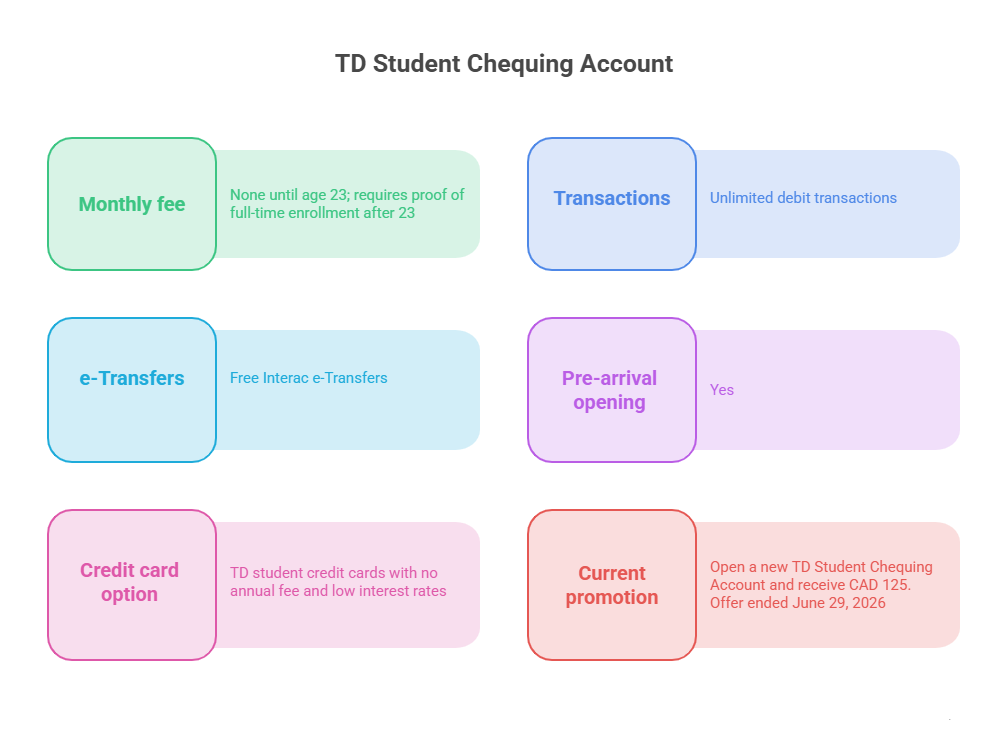
- Monthly fee: None until age 23; requires proof of full-time enrollment after 23
- Transactions: Unlimited debit transactions
- e-Transfers: Free Interac e-Transfers
- Pre-arrival opening: Yes
- Credit card option: TD student credit cards with no annual fee and low interest rates
- Current promotion: Open a new TD Student Chequing Account and receive CAD 125. Offer ended June 29, 2026; confirm current offer at td.com
CIBC Smart for Students
CIBC’s student account is well-known for its seamless international student onboarding, with multilingual support available in Mandarin, Cantonese, Punjabi, and other languages relevant to USCA Academy’s international student population. The CIBC Smart for Students account has no monthly fee and unlimited transactions. CIBC also participates in the Student GIC Program, which is relevant for students who need to demonstrate proof of funds for their study permit application. Unlike RBC and TD, CIBC online pre-arrival setup may require completing the account at a branch upon arrival.
- Monthly fee: None for students
- Transactions: Unlimited
- e-Transfers: Free and unlimited
- Pre-arrival opening: Partial; account may need to be completed at a branch
- GIC participation: Yes (useful for study permit proof of funds)
- Multilingual support: Yes, including Mandarin, Cantonese, Punjabi
Scotiabank Preferred Package for Students and Youth
Scotiabank’s student account has the added benefit of the Scene+ rewards program, which lets students earn points on everyday purchases for redemptions at Cineplex theatres, grocery stores, and entertainment venues. For high school students who want a modest rewards benefit alongside their everyday banking, this is a practical perk. The Student Price Card (SPC+) can also be linked to the account for retail discounts.
- Monthly fee: None for students with valid student ID
- Transactions: Unlimited debit and Interac e-Transfers
- e-Transfers: Free
- Rewards: Scene+ points on everyday purchases
- ATM network: 900+ Scotiabank branches across Canada
- Current promotion: Earn up to CAD 200 welcome bonus. Offer runs July 2 to November 1, 2026
Simplii Financial No Fee Chequing (for students 18+)
Simplii Financial is CIBC’s digital-only banking division. It is not suited for high school students under 18 due to age requirements, but it is worth knowing about for students who turn 18 during their Canadian studies. Simplii offers unlimited debit transactions at no monthly fee, cash-back offers, and access to CIBC’s ATM network (Canada’s largest). The current welcome offer includes CAD 300 and a CAD 50 Skip gift card for qualifying new accounts. Offer ends September 30, 2026. Visit simplii.com for current terms.
Side-by-Side Comparison: Top Student Bank Accounts 2026
| Feature | RBC | TD | CIBC | Scotiabank |
| Monthly fee | None | None to 23 | None | None with ID |
| Unlimited transactions | Yes | Yes | Yes | Yes |
| Pre-arrival opening | Yes | Yes | Partial | No |
| Multilingual support | Limited | Yes | Yes | Yes |
| Rewards program | RBC Rewards | TD Rewards | Adapta points | Scene+ |
| GIC participation | Yes | Yes | Yes | Yes |
| No-fee credit card | Yes | Yes | Yes | Yes |
| Important: All fee information reflects 2026 published rates. Welcome offer eligibility, promotional periods, and account features change frequently. Always confirm current terms directly with the bank before applying. |
How to Open a Bank Account as an International Student Under 18
Students under 18 can open a Canadian bank account but may need a parent or guardian as a joint account holder. The documents typically required are:
- Valid passport (your primary ID as an international student)
- Canadian study permit (confirms your legal status as a student in Canada)
- Canadian address (your homestay address, school address, or boarding school address)
- Social Insurance Number (SIN), if you have one. Not required for a bank account, but needed eventually for tax reporting if you work)
- Parent or guardian consent or joint account holder signature (required for students under 18 at most banks)
For students at USCA Academy’s boarding school in Mississauga, the school’s address can be used as a Canadian address for banking purposes. USCA Academy staff can also provide a letter confirming enrollment, which most banks accept alongside your study permit.
Building Credit as an International High School Student
If you plan to stay in Canada for university after high school, starting to build a Canadian credit history during high school gives you a significant advantage. A credit score affects your ability to rent an apartment, get a student line of credit, and eventually qualify for better loan terms. The strategy is simple and low-risk: get one no-fee student credit card from your bank, use it only for small regular expenses like a streaming service or a monthly transit pass (CAD 30 to 80 per month), and pay the full balance before the due date every single month.
According to WealthNorth.ca (May 2026), a single year of on-time payments with low credit utilization creates a meaningful credit profile. Never carry a balance on a student credit card. Interest rates are 19.99% to 22.99%, and carrying CAD 500 for a year costs CAD 100 to CAD 115 in interest. The card is a credit-building tool, not a borrowing tool. For context on managing finances as an international student in Ontario, read our guide on cost of living for international students in Mississauga.
| Arriving in Canada soon to study at USCA Academy? Our admissions team can advise on setting up banking before you arrive, and our boarding and accommodation staff can provide the enrollment letters and address information that banks require. Call +1 (905) 232-0411 or visit uscaacademy.com/accommodation to learn more about USCA Academy’s international student support services. |
Frequently Asked Questions
1. Can an international high school student open a bank account without a SIN?
Yes. A Social Insurance Number (SIN) is not required to open a basic chequing account at a Canadian bank. You need a SIN only if you start working in Canada, at which point your employer will require it for payroll. You can open a student bank account with just your passport, study permit, and a Canadian address.
2. Which bank is best for sending money from abroad to a Canadian student account?
RBC and CIBC both have established international transfer partnerships that make receiving international wire transfers straightforward. Families sending money from India, the UAE, Japan, Korea, or Mexico can use services like Wise (formerly TransferWise), Remitly, or their home bank’s international transfer service to send directly to a Canadian bank account. The receiving bank does not charge fees to receive incoming international wires in most cases, though the sending bank or transfer service charges a fee.
3. What happens to my student bank account when I stop being a student?
Most student account fee waivers expire when you turn 23 or when you stop being enrolled as a full-time student. After that, the account either converts to a regular chequing account with monthly fees, or the bank sends a notice asking you to switch. WealthNorth.ca (May 2026) notes that most Big Five banks offer a 6 to 12 month grace period after graduation, but that it ends silently without a clear notification. The smart move is to open a no-fee adult account (at Tangerine or Simplii Financial) before graduation, update your direct deposits and pre-authorized payments, and then close the student account. This applies to students approaching the end of high school who plan to stay in Canada for university.