
Key Highlights of provincial attestation letter Canada study permit
Here are the key takeaways about the Provincial Attestation Letter (PAL) for your study permit application:
- Canada introduced the PAL as a new requirement for many international students.
- The PAL confirms you have a spot within a province’s limit for new study permits.
- Most undergraduate and college students need a new PAL for their application.
- Your school (Designated Learning Institution) requests the PAL on your behalf.
- Master’s and PhD students are generally exempt from this requirement.
- You must include the PAL with your study permit application to avoid rejection.
Introduction
Are you planning to study in Canada? You may need a new document called the Provincial Attestation Letter, or PAL. In 2024, Immigration, Refugees and Citizenship Canada (IRCC) says most new study permit applications must have this letter. This guide will help you understand what you need to know about the PAL. We will talk about what the letter is, who needs the attestation letter, and how to get it. We want to make your path to studying and getting your study permit in Canada a little easier.
Key Highlights of the Provincial Attestation Letter Canada Study Permit Process
The Provincial Attestation Letter is now needed when you apply for a Canada study permit in 2024. This is a big change for international students who want to study in Canada. You now must have this new letter with most new study permit applications. The attestation letter shows that you are counted in the province’s student allocation.
The school you pick will ask the provincial government to get this attestation letter for you. If you do not have this letter, your new study permit application will probably not be accepted. You must know this process to make your study permit application work. Let’s look at the details so you can get your study permit and be one of the international students coming to Canada.
Quick Facts About PAL Canada 2026 for International Students
If you are a new international student and plan to study in 2026, you need to know about the PAL Canada study permit requirement. This new letter is now part of the study permit application process. It helps control how many students can study in Canada each year.
Your Designated Learning Institution (DLI), like a college or university, will get this letter for you. You cannot ask for it by yourself. The school will start the process after you accept your offer of admission.
Here are some quick facts you should know:
- The PAL is an official letter from a Canadian province or territory.
- It shows that you have a place in that province’s yearly student limit.
- Most provinces need a PAL. Quebec is different and uses the Quebec Acceptance Certificate (CAQ) instead.
- The PAL is a required paper for your study permit application if you do not have an exemption.
Why the PAL Requirement Was Introduced for Study Permits
You may ask why Canada made this extra step in the study permit process. The Canadian government started the PAL requirement to help manage how many new international students come to the country. They also want to spread the distribution of study permit applications across all provinces and territories.
In the past, some provinces got way more international students than others. This caused problems with things like housing and healthcare. The PAL system lets each province have more say in how many students they can accept each year.
This way, the international student program stays steady and grows the right way. When there is an intake cap in place for each province, the government can keep the quality of education and student life good for both international and local students. It helps make sure communities can support their student numbers well.
What Is a Provincial Attestation Letter Canada Study Permit?
A Provincial Attestation Letter (PAL) is a document that you get from the province or territory where you will study. The PAL shows Immigration, Refugees, and Citizenship Canada (IRCC) that you have a place in the province for international students. You can look at it as a kind of check that goes with your letter of acceptance from your school.
The PAL is a main part of the new PAL Canada immigration rules made in 2024. Your designated learning institution (DLI) will ask the provincial government for this attestation letter after you get your offer of admission. When you apply for your study permit, you need to include the PAL and your other papers.
Who Needs a PAL Canada 2026 and Who Is Exempt?
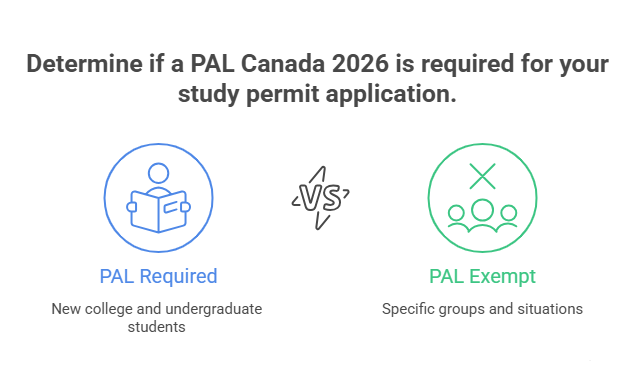
Not every international student needs a provincial attestation letter for their Canada study permit application. The need for a PAL depends on your level of study and your own situation. Most new people who want to do college or undergraduate programs will have to get this letter.
Some groups do not have to get a PAL. It is good to know if you need one, or if you are in a group that doesn’t have to get it. This is important for your study permit application to go well. Let’s look at who needs an attestation letter in Canada and who does not.
Types of Applicants That Require a Provincial Attestation Letter
If you are a study permit applicant, you need to know if a PAL is needed for you. This step is important, especially if you are a new student going to a college or a university in Canada at the undergraduate level. If you are trying to get your first study permit to go to a school, you will likely need this letter.
Your learning institution will help guide you. But it is up to you to be sure that your application is complete. If you are a person moving from a high school in Canada to a college or university, you will need a PAL too.
You will probably need a PAL if you are:
- a study permit applicant for an undergraduate bachelor’s degree program.
- applying for a college diploma or certificate program.
- a student who is visiting or just taking classes, and you plan to study for more than six months.
- going into a graduate program that does not give a full degree, like a graduate diploma.
Who Does Not Need to Submit a PAL for Canada Study Permit
Not everyone needs a PAL to apply for a Canada study permit. The Canadian government offers exceptions for certain applicants. If you qualify, you can submit your application without a PAL but must prove you are exempt. For example, master’s or PhD students, exchange students, and some with valid work permits in Canada may not need it. There are specific rules to follow.
You do not need to meet the PAL requirement if you are:
- A student who will be in a master’s or PhD program.
- A student in primary or secondary school (K-12).
- A visiting or exchange student.
- In Canada with a valid study permit, only seeking an extension.
- Applying to study in Quebec and have the Quebec Acceptance Certificate (CAQ).
If you have the CAQ, you do not need a PAL for Quebec.
Step-by-Step Process: How to Obtain a Provincial Attestation Letter in 2026
The PAL process is simple because most of the work is done by your school. The main thing you have to do is keep your spot at the school you pick. The application process for the new PAL is handled by your school and the provincial government.
When you accept your offer and pay any needed deposit, your school will ask for a new PAL for you. You do not need to fill out extra government forms. The next parts will tell you which documents you need to send your school and give you key times for the PAL process.
Documents Needed, Application Timeline, and Provincial Differences
To begin your Provincial Attestation Letter (PAL) application, you’ll need to provide key documents and information to your school. Start by formally accepting your offer of admission, which is often done online. Most institutions also require a tuition deposit to secure your spot. The PAL processing time typically ranges from 5 to 10 business days, though this can vary by province and school. Ensure all your forms and dates are correct to avoid delays and proceed smoothly.
Here’s a general overview of the steps:
| Step | Action | Details |
|---|---|---|
| 1. Accept Offer | Formally accept your offer of admission. | This is usually done through the school’s online portal. |
| 2. Pay Deposit | Pay the required tuition deposit. | The amount varies by school (e.g., $2,500 CAD at some universities). |
| 3. Request PAL | Complete a PAL request form if required. | Some schools have a specific form in their student portal. |
| 4. Receive PAL | Download the PAL from your school. | You will be notified via email when it is ready. |
How Provinces and Schools Issue the PAL Canada 2026
The process to get a PAL needs both the provincial government and your chosen designated learning institution, or DLI, to work together. Every province gets a certain number of study permits that it can give out. Next, the provinces share these permits with their learning institutions.
When a learning institution accepts you, they let you know you got one of their study spots. The institution then asks the provincial government for a PAL. The government sends the letter back to the school, and then they give it to you. Now, let’s look at a real example and also see which provinces need a PAL.
How Designated Learning Institutions Request the PAL
In most cases, international students do not apply for a Provincial Attestation Letter themselves. The process is handled by the school after you accept your offer of admission.
Here is how it usually works:
- You receive an offer of admission from a Designated Learning Institution (DLI).
- You accept the offer and pay the required tuition deposit.
- The institution requests a Provincial Attestation Letter from the provincial government.
- Once issued, the school sends the PAL to you by email or through the student portal.
- You include the PAL when submitting your study permit application to Immigration, Refugees and Citizenship Canada.
This process is similar across most provinces such as Ontario, British Columbia, and Alberta.
Which Provinces and Schools Require a PAL for Study Permit Applications
Nearly all provinces and territories in Canada now need a PAL for most study permit applications at a college or university. Every DLI in these parts of Canada has to follow a set way to ask for a PAL for international students who get admitted.
The way provinces give out PAL Canada can be a bit different. For example, in British Columbia, the Ministry of Post-Secondary Education will send the PAL to schools after the schools add student information. In Ontario, the schools ask the Ministry of Colleges and Universities for the PAL.
The provinces and territories that need a PAL include:
- Ontario
- British Columbia
- Alberta
- Manitoba
- Saskatchewan
- Nova Scotia
- New Brunswick
- Prince Edward Island
- Newfoundland and Labrador
Quebec does not follow this rule. Instead, international students in Quebec need a CAQ (Certificat d’acceptation du Québec).
How PAL Canada 2026 Affects Your Study Permit Application
The PAL is now an important part of your study permit application. If you do not have it, the IRCC will say your application is not complete and will send it back without seeing it. You cannot move ahead with your visa until you get this letter.
The PAL shows that you are part of the province’s allocation for a set intake year. It links your study permit application to the provincial cap. Because of this, you need to get your PAL fast and add it to your submission. If not, you might face long delays or even see your study permit application rejected.
What Happens If You Don’t Include a PAL?
If you submit a study permit application without the required PAL, your application will be rejected and returned by IRCC without being processed. This means you’ll lose your application fee and need to start the process again, which can delay your plans to study in Canada.
If you believe you’re exempt from the PAL requirement, include a letter of explanation and supporting documents in your application. To avoid setbacks and unnecessary fees, always check if you need a PAL before applying for your Canadian study permit.
Common Mistakes to Avoid and How to Prevent Delays
Getting your PAL and study permit can be challenging, and mistakes may cause delays. The most common error is not knowing if you need a PAL always check with your DLI for eligibility and requirements. Delays also happen if you wait too long to accept your offer or pay your tuition deposit, as schools cannot request your PAL until these steps are done.
To avoid issues, remember:
- Apply to schools early to ensure enough processing time.
- Respond to admission offers and pay tuition deposits promptly.
- Ensure your name and details match on all documents.
- If PAL isn’t needed, include a clear explanation letter.
Double-check instructions to prevent delays.
Latest Updates and Policy Changes for PAL and Study Permits
The way Canada handles international education keeps changing over time. One big change is the PAL requirement that came with the new study permit rules for 2025. This was set by the government as part of its work to manage the international student program.
It is good to keep up with all the newest updates that come from IRCC or from your province. The new rules can change how long it takes to process your study permit, who can get it, and how many places are open for students. Next, we will talk about some of the new rules and about the limits that come with study permits.
Recent Rules for Provincial Attestation Letters in 2026
The PAL requirement and cap on study permit applications introduced in 2024 will continue in 2026 and beyond, though the intake cap may change yearly. Your PAL is tied to a specific school and applicant; you cannot use it for another school. If you switch schools, you must obtain a new PAL from the new institution.
Here are some important points to remember:
- People in a master’s or PhD program do not need a PAL.
- The intake cap for study permits in Canada will be reviewed each year.
- Provinces decide how to allocate spots to their DLIs.
- If your permit is not approved, you need a new PAL to reapply.
Is There a Limit on Study Permits by Province in Canada?
Yes, there is a limit on the number of study permits given out by province in Canada. The federal government now has a new rule with an international student cap. This is a total number for the country. They break it down so that each province and territory gets its own intake cap.
Each province works with its own allocation. They choose how to split their intake among their Designated Learning Institutions. This way, each area can control how many international students they take in each year.
The international student cap is meant to make the intake slow and steady. It helps make sure that communities have the things they need for students. These numbers can change, and the government says what the intake cap will be for every new year.
Conclusion
Knowing about the Provincial Attestation Letter (PAL) is very important for international students who want to study in Canada. The provincial attestation letter Canada study permit is a new part of the study permit application. It helps make the application process easier and ensures you meet the rules set by each province. If you learn about who must have a PAL and how to get one, you can stay away from delays and mistakes that may come up. The best thing you can do is be ready and gather all the things you need for this process. This will help you go forward with your education plans in Canada. If you have any questions about the PAL or study permit, or need more help, contact our team. We are here to support you at every step.
Frequently Asked Questions
1. Do All International Students Need a Provincial Attestation Letter for a Canada Study Permit?
No, not every international student needs a PAL. Most people who apply to undergraduate or college-level programs need it, but there are some exceptions. If you are a master’s or doctoral student, a K-12 student, or an exchange student, you do not need a PAL. You should always check your eligibility. You can also ask Canadian immigration consultants to know if you need a study permit called a PAL Canada study permit.
2. How Long Does It Take to Get a PAL in Canada?
You will get your PAL Canada study permit letter in about 5 to 10 business days. The time starts after you have said yes to your offer of admission and paid any deposits the school asks for. You also need to finish any other things your school needs. You can usually get your letter on your school’s portal.
3. Can I Apply for a Canada Study Permit Without a PAL?
You can apply without a PAL only if you are in an exempt group. If your study permit application needs a PAL and you don’t include it, IRCC will send your application back without working on it. If you are not required to have a PAL, it is a good plan to add a letter of explanation with your study permit application.