

Key Highlights of canada visitor visa for parents
- The application process for a visitor visa for parents Canada has clear eligibility requirements. You must send in all the right documents.
- You will need a valid passport. You must also have proof of financial support and an invitation letter from your child in Canada.
- A Super Visa lets people stay longer than a regular visitor visa. But, it needs more proof of financial support and medical insurance.
- Processing time for a parent’s visitor visa changes. It depends on the home country and how many applications people send.
- It is important to know about the financial requirements and the application fee. This helps make the application process go well.
Introduction
Bringing your parents to Canada is a great way to see them again and bring your family together. The application process for a Canada visitor visa for parents can feel hard and unclear. This guide will show you all the steps you need, like the eligibility requirements and the necessary documents for the Canada visitor visa for parents. Knowing about these steps will help you make a strong application. It will make it more likely that you and your family can meet in Canada for a happy reunion.
Canada Visitor Visa for Parents Overview
A Canada visitor visa for parents is a kind of Temporary Resident Visa (TRV). This lets your parents visit you in Canada for a short time. The visitor visa is made for parents of a Canadian citizen or a permanent resident. They can use it for a family visit, to do some tourism, or just to spend time with their children.
For the application process, your parents have to show they meet some rules. They must have enough money for their stay, and they need to show they plan to go back to their home country. The aim of the Canada visitor visa is to keep the family reunion easy and stress-free.
What Is a Canada Visitor Visa for Parents?
A Canada Visitor Visa for Parents, also known as a Temporary Resident Visa (TRV), is a document placed in your parent’s passport. It shows that your parents meet the requirements to visit Canada for a short period. This visa is designed for parents of Canadian citizens or permanent residents, allowing them to spend time with their children and grandchildren in Canada.
To apply, parents must complete an application form and provide documents proving their eligibility. It is important to show that the visit is temporary and they will leave when required. The government created this visa to help families reunite.
Who Should Apply for a Visitor Visa for Parents Canada?
This visa is ideal for parents and grandparents of Canadian citizens or permanent residents who want to visit Canada for a short stay, such as family reunions, holidays, or special events like weddings and graduations. It’s suitable if your parents live outside Canada and are from a country that requires a visa to enter Canada.
If your parents plan to stay for up to six months at a time, the visitor visa is a straightforward option. For longer stays, the Super Visa may be better. If your parents are from a visa-exempt country, they may only need an eTA instead.
Canada Parent Visa Requirements
To get a visa for your parents, you have to meet the Canada parent visa requirements. These rules are in place to check that visitors are real and that they will follow the rules during their stay. The main things you have to look at are the general eligibility and the money needed.
In this part, you will read about the rules your parents must follow. This includes showing that they plan to go back home after their visit and proving they can pay for themselves while in Canada. Knowing about these Canada parent visa requirements is a big step in getting ready for the application process.
Eligibility Criteria for Parents
For your parents to get a Canada visitor visa, they must meet specific eligibility requirements set by Canadian immigration. The visa officer needs to be convinced that your parents will leave Canada at the end of their visit, so strong ties to their home country are crucial. Your parents must also be in good health, possibly requiring a medical exam, and have no criminal record preventing their entry.
Here are the main eligibility requirements your parents need to meet:
- Prove they have good ties to their home country, like a job, property, or other family members.
- Convince an immigration officer that they will leave Canada after their period of time ends.
- Have a valid travel document, such as a passport.
- Be in good health and have no serious criminal or immigration-related problems.
Financial Requirements and Proof of Funds
A key part of the Canada parent visa application is proving your parents have enough funds to cover their stay, ensuring they will not rely on public resources. As their child in Canada, you can also provide financial support. While there’s no fixed amount required, it’s recommended to have at least $1,230 per person for each month of their visit. Your parents must submit documents to verify financial stability. Common acceptable proof of funds includes:
- Bank statements for the last four to six months.
- A letter from an employer showing salary and job details.
- Proof of property ownership or other assets.
- A letter of financial support from you, along with your bank statements and proof of income.
Documents Required for Canada Visitor Visa for Parents
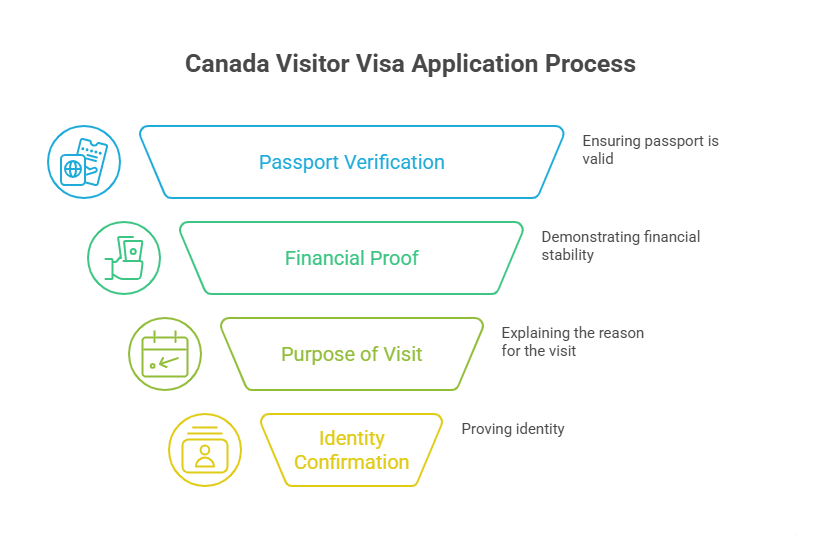
Getting the right paperwork is a key part of your application. Having a full and neat set of documents required for canada visitor visa for parents can help you get your visitor visa approved. You need to bring a valid passport, financial documents, and other papers as part of the process.
Every document shows something important. Some will prove who you are. Others will show the reason or purpose of the visit, and your financial stability. Here is a checklist of the main and extra documents you need to get ready for the application form.
Essential Application Documents Checklist
When preparing the application package for a Canada Visitor Visa for your parents, ensure you include all required documents to avoid delays or refusals. Start by gathering key identification and financial documents. The most crucial is a valid passport. Financial documents are needed to prove your parents can support themselves during their visit. Sometimes, extra documents may be required depending on your parents’ home country or circumstances.
Here’s a checklist of essential documents:
- Completed Visitor Visa application form (IMM 5257) and Family Information form (IMM 5707).
- A valid passport with at least six months’ validity post-trip.
- Two recent passport-sized photos per Canadian requirements.
- Proof of financial support, such as bank statements or a support letter.
- A letter of invitation from you, their child, residing in Canada.
How to Prepare an Invitation Letter for Parents
An invitation letter is essential for your parents’ Canada visitor visa application. As their child in Canada, you should clearly state the reason for their visit, your relationship, and the duration of their stay. Address the letter to the visa officer, formally inviting your parents. Include details about yourself, your parents, and their travel plans. Sign the letter and attach a copy of your Canadian ID (passport or PR card).
The invitation letter must include:
- Your full name, home address, and contact number in Canada.
- Your parents’ full names, dates of birth, and current address.
- The purpose of visit, trip duration, and where your parents will stay.
Step-by-Step Application Process for Parents Visitor Visa
Knowing how to apply for a Canada visitor visa for parents helps make the trip easier. The application process has a few clear steps. You start by making an online account. Then, you send in your papers and give your biometrics. Doing these steps in the right order is important to get a good result.
This part explains the visitor visa application process step by step. We talk about how to pick the right online portal. You will also see what happens after you send your finished application package. This will help you get ready for every step in the visa application process.
Creating an Account and Choosing the Right Portal (IRCC vs. VFS)
Before choosing the portal, it’s important to understand how each option works and what services they offer. Here is a comparison:
| Feature | IRCC Portal (Online) | VFS (Paper Application) |
|---|---|---|
| Application Method | Entirely online from start to finish. | Submit physical documents at a VFS Centre. |
| Document Submission | Upload digital copies. | Provide original or photocopied documents. |
| Processing Time | Often faster due to direct submission. | May be slightly longer due to mail and handling time. |
| Support | Online help center and web forms. | In-person assistance and tracking services at the visa office. |
Submitting the Application and Biometrics Steps
- After completing the application form and gathering all required documents, submit them online through the IRCC portal by uploading your files and paying the necessary fees. Once submitted, you will receive confirmation that your application is in process.
- Most applicants must provide biometrics, which includes fingerprints and a photo. After paying the biometrics fee, you’ll get a letter instructing you to visit a Visa Application Centre (VAC) to give your biometrics. There is an additional fee for this service.
- The visa office will only review your application after you have provided your biometrics, so complete this step promptly to avoid delays.
Visitor Visa Application Fees and Costs
If you want to get a visitor visa, you need to understand what it will cost. The total cost is more than just the main application fee. There may be other things to pay for as well. You must pay all these fees before the visa people will start to look at your application.
Here, we will talk about the main application fee for a visitor visa. We will also talk about other things you might need to pay for, like the costs for biometrics, medical checks, and travel insurance. If you know about these expenses early, you can make a good budget. You will not be shocked by extra costs when waiting for the visa during the processing time.
Application Fee Breakdown for Parents
The main cost for a Canada visitor visa is the non-refundable application fee, which must be paid for each applicant. If both your parents are applying, you will need to pay the fee for each of them separately. In addition to this, most applicants must also pay a biometrics fee. Both fees can be paid online during the application process. Below is a breakdown of the costs:
- Application Fee: $100 CAD for each person
- Biometrics Fee: $85 CAD for each person (or $170 CAD for a family of two or more)
- Total for one parent: $185 CAD
- Total for two parents applying together: $270 CAD
Other Potential Expenses to Consider
Besides the government fees, you should budget for additional costs that may arise based on your parents’ situation and location. A common expense is the medical exam, which must be done by an IRCC-approved doctor if required, and you pay the doctor directly. You’ll also need to consider the cost of traveling to the Visa Application Centre for biometrics submission.
Other possible expenses include:
- Medical examination fee, if required.
- Travel insurance for the duration of their stay.
- Fees for translating documents not in English or French.
- Postage or courier fees for paper applications.
Plan ahead for these expenses.
Processing Time for Parents Visitor Visa
One of the questions people often ask is how long it takes for a parent’s visitor visa to be processed. The canada visitor visa processing time for parents can be very different every time. It depends on where you apply, the time of year, and a few other things. You should apply early, long before your parents’ travel date.
The number of applications in the system at that time, and how complete your own application is, will also affect how long you wait. In this guide, we will talk about the average processing time. We will also share some tips, so you can avoid delays and get a visitor visa for your parents faster.
Average Processing Times Explained
The processing time for a visitor visa for parents varies depending on several factors. The visa office handling your case and its current workload are key influences. You can check the latest estimated processing times on the IRCC website. For instance, applications from one country might be processed within weeks, while others may take months. The time of year also affects how quickly applications are handled, with busy periods like summer and winter holidays often causing delays. Some things can make the processing time longer or shorter:
- The country your parents apply from.
- The number of applications the local visa office gets.
- If the application is complete and has all of the right documents.
Tips to Avoid Delays and Track Your Application
You can’t control how fast the visa office processes your papers, but you can help ensure your application goes smoothly. The best way to avoid delays is to submit a complete application from the start. Carefully check all forms for mistakes and make sure you include every required document. Once your application is submitted, you can track its status online. If you used the IRCC portal, log in to your account for updates. If you applied through VFS, use their tracking tool.
Here are some tips to avoid delays:
- Apply a few months before your travel date.
- Check all your forms to be sure every part is correct.
- If the visa office asks for more information, answer as soon as you can.
Duration and Extension Options for Parents Visitor Visa
When your parents get their visitor visa for parents Canada, you should know how long they can stay. The border services officer at the port of entry will decide the length of their stay. There is also a possibility of extension if your parents want to stay longer.
This section will tell you the maximum time parents can be in Canada with a visitor visa. It will also show you the steps you need to follow to ask for an extended stay. Knowing these visitor visa rules helps your parents keep their legal status in Canada.
Maximum Allowed Stay for Parents in Canada
Usually, parents visiting Canada can stay for up to six months from their entry date. When your parents arrive, a border services officer will review their passports and stamp a date by which they must leave. If no date is stamped, the default stay is six months. The visa itself, whether single or multiple-entry, can be valid for up to 10 years, but this does not change the maximum allowed stay per visit. A multiple-entry visa allows several visits, but each visit has a set duration.
Key points about the maximum stay with a temporary resident visa:
- The normal stay for a temporary resident visa is up to six months at a time.
- The border officer decides the final period of time and might give your parents less time to stay.
How to Extend a Visitor Visa for Parents
If your parents wish to stay in Canada beyond their initial visitor visa period, you can apply to extend their stay by changing their status to a “visitor record.” Submit the application package online before their current stay ends, ideally at least 30 days in advance. In your application, explain why they need more time and provide proof of funds to show they can support themselves. Applying early helps maintain their legal status while waiting for the extension decision.
To apply for an extension, you need to:
- Complete the right application form online.
- Pay the needed fees.
- Provide documents, including proof of funds and reasons for extension.
Super Visa vs. Visitor Visa for Parents in Canada
| Feature | Visitor Visa | Super Visa |
|---|---|---|
| Duration of Stay | Up to 6 months | Up to 5 years |
| Renewal Requirement | Requires renewal after 6 months | No renewal needed during the 5 years |
| Ideal for | Short trips | Longer stays |
| Income Requirement | None | Minimum income required for child in Canada |
| Medical Insurance Requirement | Not required | Proof of Canadian medical insurance needed |
| Main Difference | Duration and requirements | Duration of stay and eligibility criteria |
Knowing how the Super Visa and visitor visa are different can help you find the best way for your family reunion.
Common Reasons for Refusal of Parents Visitor Visa Applications
Getting a refusal can feel tough. When you understand the common Canada visitor visa refusal reasons for parents, you can try to avoid them. Most refusals do not just happen at random. They are usually because the person does not meet one or more rules for the visitor visa.
The most common problems come up when the forms are not complete, the person does not show enough money, or the parent does not have strong ties to the home country. When you know these things can happen, you can get ready. This helps you put together a better visitor visa application for Canada.
Incomplete Documentation or Incorrect Information
One common reason for refusal is submitting an application with missing documents. If any required forms or papers are not included, the visa officer can refuse the application immediately, often without requesting the missing items. Providing incorrect or inconsistent information such as mismatched travel dates between your flight itinerary and invitation letter can also lead to doubts about your application and result in refusal. To avoid these issues, it is essential to carefully check your documents and information before submitting.
To help with this, make sure you:
- Use the document checklist that IRCC gives to be sure your application package is complete.
- Review all your forms for accuracy and to keep everything the same before you submit.
Insufficient Proof of Return or Financial Support
Visa officers may refuse a visitor visa for parents if there is insufficient proof they will return home or lack financial support. Your parents must show strong ties to their home country, such as a stable job, property, financial assets, or close family members remaining behind. Officers also need to see your parents have enough funds for their trip and will not work illegally in Canada. Lack of financial stability or missing documents can result in refusal.
To strengthen your application:
- Give proof of their job, property ownership, and other family ties in the home country.
- Show financial documents like bank statements to prove sufficient funds.
- If supporting financially, write a letter and provide your own proof of stability.
Tips for Increasing Approval Chances for a Canada Visitor Visa for Parents
You can do a few things to boost the chances of your parents’ visa application being approved. It’s important to put together a clear, honest, and complete application package. A good application should show the purpose of the visit and make sure there is no doubt about your parents’ plans to return home after their trip.
When you focus on giving all the needed documents and avoid common mistakes, you make it more likely to have a good result in the visa application process. Now, let’s go over some useful tips that can help you during the application process.
Preparing a Strong Application Package
A strong application package should be neat, complete, and clearly explain your parents’ visit to Canada. Begin with a concise cover letter outlining the purpose of the visit and highlighting key documents. Ensure all supporting documents are easy to read, and provide certified translations for anything not in English or French. The goal is to make your application easy for the visa officer to review and understand. Presenting a well-organized, professional package increases the chances of approval.
Tips for a strong application package include:
- Organize all documents in a good order and add a clear table of contents.
- Give strong proof of relationship, like birth certificates, to show your family link.
- Include a detailed travel itinerary that shows your parents’ plans and activities while they are in Canada.
Mistakes to Avoid During Application
Avoiding mistakes in your Canada visitor visa application is crucial. Always provide accurate and truthful information, as even a small error can lead to delays or refusal. Double-check each section of the form and ensure your details match your documents. Honesty is key if a visa officer finds false or misleading information, you risk not only refusal but also a ban on future applications for several years. Take your time to review your application before submitting.
Some common mistakes to watch out for are:
- Leaving any sections of the application form blank.
- Giving unclear or mixed answers about the purpose of the visit.
- Waiting too long to apply, which causes problems if you have to give extra or additional documentation.
Rights and Restrictions for Parents on a Visitor Visa
When your parents come to Canada on a visitor visa, it is good to know what they can and can’t do. The visitor visa for parents Canada lets them travel easily in the country. They can meet family, see different cities, and enjoy fun things as tourists.
But, this type of visitor visa has rules. The main rule is that they cannot work or study in Canada with it. If they try to work or take classes without the right permit, they break the law. This can lead to big problems. Knowing these rules helps make sure their time in Canada is safe and happy.
Can Parents Work or Study While Visiting Canada?
No, parents visiting Canada on a visitor visa or temporary resident visa cannot work. These visas are only for short visits, such as seeing family or tourism. If your parent wants to work in Canada, they must apply for a work permit. Working without proper authorization is risky and can lead to removal or a ban from re-entering Canada.
Parents also cannot attend long-term school or college courses. They may take a short course if it’s completed during their authorized stay, usually less than six months. For longer studies or formal programs, a study permit is required before enrolling.
Traveling in and out of Canada on a Visitor Visa
If your parents hold a Canada visitor visa, their ability to travel in and out depends on the visa type:
- Multiple-entry visas allow parents to leave and re-enter Canada as often as they want while the visa is valid. Each entry is subject to approval by a border officer, who also decides the length of their stay.
- Single-entry visas allow entry only once; if parents leave for any country except the USA or St. Pierre and Miquelon, they must apply for a new visa to return.
- On re-entry, parents should have their travel itinerary and proof of funds ready for inspection.
Conclusion
To sum up, it is important to know how the Canada visitor visa for parents works. This will help make the application process easier and give you a better chance to get the visitor visa. Be sure to follow the rules for who can apply, get all the necessary documents ready, and go through each step as explained.
When you plan well, you can feel sure about what you are doing. Filling out the application with all the needed details can help a lot with getting approved. If you have questions or if you need help, just reach out to our team. We are here for you and will help you through all steps.
Frequently Asked Questions
1.Can parents extend their visitor visa while staying in Canada?
Yes, parents can extend their visitor visa while they are in Canada. They need to apply for a “visitor record” before the current visa ends. The application package should tell the reason for the extended stay and give proof of financial support. It is important to show proof of financial support when you apply with the visitor visa application package.
2. How much bank balance is required for parents visitor visa?
There is no set amount that you must show, but a good guideline is to have enough money to cover the cost of the trip. For most people, having at least $1,230 for each month you stay is smart. You can use bank statements or a letter from your child in Canada to show proof of financial support. This is how you show you have enough money for your trip.
3. Can parents work while on a visitor visa?
No, parents who have a visitor visa or a temporary resident visa can’t work in Canada. This visa is meant for travel or family visits only. If they want to work, they must get a work permit first. Working without the right papers is not allowed and goes against the law in Canada.
4. Can visitor visa be converted to PR?
A visitor visa does not let you become a permanent resident right away. Just being in Canada as a visitor does not give you a way to permanent residency. Your parents must meet the rules for a program, like the Parents and Grandparents Program, if they want to be permanent residents. They also need to fill out a different application for it.
5. Is Super Visa better than visitor visa for long stays?
Yes, the Super Visa is better if you want to stay for a long time. A regular visitor visa only lets you stay for up to six months. The Super Visa lets parents stay for up to five years in one trip. But, the canada super visa vs visitor visa comparison shows the Super Visa has tougher rules. You need to show proof of medical insurance.