
Key Highlights of AVI3M Course Outline
- The AVI3M course is for Grade 11 students in Ontario. It is a visual arts program that helps you get ready for university or college.
- You will do studio work in drawing, painting, sculpture, and mixed media. Your hands will be busy making art in this course.
- The AVI3M curriculum wants you to learn skills by going through the creative process and the critical analysis process.
- This is a comprehensive program. It matches the curriculum expectations set by the Ontario Ministry of Education.
- You will make a professional portfolio. This will help you when you apply for post-secondary places or want to follow aviation career pathways.
Introduction
Are you a high school student in Ontario who likes art and design? The Grade 11 Visual Arts course, called AVI3M, is a good way for you to learn more about visual arts. The AVI3M course outline shows how you can get better at drawing, painting, and other art forms. This course helps you get ready for college or university if you want to study more art later. You can try many types of art and use your creativity a lot. The course also lets you learn about art theory and history. If you are new to art or want to grow your creative skills, this visual arts course offers what you need to do well.
AVI3M Course Outline: Everything You Need to Know
The AVI3M course is a visual arts course that helps you get better at making and thinking about art. The course follows rules from the Ontario Ministry of Education. This means you get a strong and trusted education.
This comprehensive program lets you take part in different studio projects. You get to try new kinds of art. You learn to study your own work and the work of others. Now, let’s find out more about how the course is set up.
Course Overview (Credit, Duration, Course Code)
The AVI3M course is a university/college preparation visual arts course in the Ontario high school curriculum, aligned with an aviation curriculum. Designed for Grade 11 students, it offers a comprehensive study of visual arts concepts and techniques. The course can be completed over a standard school year, semester, or at your own pace if taken online ranging from four weeks to a full year at institutions like USCA Academy. It totals 110 instructional hours.
Upon successful completion, students earn one full credit toward their Ontario Secondary School Diploma (OSSD). The “M” in AVI3M indicates its focus on preparing students for both university and college arts programs, emphasizing creative skills and critical thinking needed for post-secondary education in arts-related fields.
| Attribute | Detail |
|---|---|
| Course Code | AVI3M |
| Credit Value | 1.0 |
| Course Type | University/College Preparation |
| Recommended Hours | 110 |
Who Should Take AVI3M?
This course is ideal for high school students who want to pursue visual arts, design, or related fields in college or university. AVI3M helps you prepare a strong portfolio and develop new artistic skills. If you enjoyed Grade 9 or 10 art and wish to continue, this is the next step. The course encourages creativity and critical thinking, valuable for many careers. It’s inclusive and supports students with special education needs; teachers can adjust lessons for those with an IEP. Consider AVI3M if you:
- want to apply for a college in fine arts, graphic design, architecture, or information design,
- want to build a strong and mixed portfolio,
- like hands-on projects and want to show your creative side.
Prerequisites and Eligibility Requirements
Before enrolling in the Grade 11 AVI3M course, you must meet specific eligibility requirements. These prerequisites ensure that you have the foundational knowledge necessary to succeed in this advanced visual arts class. The process is straightforward and aligns with the Ontario curriculum standards. Additionally, the school can accommodate changes to the course for students with special education needs, ensuring that all students receive equitable opportunities to learn and be assessed in the AVI3M course.
What You Need Before Enrolling
The AVI3M course requires you to have completed a high school art course, such as AVI1O or AVI2O, so you already understand basic design principles and have experience with art materials. This background helps you tackle the advanced projects in Grade 11 visual arts. The course, along with pilot training courses, is open to any high school student meeting these prerequisites.
If you have an Individual Education Plan (IEP), accommodations like extended deadlines or alternative assignments may be available to support your learning. Schools such as USCA Academy are dedicated to providing flexibility and support for all students.
The prerequisites are:
- Successful completion of AVI1O (Grade 9 Visual Arts, Open)
- OR successful completion of AVI2O (Grade 10 Visual Arts, Open)
Course Placement Guide
Deciding when to take the AVI3M course, which incorporates elements of aviation and space technology, is important for your high school plan. AVI3M is designed for students interested in art and creative careers after graduation. You’ll develop skills like technical drawing and design principles, useful for computer graphics and other fields. These abilities can help build a strong portfolio for college or university arts programs. Whether you enjoy fine art, digital media, or want to explore computer graphics, the AVI3M course is a great starting point.
The AVI3M course is a good fit for you if:
- You want a path to college or university in arts.
- You want a job using visual communication and design.
- You want a Grade 11 credit that is creative and challenging.
Complete AVI3M Course Structure and Units
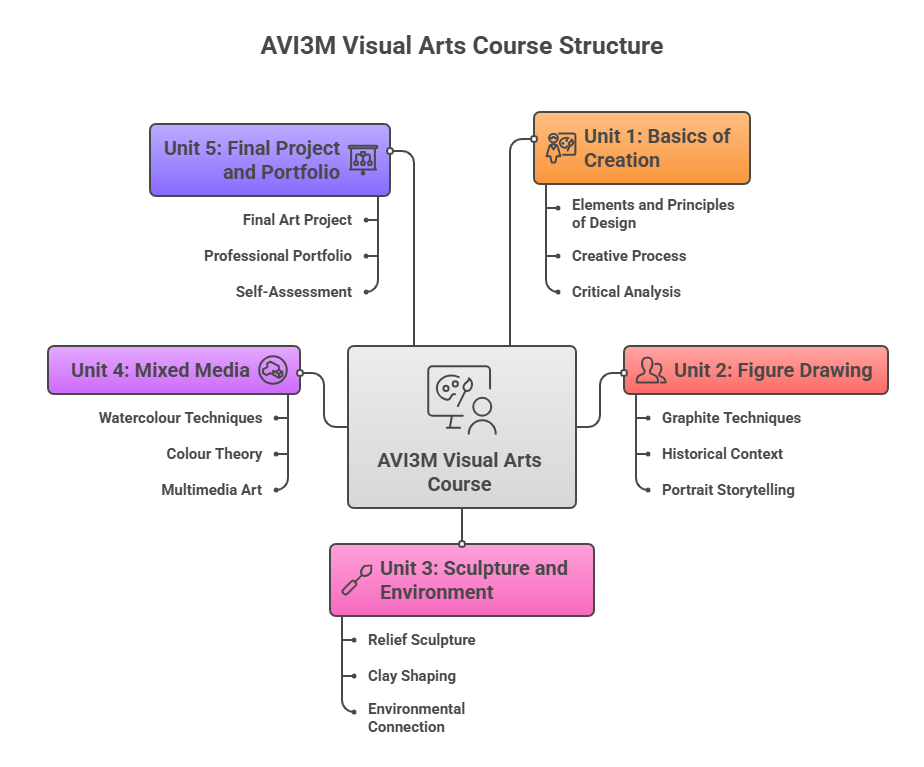
The AVI3M visual arts course offers a comprehensive program that explores various skills and concepts, as outlined in the AVI3M course outline. Each unit focuses on different aspects of visual arts, including a particular art form such as drawing, painting, and three-dimensional creation, allowing you to experience a wide range of artistic practices.
The course builds on your existing knowledge, enhancing your proficiency with tools and deepening your understanding of art. You will engage in studio work, analyze works by other artists, and refine your own creations. Throughout the semester, your creative process will continually evolve with each unit in this dynamic program, as detailed in the AVI3M course outline.
Unit 1: The Basics of Creation
This unit introduces you to the foundations of visual arts. You’ll review the elements and principles of design and see how to apply them in your own artwork. The importance of the creative process will be discussed, helping you understand how ideas grow from start to finish. Working with a sketchbook is a key skill, allowing you to develop and experiment with your ideas.
A major focus is learning to view and analyze art critically, using the critical analysis process throughout the course. You’ll also explore topics beyond studio work, such as Canadian copyright law and its impact on artists. Projects in this unit let you apply new skills through activities like basic composition tasks or collage creation, encouraging you to explore a wide range of themes.
What you will focus on:
- The elements and principles of design
- Understanding the creative process
- Applying the critical analysis process
- Using a sketchbook for idea development
Unit 2: Figure Drawing
In Unit 2, you will explore figure drawing with a focus on creating portraits using graphite pencils. The unit emphasizes building technical skills, such as using various pencils to convey texture, light, and realism. You will study how the human body has been depicted in art across different cultures and historical periods, including notable artists from Canada. Hands-on activities include sketchbook exercises and a final portrait project. You’ll also analyze works by skilled artists, including Canadians, to learn storytelling through portraiture. By the end of this unit, you will improve these key skills:
- Using graphite to add texture and light
- Showing story in a portrait
- Looking at how history and culture affect figure drawing
Unit 3: Sculpture and the Environment
This unit shifts your focus from flat art to creating sculptures with real shape and depth. You’ll explore relief sculpture, mainly using clay, and learn how space, form, and texture change in 3D work. You’ll study Canadian relief sculptors like Barbara Reid, try their techniques, and then create your own final piece. The project lets you use color mixing and composition skills in three dimensions. You may also experiment with other art forms, such as printmaking or mixed media.
In this unit, you will study:
- The basics of relief sculpture.
- How to use and shape clay.
- How art, the outdoors, and the world around us are tied together.
- The way to take good photos of 3D art.
Unit 4: Mixed Media
Unit four lets you explore art beyond traditional methods by using mixed media. Here, you’ll work with watercolour a paint important in Canadian art history. You’ll study colour theory, learn to mix colours, and try different watercolour techniques. This unit also teaches you how to combine materials and styles to create multimedia works. You’ll be introduced to Canadian watercolour artists who found inspiration in nature. For your main studio project, you’ll paint a still-life featuring natural subjects such as leaves or fruit, using your new watercolour skills.
Key projects and skills in this unit:
- Learn watercolour painting techniques
- Apply colour theory in your work
- Make a still-life painting
- Combine different materials for multimedia art
Unit 5: Final Project and Professional Portfolio
The last unit of the visual arts course brings together everything you’ve learned. You’ll create a final project that highlights your personal ideas and showcases the art skills you’ve developed throughout the program. This is your opportunity to produce a unique piece that represents your growth and creativity.
A major focus of this unit is building a professional portfolio that demonstrates your aerospace education. You’ll select your best artwork from the course, refine each piece for display, and apply the critical analysis process to reflect on your progress. Your portfolio will be prepared for applications to schools or future opportunities. This is especially useful if you’re interested in careers in aviation, design, marketing, or traditional art fields.
In this unit, you will:
- Create a final art project.
- Develop a professional portfolio.
- Improve your self-assessment skills.
Overall Course Expectations
The AVI3M visual arts course aligns with the Ontario Ministry of Education’s curriculum expectations, which are divided into three main categories assessed through an achievement chart. This structure ensures a balanced development of various skills, supporting all students, including those learning the language of instruction. These categories guide all aspects of the course, from creating art to analyzing and interpreting it. With this framework, you will enhance not only your artistic abilities but also your critical thinking and appreciation of art in a thoughtful manner.
Category A: Creating and Presenting
The “Creating and Presenting” category focuses on hands-on art activities. You will use the creative process to make art, both independently and with classmates. This involves brainstorming ideas, experimenting, making changes, and finalizing projects. A key aspect is using the elements and principles of design to communicate messages, ideas, or feelings through your artwork.
You’ll discover that presenting your art and the art of others can change its meaning depending on the setting or timing. This category encourages you to go beyond making things look appealing and instead use art as a way to express yourself and connect with viewers.
In this category, you will learn to:
- Use the creative process to develop and improve artworks.
- Apply principles of design to show your feelings and ideas.
- Make and share art using different media and technologies.
The emphasis remains on visual arts, including your own work and that of others.
Category B: Reflecting, Responding, and Analyzing
This section centers on developing your critical thinking skills. The aim of “Reflecting, Responding, and Analyzing” is to teach you how to observe art closely and use the critical analysis process to discuss works of art, including your own and pieces by other artists from different times. You will explore how art relates to society and its values, showing what life was like when it was made and how it can influence or reflect social change.
Giving and receiving descriptive feedback is key in this process. This category also encourages you to consider future opportunities in the arts and to remain engaged with artistic practices beyond school.
Key objectives include:
- Using the critical analysis process to look at works of art.
- Learning how art can show and change what society cares about.
- Seeing how what you learn in the classroom can help you find new chances in the arts later on.
Category C: Foundations
The “Foundations” section gives you the essential knowledge on flight training fundamentals you need to confidently discuss, create, and behave professionally in visual arts. You will become familiar with the correct terminology to describe the elements and principles of design, as well as other major concepts in the field. This foundation will help you express your thoughts clearly and professionally.
You will also explore how artists follow specific rules and use a variety of techniques to make art. This includes learning about brushwork in painting, sculpting methods, proper care for art materials, understanding copyright, and following safety practices in the studio environment.
Under Foundations, you will:
- Use the correct visual arts terminology with confidence.
- Understand the rules and methods used for art creation and the principles of design.
- Show that you know about safe and responsible ways to work.
Assessment and Grading Breakdown
Knowing how your work will be assessed as part of assessment is crucial for success in the AVI3M course. You will receive ongoing feedback to enhance your learning. Your final grade reflects your performance across all curriculum expectations. The report card consists of two components: your term work and a final test or project. This dual assessment approach ensures your achievement level accurately reflects your efforts throughout the course, making the final grade fair and comprehensive based on your overall work.
Term Work Evaluation (70%)
The largest part of your grade, 70%, is based on term work completed throughout the course. Your teacher evaluates your progress and skills in the achievement categories: Creating and Presenting, Reflecting, Responding and Analyzing, and Foundations. Studio work should consistently demonstrate your level of achievement. Your grade is determined by a range of assessments, not just final projects. The quality of your process matters, and special consideration is given to growth shown in new work. Your most consistent performance during the term is reflected in your grade.
Term work assessments may include:
- Completed studio work and projects, like drawings, paintings, or sculptures.
- Sketchbook assignments and process work.
- Critical analyses, research, and written reflections.
Final Evaluation (30%)
The final evaluation counts for 30% of your grade and takes place at the end of the course. This assessment allows you to demonstrate the knowledge and skills you have gained. The format of the final evaluation can differ depending on your school and teacher. It is designed to reflect the key goals of the course and is marked using the achievement chart. You might have a final exam, a major project, or both. Some schools use a performance task with a smaller exam, while others use just one final exam.
The final evaluation may include:
- A final project or performance task.
- A final exam that includes theory and terminology.
- A portfolio review and presentation.
Unit-by-Unit Weighting
While the final grading breakdown for AVI3M is 70% term work and 30% final evaluation, understanding how your time is structured can help you plan your efforts. The course runs for 110 hours, with time distributed across core units to ensure all curriculum expectations are met and provide balanced opportunities to build skills in drawing, painting, and sculpture. The suggested timeline below reflects the weight each unit may carry within term work, even if it’s not a direct grading breakdown. This pacing helps guide project completion and assessment throughout the semester.
| Unit | Suggested Time |
|---|---|
| Unit 1: The Basics of Creation | 25 Hours |
| Unit 2: Figure Drawing | 25 Hours |
| Unit 3: Sculpture and the Environment | 25 Hours |
| Unit 4: Mixed Media | 25 Hours |
| Final Culminating Project | 10 Hours |
Assessment Methods Used
Teachers in the AVI3M course use various assessment methods to ensure fairness and validity. The primary purpose of assessment is to help you improve, not just to assign grades. You will often receive descriptive feedback from your teacher, highlighting your strengths and areas for growth. Assessment focuses on hands-on art projects, giving multiple opportunities to demonstrate learning. Methods are accessible to all students, including those with an IEP, and you’ll receive clear instructions and criteria for success.
Assessment methods include:
- Observations of your creative process during studio work.
- Conferencing and one-on-one discussions with your teacher.
- Checklists and rubrics for projects.
- Peer and self-assessment activities.
What Materials and Assignments to Expect
In the AVI3M visual arts course, you will explore various materials and complete engaging assignments. Expect to work in different mediums, including:
- Drawing, Painting, and Sculpting: Use graphite pencils for portraits, technical pens for ink drawings, watercolour paints for still-life, and clay for relief sculptures.
- Collage and Multimedia Projects: Combine materials and express your ideas creatively through the creation of collage.
- Assignments and Portfolio Development: Maintain a sketchbook, complete unit artworks, research artists, and culminate in a final project showcasing your skills in a professional portfolio.
The course emphasizes critical analysis, helping you articulate your artistic choices.
Conclusion
In conclusion, the AVI3M course outline provides an excellent framework for exploring visual arts. Throughout this course, you will enhance your skills and discover your unique artistic style through various mediums. The structured lesson plan makes learning engaging, covering essential topics like figure drawing and sculpture.
You’ll have ample opportunities for hands-on creation and will compile a portfolio showcasing your best work. Understanding the course goals and grading criteria will empower you to excel. As you embark on this visual arts journey, remember that support is always available feel free to ask questions or seek further information whenever needed.
Frequently Asked Questions
1. How is AVI3M course outline different from AVI3O?
The big difference is in the way these courses are set up. AVI3M is part of the visual arts program in Ontario. It is made to help students get ready for university or college after high school. AVI3O is different. This “Open” course is for anyone to join. It helps students grow their skills and find new interests, but it does not focus on planning for college or university.
2. Can you skip units in the AVI3M course outline?
No, you can’t skip any units in the AVI3M visual arts course. The whole visual arts course must be finished because it follows the curriculum expectations set for Ontario. Each unit is needed because it helps you learn, and you have to finish all of them to get the credit.
3. Can students take AVI3M online at USCA Academy?
Yes, you can take the AVI3M visual arts course online. Places like USCA Academy offer this visual arts course online, and you can work on it when you have time. The program uses the same Ontario curriculum expectations as classes held in person. This means you get a good quality education.
4. Is the AVI3M course outline approved by Ontario Ministry of Education?
Yes, the AVI3M course is made and approved by the Ontario Ministry of Education. This means the visual arts course meets the rules set by the province for quality and learning. The credit you get from this course is accepted by all schools and colleges in Ontario.