

Key Highlights of What is MHF4U
- MHF4U is the main course code for Grade 12 Advanced Functions in the Ontario curriculum. It is an important part of university preparation.
- The course takes what you get from Grade 11 Functions (MCR3U) and goes further with topics like polynomial, rational, logarithmic, and trigonometric functions.
- Core mathematical processes, such as solving problems, reasoning, and connecting different ideas, are a part of all units.
- Grades usually split into 70% from your regular work and 30% from a last exam or big project.
- You need to finish this course to get into many university programs, especially those in science, engineering, and business.
- The mhf4u course outline helps you build critical thinking skills. It also gets you ready for harder math, like Calculus and Vectors.
Introduction
If you are in Grade 11 or 12 in Ontario and plan to go to university, you may hear about a course called MHF4U. You might wonder what is MHF4U. This is an advanced functions course that is part of the Ontario curriculum. It helps you build a strong math background. The class goes past simple math ideas. The goal is to get you ready for harder work in school after high school. It also helps your student learning in other ways. This guide will give you all you need to know about this functions course and how it can help you.
What is MHF4U?
MHF4U is the official course code for Grade 12 Advanced Functions in the Ontario curriculum. It is designed for senior mathematics students and prepares them for various university programs while adhering to the high standards set by the Ontario Ministry of Education.
The course covers different types of functions and teaches students how to combine them. According to the Ontario Ministry of Education, it enhances understanding of rates of change, which is crucial for higher-level mathematics, especially for English language learners. This foundational knowledge is essential for success at university and in fields that utilize advanced functions.
Course purpose in Ontario curriculum
The reason for MHF4U in the Ontario curriculum is to do two things. The first is that this course refines the use of the mathematical processes for any student who wants to study MCV4U (Calculus and Vectors) next. You need both of these senior mathematics credits if you are hoping to get into many university programs, like engineering, computer science, or the physical sciences.
The second job of this course is for students who want to improve their understanding of mathematics before they start any college or university program. Some programs don’t need calculus, but you still need strong thinking skills with numbers. The ministry of education says the curriculum expectations are there to help you get better at using mathematical processes so that the level of student achievement is high.
The goal of MHF4U is to make sure every student in Ontario has the same and strong understanding of functions. This way, you get ready to go into university knowing you have the right skills. No matter where you go to study, you can feel good about your abilities and take on new schoolwork without falling behind.
MHF4U Prerequisites and Course Outline
Before you sign up for MHF4U, you need to meet some academic rules. These rules make sure that you be ready with the right basic math skills. You need these skills for the new and hard topics in this senior mathematics course. Knowing what you need to get into the course is the first thing to do when you plan your Grade 12 classes.
The mhf4u prerequisites are set by the Ontario curriculum. These rules help you move smoothly from Grade 11 math to Grade 12 math without trouble. Below, we look at the needed courses you must finish first and what to expect in the MHF4U course.
Entry requirements (MCR3U or equivalent)
The main entry requirement for MHF4U is that you finish MCR3U, which is the Grade 11 Functions class. This is because MHF4U teaches more about algebra and functions. It builds right on top of what you learn in MCR3U. If you do not have a strong understanding of MCR3U, you might find the pace and ideas in Advanced Functions to be very tough.
The Ontario Ministry of Education sets these MHF4U prerequisites. They want you to move from one course to the next in a way that makes sense. Sometimes, a different course that matches may be accepted. It is important to check this with your school guidance counselor or the college or university you want to apply to. The accepted prerequisites are:
- MCR3U – Functions, Grade 11 (University Preparation)
- MCT4C – Mathematics for College Technology, Grade 12 (College Preparation)
MCT4C is allowed as an option for some people. But most students who are working toward university programs with Advanced Functions will take MCR3U. This course gives you the best start and background for the ideas you will meet in your next math courses.
Credit value & structure
Upon completing MHF4U, you earn one full credit (1.0) toward your Ontario Secondary School Diploma (OSSD) at the university preparation level. This credit is considered by universities when reviewing applications, and the final grade appears on your official transcript and report card.
The course typically requires around 110 hours, similar to other full-credit courses in Ontario. This time includes lessons, activities, and assessments, divided into units that cover various trigonometric functions and math concepts such as polynomial, rational, and trigonometric functions. The course concludes with a final evaluation, which may involve a project or exam.
Whether you study during a semester, quadmester, or online, the credit and required time for advanced functions remain consistent to ensure all students receive an equal learning experience.
Key Units in MHF4U
The MHF4U course consists of main units focusing on families of functions, enhancing your understanding of the rate of change step by step. Expect to explore properties, graphs, and algebraic methods, making the challenging material rewarding with persistence.
Polynomial, Rational, and Exponential Functions
One of the main parts of MHF4U is about polynomial functions, including algebraic representations of polynomial functions. You start by building on what you know about quadratics, and then learn more about cubic, quartic, and quintic functions. In this part, you find and understand their key features, like finding their intercepts and observing how they act at the ends of a graph. This unit also helps you solve equations and inequalities using these polynomial functions.
Next, you move on to rational functions, which are made by putting polynomials in both the top and bottom of a fraction. Here, you mainly focus on finding asymptotes lines on a graph that the curve gets close to but never touches. You learn how asymptotes affect the domain and range of the function, and you also solve rational equations.
At the end, you return to exponential functions. You look more closely at their properties and how they appear in real life. What you learn about exponential functions also helps you understand logarithmic functions, which are the inverses.
- Analyzing graphs of polynomial functions.
- Solving polynomial and rational inequalities.
- Understanding vertical and horizontal asymptotes.
- Modeling real-world scenarios with exponential functions.
Trigonometric and Logarithmic Functions
This part of the course helps you learn more about trigonometric functions. You will go beyond the basic trigonometric ratios (SOH CAH TOA) and use radian measure, which gives another way to work besides degrees and is used a lot in higher math. You’ll look closely at the graphs of sine and cosine functions, called sinusoidal functions, and see how changes in amplitude, period, and phase shift affect the graphs.
You’ll also get good at proving trigonometric identities, which are equations that always stay true no matter what values you use. To prove them, you need to use logic and algebra, which includes algebraic representations of the corresponding trigonometric functions, and you’ll also solve tricky trigonometric equations.
You’ll learn about logarithmic functions, which work opposite to exponential functions. The course covers the basic laws of logarithms and shows how to use these laws to make expressions simpler and solve logarithmic equations.
- Working with radian measure and the unit circle.
- Graphing transformed trigonometric functions.
- Proving trigonometric identities.
- Applying the laws of logarithms to solve equations.
Properties and Applications of Functions
A big part of MHF4U is learning the properties of polynomial and other functions, including the properties of the resulting functions. You need to know more than just the formulas given in class. It is important to look at how functions work and think about why they do what they do. You will learn to find key features like the domain and range of a function, when the function gets bigger or smaller, and where its graph has breaks. You can check for these important points by using equations or looking at graphical representations.
You will work with more than one function, learning how to put two functions together by adding, subtracting, multiplying, or dividing them, and also making new functions. The course will also cover composite functions, where you place the output of one function into another, for example f(g(x)).
In this unit, you will use what you learn for real-life problems. Functions help model things like how a population grows, how loud a sound is, or how money changes over time. This way, you can see how key features from math are useful in the world outside the classroom.
- Identifying key properties of polynomial and other functions.
- Performing operations on functions (e.g., f(x) + g(x)).
- Understanding and creating composite functions (e.g., f(g(x))).
Solving Equations and Inequalities
A key part of MHF4U is to help you get better at solving different kinds of tough equations and inequalities. This is important because you will use these skills in every part of the course. The problems will be harder than just basic linear equations, and you’ll work with new types of functions.
You will learn several methods to solve equations that basic algebra can’t handle, like factoring, graphing, and other algebraic tricks. These strategies will help you solve rational, trigonometric, logarithmic, and polynomial equations. You’ll also discover how solving equations is different from solving inequalities. For inequalities, you’ll use tools such as interval testing and graphing to find which values are solutions.
- Solving complex rational equations.
- Finding answers for trigonometric equations within a set domain.
- Using standard algebraic techniques to solve logarithmic equations.
Mathematical Modeling
Mathematical modeling is an important skill you will learn in MHF4U. It means taking a real-life problem, turning it into a math problem, solving it, and then using your answer to help with the real situation. You need to use both problem solving and critical thinking for this.
In MHF4U, you won’t just get equations to solve. Your teacher will give you stories or situations, and you pick the function that fits best, like polynomials for the path of an object or exponential functions for radioactive decay. This helps you see that math is a useful tool for understanding and solving real-world problems.
- Applying functions to model and solve real-world problems.
- Developing critical thinking and advanced problem-solving skills.
Evaluation and Grading
Your performance in MHF4U is checked using a clear and balanced process. The main goal, as given in Ontario’s rules for schools, is to help student learning. Teachers watch your work to see what you do well and what you have trouble with. They give you descriptive feedback so you can know how to get better. Your final grade shows your level of achievement.
Evaluation means the teacher looks at your work and matches it against the achievement chart, which plays a crucial role in a student’s learning. Then, a number or letter is given for your report card. This score comes from looking at all you do in the course, but there is extra attention on your most recent work.
Coursework Components
Most of your final grade in MHF4U is based on coursework you do during the term, which usually makes up 70% of your whole mark. This means your mark does not depend on just one big exam, and your teacher gets to see many examples of how you understand the work. Your coursework grade shows your most steady level of achievement, although special consideration will be given to your recent performance.
The activities look at the four parts of the achievement chart: Knowledge and Understanding, Thinking, Communication, and Application. This makes sure you are tested in all areas.
Common coursework tasks include:
- Unit tests and quizzes
- Problem sets and assignments
- Investigations or projects
Your teacher will look at your work often and give feedback to help you learn. More recent evidence of achievement is important, so if you keep working hard and show you get better over time, it can really help your final grade.
Final exam / culminating task
The last 30% of your grade is based on a final check at the end of the course. This is meant to see how well you understand everything you’ve learned. How you are tested can be different, depending on what your teacher or school decides.
Usually, you will write a formal, supervised final exam at the end of the course, covering all the main units and topics. Some classes might have a big final project instead, or a mix of a project and a test. A project means you’ll work on a larger task that uses what you learned from different parts of the course, often to solve a challenging problem.
- Final Exam: A supervised test covering all course material.
- Culminating Task: An in-depth project or investigation completed toward the end of the course.
Typical weightage breakdown
The Ontario Ministry of Education makes sure the weight for MHF4U is easy to understand and the same for everyone. You can trust that your final grade will be worked out in a fair way and shown clearly on your report card.
Your final grade will be set by this formula:
- 70% Coursework + 30% Final Evaluation = 100% Final Grade
This split of 70% and 30% is used for all senior-level university preparation courses in Ontario. The 70% part comes from how you do on all the coursework and assessments during the year. The 30% part comes from the final exam or the last big project. Your teacher will look at the achievement chart and use their own judgement, and will always try to show your most recent and steady level of achievement on your report card, as set by the ministry of education.
Why Take MHF4U? Benefits for Students
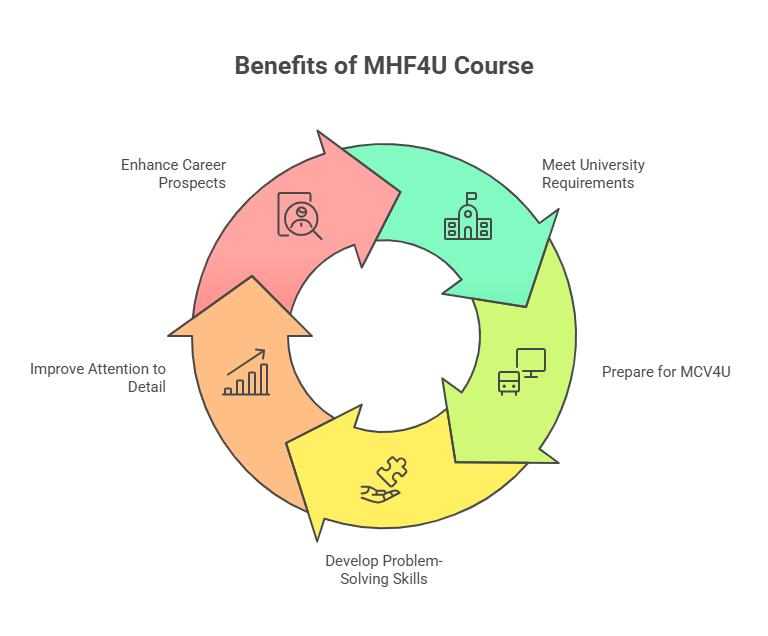
MHF4U not only meets university requirements but also equips you with vital skills like advanced thinking and problem-solving, essential for both academic and career success. This course is an excellent choice for those pursuing STEM fields or wishing to improve their math skills, providing a strong foundation for the future.
Preparation for Calculus & Vectors (MCV4U)
One of the most direct benefits of taking MHF4U is that it prepares you for Calculus & Vectors (MCV4U). The ideas about functions, rates of change, and instantaneous rate of change, and limits in MHF4U are the basics you need for calculus. You need to know advanced functions well, or doing well in university calculus will be hard for you. The senior mathematics courses in Ontario follow a set order. First, you learn from MCR3U, then build on that in MHF4U, and MCV4U comes after, using what you learned in MHF4U. If you skip a step or go into a new course without this background, it can make things very tough.
When you take MHF4U, you show you know:
- The algebra skills for working with harder math problems.
- The basic ideas of functions to help you get the main points in the vectors course and in calculus.
In simple words, MHF4U gives you the basics you need, and MCV4U shows you a new and better way to use those skills.
University program requirements
For many students, taking MHF4U is not just a choice it’s something you have to do. Many university programs require Advanced Functions for admission, especially if you’re interested in mathematics or science fields. It’s important to check the admission requirements for the program you want as early as possible, because not having MHF4U can limit your options. Your grade in this course also matters to admissions officers.
University programs that usually need MHF4U include:
- Science: Physics, Chemistry, Biology, Life Sciences
- Engineering: All disciplines (for example, Mechanical, Electrical, Computer)
- Business/Commerce and Economics
- Computer Science and Data Science
- Mathematics and Statistics
Some college technology programs may recommend or require MHF4U for entry into advanced streams.
Real-world problem-solving skills
Even if you are not going to use calculus every day in your job, you still get something important from MHF4U. In this course, you train your mind to think in a clear and step-by-step way. It helps you be good at problem solving and critical thinking. These are essential skills that you will use in any job, no matter the field.
You learn how to take big and tough problems and break them into smaller and easier steps. This skill is needed in project management, research, and planning. You also get better at being careful and paying attention to small details because a small mistake in math can change the result.
These are critical thinking, problem solving, and other skills that many employers want. You will use them in all kinds of jobs, even with new communications technologies.
- The ability to get into problems in a logical and careful way.
- The practice of building up your critical thinking and being able to look at things using good reasoning.
- Getting better at not giving up and keeping at something even when the task is tough.
MHF4U vs MCV4U Differences
While MHF4U and MCV4U are both Grade 12 math courses meant for university preparation, they focus on different areas of mathematics.
Knowing the differences between MHF4U and MCV4U is important for planning your high school courses. The table below outlines the key differences based on what each course covers.
Feature | MHF4U (Advanced Functions) | MCV4U (Calculus and Vectors) |
|---|---|---|
Primary Focus | Studies the properties and graphs of different types of functions in detail. | Introduces how things change (calculus) and how to work with shapes in 2D and 3D (vectors). |
Key Topics | Covers polynomial, rational, trigonometric, and logarithmic functions; combining functions; and average rates of change. | Discusses derivatives, limits, drawing curves, optimization, and vector operations like dot and cross products. |
Role in Curriculum | Serves as the foundational course and is required before taking MCV4U. | A higher-level course that uses the concepts learned in functions to solve calculus and spatial problems. |
Core Question | “What are the features of this function, and how does it act?” | “How does this function change at a certain point, and how can we explain movement and forces in space?” |
Conclusion
To sum up, knowing “What is MHF4U?” is important for students who want to do well in math and get ready for university. This course teaches you about key functions and shows you ways to use them. You also learn how to solve problems, skills that are very helpful for college. When you finish MHF4U, you set yourself up for harder classes, like Calculus & Vectors. This makes you ready for what comes next in school.
If you study hard and get help from places like USCA Academy, you can get through this course in a better way and feel more sure about math. If you want to move forward and do well, you can book a free talk with one of our experts. You will find out how we can help you do better in MHF4U and in your future studies.
Frequently Asked Questions
1. How many hours per week should I study for MHF4U?
Success in the advanced functions course needs steady work from you. Set aside 3 to 5 hours each week for study. Make this study time outside the class. Doing learning activities often can help you. It will help you get a better grade in the advanced functions course. Your good study habits also show up on your report card and can help your student achievement.
2. Can international or out-of-province students take MHF4U online?
Yes, you can take a mhf4u online course at many places. Private online schools, like USCA Academy, offer this online course that considers each student’s individual education plan. The course gives you an Ontario high school credit. Students can sign up from anywhere in the world. The schools also help with special education needs, so all people get support.
3. Does every university program require MHF4U for admission?
No, you do not have to take advanced functions for every university program. But most science, engineering, business, and health sciences programs will ask for it. When you do your program planning, it is important to look up the curriculum expectations for each university program you want to apply to. This can help you know what you need before you go further.
4. Can I take MHF4U in summer school or fast-track the course?
Yes, many school boards and private schools give advanced functions as part of summer school or in a fast-track plan. These shorter classes of the mhf4u course outline go over all the same things as the full course. The work is just done in less time, so you can finish by the end of the course.