Key Highlights of private school admission for temporary residents Canada
- Learn how kids of temporary residents can get into private schools in Canada.
- Find out who can go to school in Canada if you have a work permit, study permit, or even a visitor visa.
- See which documents you need for your application, like your study permit and proof of your status.
- Get details about tuition fees for temporary residents in Canada. These fees are not always the same as fees for citizens.
- Check the rules about children who come on a visitor visa and how they can get into school in Canada. You will also learn when you need a study permit.
Introduction
Are you in Canada with a temporary visa and need to know more about your child’s education? If yes, you are in the right spot. The Canadian education system is well-known for being excellent, offering many private school choices. Families here for work or from other countries may worry about private school admission for temporary residents Canada. This guide will help you navigate every step of the private school process, from who can apply to how to submit your paperwork. With this information, you’ll be prepared for a smooth start in the Canadian education system for your children.
Private School Admission for Temporary Residents Canada
Getting your child into a Canadian private school is a big moment. The private school admission process in Canada is clear and easy to follow, even if you are temporary residents. Many schools have certain steps for international students and for families who are not permanent residents.
First, you need to know if your child can attend school as a temporary resident. Your own status in Canada matters. If you are here on a work permit, study permit, or visitor visa, this will change how you go through the application process and what documents you must give.
Understanding Private School Admission in Canada
- The Canadian education system includes many private (independent) schools, which differ from public schools by receiving funding from private sources and having their own admission rules and specialized programs.
- When applying, you must provide your child’s school records and information about your family’s temporary resident status in Canada; some schools may require an interview, and requirements can vary, so it’s important to check with each school. Many private schools are designated learning institutions, approved to accept international students.
- Private schools aim to provide quality education. As a temporary resident, you’ll usually need to show proof of your legal status in Canada, your child’s previous school transcripts, and sometimes evidence of your child’s ability in English or French.
Who Are Temporary Residents? (Work Permit, Study Permit, Visitor Visa)
- In Canada, temporary residents are people from outside the country who have permission to stay for a set time, such as those with a work permit who gain Canadian work experience while they are here.
- Another group of temporary residents includes those with a study permit, who come to Canada for college or university and often bring their children, who will need to attend school during their stay.
- People on a visitor visa are also considered temporary residents; they usually come for tourism or to visit family, but may sometimes want to look into schooling options for their children families in all these situations will need to gather specific documents when applying to private schools.
Eligibility Criteria for Temporary Residents
Figuring out if your child can attend a private school in Canada primarily depends on your visa type, such as a work permit, study permit, or visitor visa, each with its own requirements. While private schools may have different processes, they must adhere to Canadian immigration laws. It’s essential to prepare the necessary documents that validate your visa status and your child’s identity. Understanding how your visa type influences admission requirements is crucial for a smooth application process.
Admission Requirements Based on Visa Type
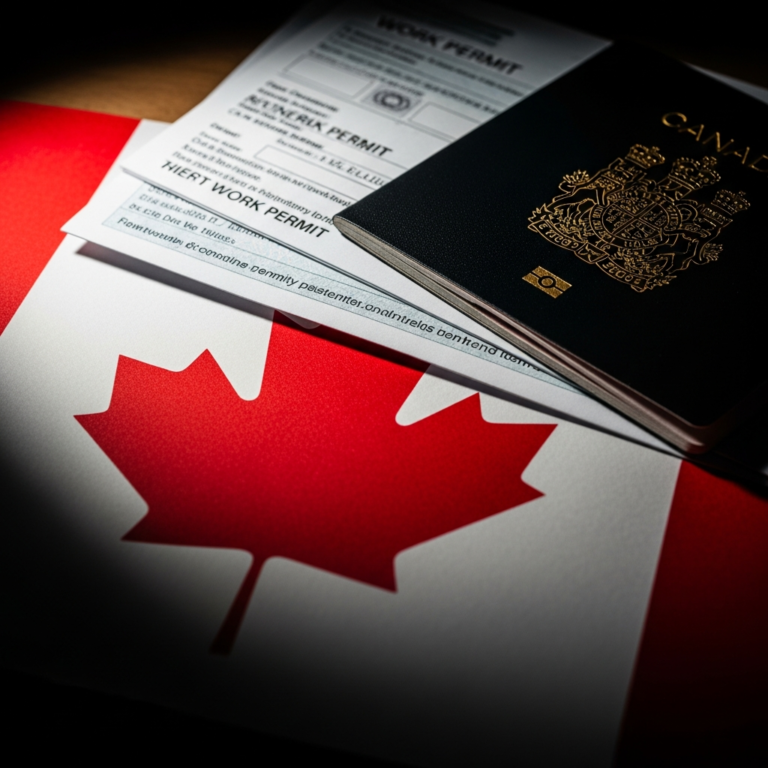
- If you are in Canada with a work permit, most private schools will let you apply for your child’s spot. You need to provide a copy of your work permit, your child’s birth certificate, and their past school records. The application process is usually simple, clear, and quick for work permit holders.
- If you are a parent on a study permit, the requirements are similar. You should bring your valid study permit and your letter of acceptance from the designated learning institution. Some schools may also want to confirm that you are studying full-time.
- If your family is in Canada with a visitor visa, the process is more challenging. Your child can join a short-term program (less than six months), but to enroll for a full school year, you must obtain a study permit and change your child’s status. The school’s application form will specify the required documents for the process.
Age Restrictions and Grade Placement
- Canadian private schools apply the same age rules to children of temporary residents as they do to children of citizens, placing students in grades based on age and previous learning, which typically aligns with the Canadian school year.
- For example, children who are five or six years old by the end of December usually start in Kindergarten, the first level of elementary school, and advance to the next grade each year; schools review past school records and may conduct extra assessments to determine the best grade placement.
- This process ensures that your child can smoothly integrate into the curriculum at both elementary and secondary school levels, supporting their learning and social experience.
Documents Required for Private School Admission
Getting the right paperwork ready is crucial for a successful application. While the list of required documents may seem lengthy, having everything prepared will make the process smoother. You need to provide proof of your child’s identity, such as a birth certificate or citizenship documentation from your home country. Additionally, your status in Canada is important, so include your work or study permit. Private schools are aware of the necessary documents, so ensure you have the right ones based on your visa type.
Checklist for Work Permit Holders
If you have a work permit, Canadian private schools must check your eligibility to work in Canada and confirm that your child can live with you. Preparing the required documents in advance can help speed up the admission process. Most private schools request similar documentation, but always verify the specific requirements of each school. Generally, you and your family will need to provide the following:
- A copy of your valid work permit.
- Your child’s passport and birth certificate.
- Paperwork showing guardianship or custody.
- School transcripts for your child from the last two years.
- Proof of vaccinations.
- The completed school application form.
Once submitted, the school will review these documents. If approved, your child may receive a letter of acceptance, securing their place at the school.
Checklist for Study Permit and Visitor Visa Families
For parents in Canada with a study permit, you must prove you are a full-time student at a Canadian school. If your family is in Canada on a visitor visa, the admission process changes, especially if your child plans to study for over six months. In this case, applying for a study permit for your child is necessary. Required documents include:
- A copy of the parent’s valid study permit or visitor visa
- The child’s passport and birth certificate
- The child’s immunization records and academic history
- Proof of funds for tuition and living costs
- Letter of acceptance from the private school
- Completed school application form
Always confirm with the school for a complete list.
Beginner’s Guide to Applying: What You Need to Get Started
Are you ready to start the application process? Picking the right school for your child is a big step. The private school admission process in Canada asks you to do research, fill out paperwork, and talk with schools that interest you.
First, think about what you want in a school. It could be special programs, where the school is, or the way they teach. When you know your main choices, you can get the papers you need for each application form. This guide will help you as you look for the right school and get your materials ready.
Researching Private Schools in Canada
- Start by researching private or independent schools in your preferred city or province. Make sure the school is recognized by the ministry of education, and if your child needs a study permit, confirm that the school is a designated learning institution.
- Consider the different types of independent schools, such as boarding schools (where students live on campus) and day schools (where students return home after classes). Think about your child’s needs and interests some schools excel in arts, some in STEM, and others may have a religious focus. Choose the one that best fits your child.
- Most schools accept applications for the following school year and open the process in the fall. Begin your research 6-12 months before your child’s intended start date to explore all options and avoid missing important deadlines.
Preparing Application Materials and Resources
After making your list of schools, start preparing your application materials. Each school will provide an application form and tell you which documents are required. Save time by collecting common papers early and keep paperwork for each school in separate folders to stay organized with deadlines. Check if you need to provide translated documents, especially if your child’s records aren’t in English or French. This shows schools your child’s academic strengths and your commitment.
- Copies of passports and visas for you and your child.
- Proof of citizenship like your child’s birth certificate.
- Official school transcripts from the last two or three years.
- Immunization records for your child.
- Any letters of recommendation, if a school asks for them.
- Proof of financial ability to pay tuition fees.
Step-by-Step Guide to Private School Admission for Temporary Residents
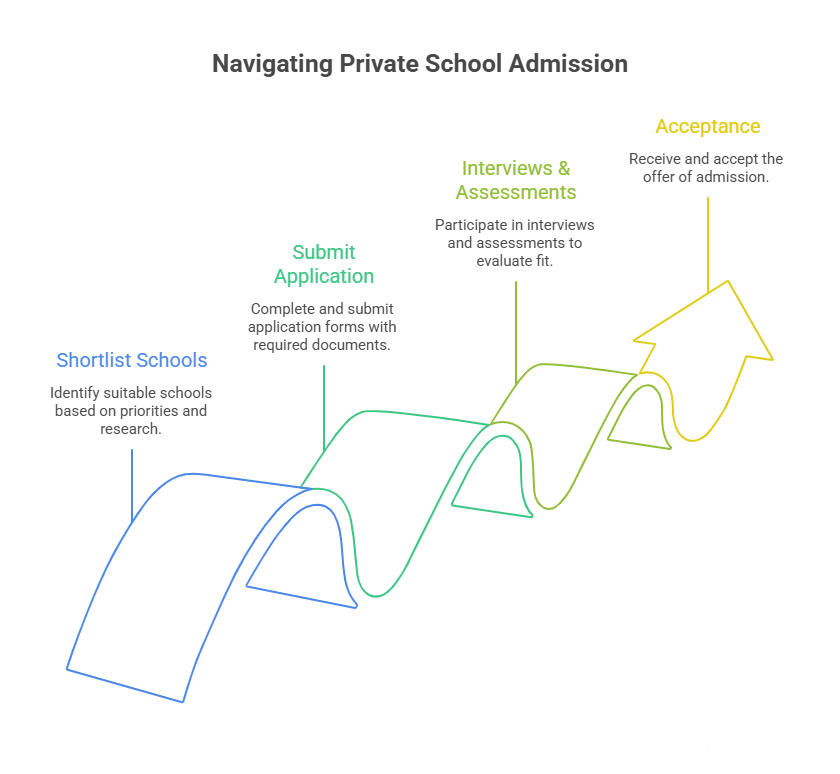
The application process for a private school is made up of a few clear steps. This easy guide will help you understand how to apply to a private school in Canada. If you follow these steps, you can help your child get started the right way.
Start with making a list of schools you like. Keep going, one step at a time, until you get to accepting an offer. Every step matters a lot. If you are a temporary resident, you need to keep up with all your important papers. This will be key for your child to go to school. Let’s go over each part of the process.
Step 1: Shortlisting Suitable Schools
Finding the right school is the first step in securing a good education for your child. Start by listing your family’s priorities, such as curriculum type, sports programs, or support for international students. Private schools have their own admission processes and do not select students based on where they live, but on fit with the school’s values.
- Location and Curriculum: Research schools nearby and compare their academic offerings.
- DLI Status: Ensure the school is a designated learning institution if a study permit is needed.
- School Culture: Explore school websites, read reviews, and attend virtual open houses.
Thorough research helps you choose the best fit.
Step 2: Submitting Applications and Required Documents
- After selecting your schools, complete and submit the application forms most schools now accept online applications for convenience. Always check and meet the application deadlines, as they are strictly enforced by popular schools.
- Upload all required documents with your application, including your child’s school records, proof of your legal status in Canada, and your child’s birth certificate. Providing accurate and complete documents is crucial to prevent delays.
- Once your application is received, the review process can take several weeks to months. If accepted, you’ll receive an official letter of acceptance, which is essential for applying for a study permit.
Step 3: Interviews, Assessments, and Acceptance
- Private schools often require interviews and assessments as part of the admissions process to understand your child beyond their grades; interviews may involve your child, parents, or the whole family and can be done online if you’re not local.
- Assessments help the school determine your child’s academic strengths and areas that may need support, sometimes through informal reviews of reading, writing, and math skills rather than formal tests, ensuring proper grade placement.
- After completing the interview and assessment, the school decides on admission; if accepted, you’ll receive an acceptance package, marking the completion of the application and confirming your child’s spot.
Tuition Fees and Additional Costs for Temporary Residents
One big difference between public and private education is the cost. Private school tuition fees can be high, so you need to plan your budget. For international students, these tuition fees in Canada are often more than what Canadian citizens or permanent residents pay.
The reason is that your children, as international students, do not get help from the money collected by provinces through tax. No matter if your child goes to a private high school or an elementary school program, you should know the whole cost. Now, let’s look at the different fee rules and see how they match up.
Understanding Fee Structures and Payment Options
Yes, temporary residents typically pay higher “international student fees,” which cover the full cost of education without government subsidies. Check the school’s fee schedule for all costs, not just tuition. Schools usually offer options to pay in full or in installments. Additional costs like uniforms, books, and activities are common. Always ask for a breakdown of fees. Here is an example of a typical fee structure:
| Fee Type | Estimated Cost (Annual) | Notes |
|---|---|---|
| Tuition Fee (International) | $15,000 – $30,000+ | Varies significantly by school and location. |
| Application Fee | $100 – $300 | One-time, non-refundable fee. |
| Uniforms | $500 – $1,000 | Can be a one-time or ongoing cost. |
| Books & Supplies | $300 – $800 | Depends on the grade and courses. |
| Extracurricular Activities | $200 – $2,000+ | Varies based on sports, clubs, or trips. |
Comparing Tuition Fees for Temporary Residents vs. Citizens
When considering private and public schools in Canada, cost is a major factor for temporary residents. Children of temporary residents with work or study permits can often attend public schools for free, depending on local rules and funding from area taxes. However, private schools require tuition from all families, with rates varying. Citizens and permanent residents pay lower “domestic” tuition, while temporary residents pay the higher “international” rate.
Key differences:
- Funding Source: Domestic tuition may be partly covered or lower; international tuition reflects full cost.
- Rate Difference: International fees are two to three times higher.
- Public School Alternative: Free public education remains an option.
Public vs. Private School Options for Temporary Residents
| Aspect | Public Schools | Private Schools |
|---|---|---|
| Funding | Funded by the government; usually free for temporary residents with work or study permits. | Funded through tuition and private sources; costs vary. |
| Enrollment Process | Simple; sign up at the local school board. | More complex; involves submitting academic records, interviews, and tests. |
| Location | Typically assigned to schools close to the residence. | No geographical restrictions; families can choose from various options. |
| Documentation Required | Proof of address and legal papers. | Records of academic performance and potentially interviews/tests. |
| Decision Authority | Limited; placement based on local school board. | Greater choice; families can select based on offers received. |
| Flexibility | Fewer options; primarily local public schools. | More options; can choose from various private institutions, including international schools. |
Discover why families choose private schools in Mississauga for exceptional education and personalized learning.
Visa-Related Considerations and School Enrollment
Your visa impacts your child’s ability to enroll in school. Families with temporary permits often seek permanent residency, frequently considering Express Entry. If your work falls under a specific National Occupational Classification, it may facilitate this process. While in Canada temporarily, ensure your stay remains legal, and your child has the necessary requirements for education, which may include a study permit. Understanding immigration rules is crucial for school admission.
Study Permits for Dependent Children
- Minor children of parents with a valid work or study permit in Canada usually do not need a separate study permit for elementary or secondary school, but exceptions exist depending on the parent’s permit and study program level.
- It is important to check the latest rules on the official Government of Canada website or consult with an expert, as requirements can change and may be complex based on individual circumstances.
- If a study permit is required for your child, you must apply and provide a letter of acceptance from the school plus proof of the parent’s valid work or study permit in Canada.
Can Children on Visitor Visas Attend Private School?
Yes, children on a visitor visa can attend private school in Canada, but only for programs that are six months or less, such as a single semester or a short course. Enrolling in longer programs with just a visitor visa is not allowed under immigration rules.
For a full school year, your child will need a study permit. First, get a letter of acceptance from a designated learning institution, then use it to apply for the permit while in Canada. If studying in Quebec, you must also obtain a Quebec acceptance certificate before applying for the study permit.
Support Programs and Services for International Students
Many Canadian private schools say they have a mix of people and cultures. These schools want international students and temporary residents to feel at home. They offer special programs and support. This is to help your child get used to a new school and a new country.
There are orientation programs that welcome new families. There is also language help for those who do not speak English as their first language. These services can really help. Some schools, like boarding schools, have staff just for helping international students. Getting consultation can help you pick a school with the support your child needs.
Orientation and Language Support
Yes, many private schools offer strong support for international students, starting with orientation programs for new students and families. These sessions help everyone understand the school, rules, and campus, making it easier to settle in. Language support is key, with ESL or FSL classes provided during or after school to help students succeed. Academic tutoring, homework clubs, and peer mentoring programs help new students connect and adjust. Workshops introduce Canadian culture and customs. Some schools have special summer programs to prepare students before classes begin.
- New student and family orientation sessions.
- Peer mentoring programs that match new students with current ones.
- ESL or FSL (French as a Second Language) classes.
- Academic tutoring and homework clubs.
- Workshops about Canadian culture and customs.
- Some schools even have special programs during the summer months to get students ready.
Consultation and Admission Assistance
Going through the application process alone can be challenging, especially for international families and temporary residents. USCA Academy offers personalized support to help you find the right school and complete your application smoothly. We understand the unique needs of families new to Canada and aim to make the process as simple and stress-free as possible.
- Personalized Consultation: We help you explore your options and choose the best school.
- Application Support: We assist with paperwork and meeting deadlines.
- Expert Guidance: Our team is experienced with private school applications for temporary residents.
- Seamless Transition: We support your child in adapting to a new school.
Contact USCA Academy today for guidance on private school admission in Canada.
Conclusion
It can be challenging to navigate private school admission for temporary residents in Canada. However, understanding the eligibility rules, required documents, and admission steps can simplify the process. Whether you’re on a work permit, study permit, or visitor visa, it’s essential to consider tuition fees and other costs when choosing between private and public schools. If you need assistance, our team is here to support you in ensuring your child receives the best education possible in Canada.
Frequently Asked Questions
1. Do temporary residents have to pay higher tuition fees for private school admission in Canada?
Yes, if you are a temporary resident, you usually pay higher tuition fees when you go to a private school in Canada. These are called “international student” fees. This is because local taxes do not help pay for your schooling. The tuition fees for temporary residents can be two to three times more than what Canadian students pay for private school.
2. Are there special programs or support for international or temporary resident students in Canadian private schools?
Most private schools have special programs for international students. They often give things like help with language, ESL classes, and orientation to get used to life in the new place. Boarding schools also do a lot for these students. They have people and programs ready to help new students from other countries fit in and do well.
3. Can temporary resident families apply to private schools before arriving in Canada?
Yes, you can apply before you get to Canada. In fact, you should start the process early. The admission process for private school in Canada can begin while you are still in your home country. It is important to get a letter of acceptance from the right school. Your child will need this letter to apply for a study permit before coming to Canada.