
Key Highlights of OSSD vs GCSE A-levels Canadian universities
- The Ontario Secondary School Diploma (OSSD) is a globally recognized high school qualification that opens doors to top Canadian universities.
- Unlike GCSE and A-Levels, the OSSD uses a balanced evaluation system, reducing exam stress for international students.
- Canadian universities view the OSSD as a direct equivalent to their own high school diplomas, simplifying the admission process.
- Students can fast-track their education and even upgrade marks from previous studies like GCSEs by choosing the OSSD pathway.
- The OSSD curriculum focuses on critical thinking and real-world skills, preparing you for success in higher education.
- The OSSD is a flexible option, allowing you to choose courses that align with your future academic goals.
Introduction
Are you a student from another country who wants to study in Canada? There are many high school and secondary school options out there. It can be hard to know how your GCSEs or A-Levels match up to what people have in Canada, especially when considering the OSSD vs GCSE A-levels Canadian universities. The good news is, this guide is here to help you. In it, we will look at the Ontario Secondary School Diploma (OSSD), which is well recognized and respected. We will also see how it compares to the system in the UK. Picking the right secondary school and high school qualification is the first thing that can help you get into a great Canadian university.
OSSD vs GCSE A-levels Canadian universities: Understanding Key Differences
When you want to study for higher education in Canada, you need to know how your qualifications are seen. There are key differences between the Ontario Secondary School Diploma (OSSD) and the UK’s GCSE and A-Levels. These things can really change how you apply. Canadian institutions have their own way to look at each education system.
If you know about these differences, you will be able to pick the best way to reach your academic goals. Here, we talk about what each qualification means and how Canadian universities check them. This should help you understand OSSD vs GCSE and OSSD vs A-Levels in Canada.
What Is OSSD, GCSE, and A-Levels?
The Ontario Secondary School Diploma (OSSD) is the main high school qualification in Ontario, Canada, requiring 30 credits, 40 hours of community service, and a literacy test. It’s recognized by universities in Canada, the U.S., the U.K., and Australia. The OSSD’s flexible, credit-based system lets students choose courses they enjoy.
In contrast, the UK’s General Certificate of Secondary Education (GCSE) is taken at age 16, followed by A-Levels, which are focused two-year courses in selected subjects. Both GCSEs and A-Levels are strong qualifications, but the OSSD’s flexibility appeals to students aiming for global university admission.
How Canadian Universities Evaluate Each Qualification
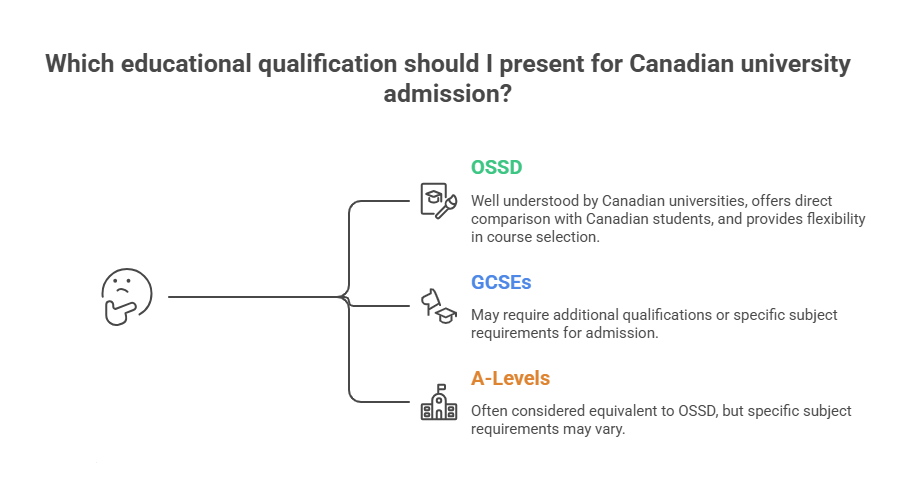
Canadian universities assess all applicants fairly, whether they hold an OSSD or A-Levels/GCSEs. When considering OSSD vs GCSE A-levels Canadian universities admissions, students with an OSSD are evaluated as domestic students, making the process straightforward since your grades align with Canadian standards. UK students applying with A-Levels are recognized for strong academics and can qualify for direct entry or transfer credits. GCSEs are usually considered only as prerequisites for A-Levels and are not sufficient alone for university admission. Admissions offices compare your qualifications to program prerequisites to ensure eligibility in the OSSD vs GCSE A-levels Canadian universities context.
| Qualification | How It’s Viewed by Canadian Universities |
|---|---|
| OSSD | Considered a direct equivalent to a Canadian high school diploma. Admissions are based on the top six Grade 12 U/M courses. |
| A-Levels | A-Levels are viewed as academically rigorous and often qualify students for direct first-year entry and sometimes transfer credits. |
| GCSEs | Generally seen as a prerequisite for A-Levels. They are considered but are not usually sufficient for direct university entry on their own. |
Admission Requirements: How Canadian Universities Evaluate OSSD, GCSE, and A-Levels
You need to know what is needed for admission before you apply to a university. Canadian universities tell you what is needed if you come from different education systems. If you have an OSSD, GCSEs, or A-Levels, they will look at your grades and the subjects you took. The schools want to see if you meet the requirements for the program you want.
When it comes to competitive programs, the needs are even more exact. Canadian universities want to see that you did well in the main subjects. This helps them understand if you are ready for higher education. Now, let’s look at what you need for top universities and how they check each qualification.
a-level equivalent ossd: What Counts for University Admission?
Many international students wonder if the OSSD is like the A-Level. For Canadian universities, the OSSD is the main standard for admission and is well understood by admissions teams. The OSSD pathway prepares you for university by evaluating both coursework and exams. Admission usually requires strong results in your top six Grade 12 University (U) or University/College (M) courses.
This system gives you many benefits:
- Direct Comparison: Your grades are matched with those of Canadian students.
- Flexibility: You can choose various courses to meet requirements.
- Reduced Exam Stress: Seventy percent of your grade comes from coursework.
uoft a-level requirements and Other Top Canadian Universities’ Criteria
Top Canadian universities like the University of Toronto (UofT), McGill, and the University of British Columbia accept students with A-Levels and recognize the rigor of the UK system. Each university and program may have slightly different requirements. For competitive programs such as engineering or business, you’ll need higher grades and specific A-Level subjects like Mathematics and Physics. Universities may also review your GCSE results to understand your academic background. In general, top Canadian universities look for:
- At least two or three A-Level subjects.
- Strong grades that are mostly from A* to B.
- Certain A-Level subjects required for your program.
- Proof of English language skills, if required.
- A completed secondary school diploma.
Are GCSEs Enough or Are A-Levels Needed for Canadian Admission?
Many UK students wonder if GCSEs alone are enough for admission to Canadian universities. Typically, GCSEs are not sufficient, as Canadian universities consider them equivalent to Grade 10 or 11 not a full high school completion. To qualify for admission, you generally need to complete A-Levels, which demonstrate advanced subject knowledge and university readiness. Most competitive Canadian programs require strong A-Level grades. While GCSE results are reviewed, they are seen as foundational, with A-Levels carrying the most weight in admission decisions. In summary, A-Levels are usually necessary for UK students applying to Canadian universities, while GCSEs alone are not enough.
Academic Advantages: Why Choose OSSD Over A-Levels or GCSEs?
When you are planning to go to a Canadian university, the OSSD offers some clear academic benefits over A-Levels or GCSEs. The OSSD fits well with the Canadian education system. It helps OSSD graduates move into higher education without trouble. With its global recognition and flexible course selection, you can work towards your academic goals in a way that suits you.
There are big benefits for international students too. You can finish your course faster and get a chance to improve your marks. Picking the OSSD can help you stand out when applying to university.
Fast-Track Pathways: Graduate Faster and Apply Sooner
One major advantage of the OSSD is its flexible, fast-track pathways. Unlike the strict structure of A-Levels, the OSSD lets you finish high school at your own pace. Ambitious students can take courses year-round, including summer, to earn their 30 credits faster. This flexibility allows you to graduate early and apply to universities ahead of others. Fast-track OSSD programs in Canada support your goals while maintaining quality education. This option is ideal for mature students or anyone eager to start university sooner.
Key benefits of fast-tracking include:
- Accelerated Graduation: Complete your diploma requirements in less time.
- Early University Application: Apply to universities a semester or even a year ahead.
- Personalized Pace: Study at a speed that matches your learning style and academic readiness.
gcse conversion ossd: Upgrading Marks and Transferring Credits
Did you not achieve the GCSE results you hoped for? The OSSD pathway offers a fresh start through GCSE conversion, allowing your previous studies to be assessed for possible credit transfer. Accredited schools like USCA Academy review your records and may grant you credits, reducing the number of courses you need to complete. If you wish to improve a subject mark, you can retake the course, with your grade based on coursework and a final exam. You’ll also receive guidance from certified Ontario teachers to help you succeed.
This OSSD pathway can help you:
- Transfer your credits from what you studied before.
- Get better marks in the subjects you need for your application to university.
- Build a stronger academic profile.
- Get good support to reach your goals.
Real-Life Success Stories of OSSD Students Entering Canadian Universities
The OSSD program is popular among international students aiming for Canadian universities. Many from India, China, and the UK find OSSD a helpful pathway, appreciating its focus on critical thinking and frequent progress checks. One UK student struggled with high-stakes exams back home but excelled in OSSD by completing class tasks and projects, eventually gaining admission to a top business program. These experiences highlight OSSD’s practical benefits.
Here are some common things students share:
- Students transfer credits from their country, saving time and money.
- Many achieve better grades in core subjects, strengthening their applications.
- Graduates feel prepared for independent university learning.
Application Process: OUAC, Documentation, and Next Steps for International Students
Going through the university application process can feel hard at first. But when you have good information, it gets much easier. If you are an international student applying with an OSSD, the steps are more simple. Most people send their applications to Ontario universities by using a main system. This means you can apply to more than one school at the same time.
It is important to know how this system works. You also need to know what documents to send and when to send them. Keep track of all deadlines. Follow these steps to make your path into higher education in Canada easier and more successful, especially for international students.
Role of the Ontario Universities’ Application Centre (OUAC)
The Ontario Universities’ Application Centre (OUAC) is the central portal for applying to undergraduate programs at Ontario universities. If you’re an Ontario high school student, you’ll use the OUAC 101 application, designed to make the process straightforward. Schools like USCA Academy provide you with a PIN to access the application. Your school submits your grades directly through the OUAC portal, ensuring accuracy and saving you from having to send transcripts yourself.
Key things that the OUAC does include:
- Gives you one online application for all the universities in Ontario.
- Sends your grades and other academic info to the universities you pick.
- Takes care of application fees and sends you a confirmation.
Required Documents and Important Deadlines for Applicants
Staying organized with your documents and being aware of deadlines is essential for a smooth application process, especially for international students. The documents you need may vary depending on your high school background and the universities you apply to, but most schools require the same basics. You must submit official transcripts, and if they’re not in English, certified translations are necessary. Always track deadlines, as late applications are usually not considered the OUAC 101 deadline for fall is typically mid-January.
Make sure to have these things ready:
- Official transcripts from each secondary (high school) or post-secondary institution.
- Proof of English proficiency (IELTS or TOEFL), if required.
- Copy of your passport or study permit.
- Supplementary forms or essays requested by specific programs.
- Payment for the application fee.
Tips for a Smooth Application from the UK, India, and Other Countries
Applying to Canadian universities from the UK, India, or other countries can seem challenging, but with early planning, it becomes manageable. Start by researching universities to understand their specific requirements. Check how your credentials, like A-Levels or national diplomas, are evaluated by each institution. This helps you know what grades you need.
To streamline your application, follow these steps:
- Start checking out schools at least a year before you want to go.
- Make a calendar with all the important dates marked.
- Reach out to the university admissions if you have any questions.
- Make sure your documents are checked and translated if needed.
- If you’re working on your OSSD, talk to your guidance counselor at a top place like USCA Academy. They can help you meet all the requirements.
Special Considerations: Credit Transfer, Bridging Programs, and Upgrading Options
Many international students may need to follow a different path to enter a Canadian university. The Canadian education system has many choices that can help you move into higher education. For example, you might get credit for what you have studied before. Or you may have to join a bridging program so you meet the school’s admission rules.
You should know how credit transfer works and find out about any foundation or bridging programs that are offered. This can give you new ways to get into university. These steps help students who come from different places and have different study backgrounds when they are starting higher education in Canada.
How Credit Transfer Works Between GCSE/A-Levels and OSSD
If you have completed your GCSEs or A-Levels, you might use those credits toward your OSSD through Prior Learning Assessment and Recognition (PLAR). An Ontario school will review your transcripts and possibly award equivalent credits, helping you finish your OSSD faster. GCSEs usually count for earlier-level credits, while A-Levels may be recognized for higher-level courses. The credit transfer process involves:
- Sending in your official transcripts from your previous school.
- The Ontario school reviews your coursework and decides what matches their requirements.
- You receive a personalized plan outlining which credits you still need for your OSSD.
Popular Bridging and Foundation Programs for International Students
If you do not meet the direct entry requirements for a Canadian university, many schools offer bridging or foundation programs designed for international students. These programs help you develop important academic and language skills needed for degree studies. They typically last from a few months to a year, combining academic courses with language support. Successful completion often leads to guaranteed entry into an undergraduate program at the same institution. This is a great way to improve academic readiness and adjust to the Canadian education system.
Popular ways for international students to join include:
- University foundation programs.
- English for Academic Purposes (EAP) programs.
- Pre-sessional math and science courses.
- The OSSD program itself, which is a strong path to prepare for university.
Benefits of OSSD for International Students in Canada
The Ontario Secondary School Diploma (OSSD) offers several advantages for international students pursuing education in Canada:
- Recognized globally, the OSSD facilitates smooth transitions into higher education.
- The curriculum emphasizes critical thinking, research, and independent learning, preparing students for university life.
- Grading is based on 70% coursework and 30% final exams, reducing stress and allowing for a more accurate assessment of student capabilities.
- OSSD graduates are viewed on par with local students during university applications, enhancing their chances of acceptance into top programs.
Choosing a reputable school like USCA Academy can maximize these benefits.
Conclusion
To sum up, picking the right school path can really change how you get into Canadian universities. Both OSSD and GCSE/A-Levels are good, but when considering OSSD vs GCSE A-levels Canadian universities, the OSSD has more benefits, especially for international students. It has flexible ways to improve your grades and move your credits. The OSSD helps get you ready for university and raises your chances to get in. When you decide, think about how the OSSD’s setup and help can match your academic goals. If you want to take the next step, reach out to us. We will give you advice and support that fits your goals.
Frequently Asked Questions
1. Is the OSSD accepted as an A-Level equivalent for Canadian universities?
Yes, but it is better to say the OSSD is the local high school standard. Canadian universities take the OSSD as the main high school diploma you need for getting in, so it is a direct way to these schools. Even though A-Levels are known to be tough, the OSSD works best with the evaluation methods used by canadian universities.
2. How do Canadian universities convert and recognize GCSE and A-Level results?
Canadian universities look at your A-Level results by checking what subjects you took and the grades you got. They often need you to have taken two or three subjects to let you in. GCSEs are seen as basic and are not enough by themselves to let you get in right away. Each canadian university has its own way to change your grades to their system and has its own rules for who they will admit.
3. Where can students find official guidelines on OSSD, GCSE, and A-Level equivalency for admissions?
The best spot to find the official rules is on the admissions websites of the Canadian universities you want to look at. You can also go to the Ontario Universities’ Application Centre (OUAC) if you need general info. If you want help that fits you, it’s a good idea to talk to an academic advisor at a school like USCA Academy.