
Key Highlights
- Ontario academic credits are the steps you need to take to get your high school diploma.
- The old fifth-year, also called Grade 13 (OAC), was replaced in 2003 by the four-year high school system we use now.
- To finish high school, students must have 30 credits. You need to get 18 required credits and 12 elective ones, following the Ministry of Education diploma requirements.
- You can get, move, or raise credits through public, private, and online Ontario schools.
- Credit upgrade in Ontario schools helps you have better grades when you apply to college or university.
Introduction
Finishing high school in Ontario might look hard at first, but the main thing you need to know is about credits. Credits are what you use to finish your fifth year of secondary education. These credits also help you reach your future plans in school and work. If you are a student who wants to choose courses, a parent helping your child, or someone new to Ontario schools, this guide helps you learn about high school credits. It shows you how to get, improve, and handle your credits so you can reach graduation.
Understanding Ontario Academic Credits
“Ontario academic credits” can mean two things. It can be the credits you get now, or an old system that was used before in Ontario, specifically before the formal elimination of the Ontario Academic Credit. A credit is when you finish a high school course that the ministry of education approves. You get recognition for that work.
If you know about the history of high school credits, it will help you see why the system is the way it is today. There was even a year called Ontario Academic Credit year, or OAC, which was part of the changes announced by Premier Mike Harris. By knowing its story, you understand the changes that led to the system high school uses now. Let’s look at what academic credit means for you and see how high school credits changed over time.
What Are Ontario Academic Credits and Their Purpose
In the Ontario education system, an academic credit is given to a student who finishes a 110-hour course. Think of it as one of the building blocks of your high school years of high school. Every credit helps you get closer to earning your Ontario Secondary School Diploma. The school uses them to keep track of your progress toward that diploma.
The Ministry of Education in the province of Ontario checks and controls these high school credits. This helps keep the quality and what you learn the same at every school. It doesn’t matter if you are at a public, Catholic, or private school. Because of this, if you earn a credit at one school, it counts at another without any issue.
In the end, high school credits in Ontario are for more than just your diploma. They show the skills and knowledge you pick up along the way. The credits you choose also affect which college or university programs you can apply to later, so they play a big role when planning your next steps after school, especially as a result of the double cohort.
Changes from OAC Ontario Grade 13 to Today’s System
For many years, the high school system in Ontario had five years of secondary education. The fifth year was called Grade 13 or the Ontario Academic Credit (OAC) year. This extra year of secondary education was for students who wanted to go to university. It had special courses you needed for university admission.
But later, the education system changed. The OAC year was taken away, and the last students in it graduated in 2003. This move made Ontario’s four-year high school model match the rest of North America. When this happened, it created something called the “double cohort.” That’s when students from the five-year system, including those who decided to take an extra year of high school, and four-year systems finished at the same time.
Now, the advanced lessons from old OAC courses are part of the Grade 11 and 12 curriculum. Instead of doing a fifth year, students finish and get their OSSD in four years. They do this by earning 30 academic credits, which prepares them for college, the university of their choice, or to go right into work.
Diploma Requirements in Ontario High Schools
Getting an Ontario Secondary School Diploma (OSSD) is a big step in your life. The diploma requirements are meant to help you have a good education, facilitating the completion of schooling so you are ready for what comes next. The secondary school system in Ontario works with credits that you must earn as a student.
To finish and get your secondary school honours graduation diploma, you need to earn a set number of required and extra credits. You also have to pass a literacy test and do community involvement hours. The credit system gives you a strong start in important classes and lets you try out your own interests too.
Mandatory Credits and Elective Choices for Graduation
The path to graduation requires earning 30 credits in total. Of these, 18 are mandatory credits, ensuring you have essential skills in key subject areas. These compulsory courses cover subjects that are fundamental to your learning and future success. The remaining 12 are elective credits, which you can choose based on your interests and career goals.
These elective choices allow you to explore subjects like technology, the arts, or business, and they can also be used to take the necessary prerequisite courses for specific university or college programs, including those that may have been established following the last OAC. This blend of mandatory and elective OSSD credits gives you a balanced high school education.
Here are some of the mandatory credits you need:
| Mandatory Credits | Number of Credits |
|---|---|
| English | 4 (1 per grade) |
| Mathematics | 3 |
| Science | 2 |
| Canadian History | 1 |
| Canadian Geography | 1 |
| The Arts | 1 |
| Health & Phys. Ed. | 1 |
| French as a Second Language | 1 |
| Civics and Career Studies | 1 (0.5 credit each) |
How OAC Ontario Shaped University Admissions
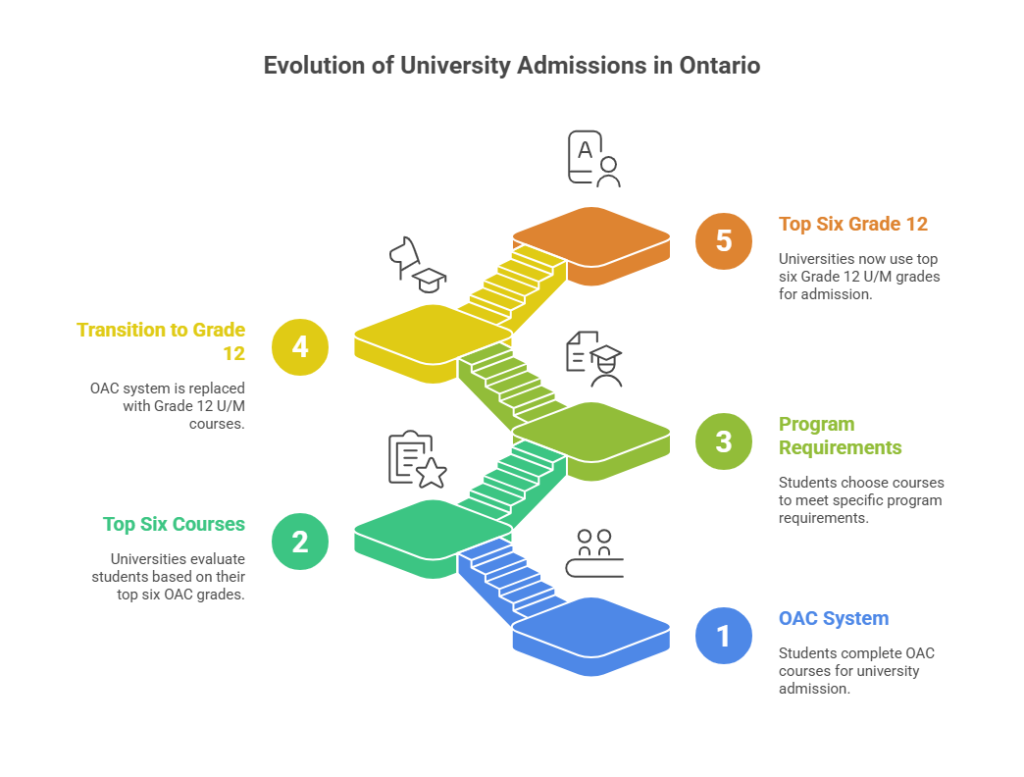
In the past, the OAC Ontario system had a big role in getting into university. Students had to finish their final year of high school and take OAC courses. Universities would look at grades from your top six OAC level courses. They would use these grades to make an average. This average was the main thing they used to decide if you got in.
Each program at Ontario universities wanted students to have certain OAC courses, as these were considered the highest level courses. For example, a science program might need OAC Calculus, Chemistry, and Physics. A humanities program would need OAC English. Because of this, students had to think hard about which OAC courses to take to meet competitive admission standards for the program they wanted.
Later, the OAC year and Grade 13 ended for high school in the United States. Now, universities look at your top six Grade 12 U (University) or M (University/College) level courses instead. The idea of using the “top-six” grades is still there. But now it’s part of the four-year high school plan.
Earning and Upgrading Ontario Academic Credits
Your path in high school is different from others. Sometimes you need options that fit your needs and help you reach your goals. The Ontario education system has a few ways you can earn high school credits, including what some students refer to as the victory lap. These choices let you catch up, stay ahead, or try for better grades. There is a way for everyone to get what they want in high school.
Some students get credits from regular Ontario schools. But there are good other ways to earn credits too. If someone wants to get a better mark for college or university, credit upgrade in Ontario schools is a common and smart choice. Let’s talk about the ways you can earn and upgrade high school credits in the Ontario education system.
Approved Pathways: Public, Private, and Online Learning (including USCA Academy)
The Ontario Ministry of Education lets students get OSSD credits in many ways, including during their fifth year of high school. This helps every student choose a way to learn that fits them the best. You are not tied to one kind of high school to finish your education.
Many people pick a private school because the classes are smaller and you get more of the teacher’s time. USCA Academy is a trusted place that has courses approved by the Ministry of Education. You can use these courses to get new high school credits or to raise your grades. This is one of the best international schools, and students come to it from all over the world. Online high school Ontario is also a top choice for getting high school credits if you need a plan that is more open.
Online high school Ontario providers, including both public and private options, as well as programs for first grade students.
- Public and Catholic school boards
- In-person private high schools like USCA Academy
- Online high school Ontario providers, both public and private
- Summer school and night school programs
Credit Transfer, Recovery, and International Student Options
The Ontario education system can fit the needs of students who have special situations. If you move to Ontario from another province or another country, you might be able to transfer your current credits, potentially impacting your days of schooling. The school boards will check your old education to see how many of your past credits count toward your OSSD credits.
There is something called credit recovery Ontario for students who did not pass a course. It lets you retake the course and get the credit without needing to repeat everything from the start. There are also credit upgrades and credit upgrade Ontario options, where students can take a class again that they have already passed. This can help you get a better grade, which is good for university applications.
For international students from other countries, getting Ontario credits is the best way to get into Canadian universities. Many schools have programs that help international students learn the Ontario education system and finish the international students Ontario credits they need.
- Credit Transfer: Get credit for classes you did before you came to Ontario.
- Credit Recovery: Another way to get a credit for a course you did not pass in the past.
- Credit Upgrade: Take a class again to get a higher grade.
- International Student Programs: Extra help for students from outside Canada to earn OSSD credits.
Conclusion
To sum up, it is important to know about how Ontario academic credits work, especially regarding your fifth year of secondary school education. This can make a big difference in your learning journey. You might be getting, upgrading, or moving your credits. The key is to know the many paths you can take, which includes studying at good places like USCA Academy. When you make sure you follow all diploma requirements and pick your courses wisely, you make it easier for yourself to finish school and open up chances for your future. Taking control of your own learning helps you reach your goals. If you have questions or want help, contact us. We will be with you at every step.
Frequently Asked Questions
1. Are there online resources or courses available for earning or upgrading Ontario Academic Credits?
Yes, you can do this. Many Ministry-inspected schools have courses through online high school Ontario platforms. This makes it easy to do a credit upgrade in Ontario or get new high school credits when you need more time. Some private schools, like USCA Academy, also give full online learning choices for Ontario high school credits.
2. What are Ontario Academic Credits and how do they impact my education?
Ontario academic credits show that you have finished a high school course. These are the units that build up to your high school diploma. The different credit values can affect the credits you get, which will matter for your graduation and can affect if you can get into post-secondary programs at Ontario schools. These credits help shape your education path.
3. Are there specific requirements or prerequisites for earning or upgrading these credits?
Yes. Many higher-level classes ask you to finish the necessary prerequisite courses from earlier grades first. If you want to recover credit or improve your marks, you just need to have taken the class before. Always check the diploma requirements and your course list to be sure you are moving in the right way.