

Key Highlights of IELTS vs TOEFL in Canada
- Both IELTS and TOEFL are used by many Canadian universities for getting in.
- For getting into Canada through immigration, like Express Entry, they only take the IELTS exam. TOEFL is not used for this.
- The IELTS exam lets you talk to someone face-to-face in the speaking part. With TOEFL, you use a microphone.
- IELTS also lets the person do a “One Skill Retake,” if they want. You can’t do this in TOEFL iBT.
- The test you choose really depends on what you need. Ask if it is for studying, coming to Canada, or maybe both.
- Knowing the difference between these english language tests will help the person make an informed decision about which english proficiency test is good for them.
Introduction
Are you considering moving to Canada for studies or a new life? One vital requirement is demonstrating your English language proficiency. The two primary exams you’ll encounter are the IELTS and TOEFL. Choosing between them can be challenging. This guide explores the differences between IELTS vs TOEFL in Canada, including test formats, university acceptance, and immigration requirements. Understanding these factors will help you determine which English language exam best suits your needs for a successful transition to Canada.
IELTS vs TOEFL in Canada: Detailed Comparison Table
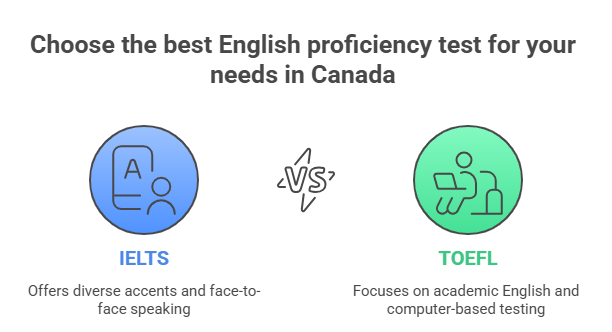
When you’re deciding between language proficiency tests, seeing the differences side-by-side can be incredibly helpful. The IELTS exam and the TOEFL iBT are both designed to assess your English skills, but they do so in distinct ways. From the way you speak to an examiner to the total test time, these details can influence which test is a better fit for you. Test takers often find that one format aligns more closely with their personal strengths and comfort level.
Understanding these core differences is the first step toward choosing the test that will best showcase your language ability to academic institutions. Below is a simple breakdown of the main features of each English language test.
| Factor | IELTS | TOEFL | Best For / Notes |
|---|---|---|---|
| Test Versions | Academic & General Training | iBT (Internet-based Test) | IELTS Academic for universities; General for immigration |
| Acceptance in Canada | Accepted by all universities & IRCC (General for PR) | Accepted by universities, not valid for PR | Immigration requires IELTS General |
| Test Format | Paper-based or Computer-based | Fully computer-based | Both accepted for universities |
| Sections | Listening, Reading, Writing, Speaking | Listening, Reading, Writing, Speaking | Similar coverage; slight format differences |
| Speaking Section | Face-to-face with examiner | Computer-recorded responses | IELTS mimics real conversation; TOEFL is on mic |
| Reading Section | Academic texts & General passages | Academic/Integrated passages | TOEFL more academic-heavy; IELTS uses diverse passages |
| Listening Section | British, Australian, Canadian, American accents | Mainly American accents | IELTS better for multi-accent exposure |
| Writing Section | Essays, graphs/charts (Academic), letters (General) | Integrated tasks: essay + reading/listening input | TOEFL requires synthesis of reading/listening |
| Scoring System | Band 0–9 | 0–120 points | Universities may convert scores to equivalent bands |
| Test Duration | ~2 hours 45 minutes | ~3 hours | TOEFL slightly longer |
| Availability / Test Centres | Widely available in Canada & worldwide | Widely available | Both have multiple dates and centres |
| Cost | CAD 250–330 | CAD 300–350 | Varies by location |
| Result Delivery | 13 days (paper) / 5–7 days (computer) | 6–10 days | TOEFL slightly faster for computer-based |
| Score Validity | 2 years | 2 years | Both have same validity |
| Preparation & Difficulty | Practical English, variety of accents, face-to-face speaking | Academic & formal English, computer-based | Depends on test-taker style |
Which Exam is Preferred by Canadian Universities?
The great news is that almost all Canadian institutions take both the IELTS Academic and TOEFL tests when it comes to english language skills for academic purposes. There is not a clear choice for one test over the other, so you can pick the one you feel is better for you. Most universities and colleges set their own minimum english language requirements for both. That means you get to decide which one suits you best.
But you should always look at the english language requirements on the admissions pages of the schools you are thinking about. Some programs may need higher IELTS band scores, or have different cut-offs for TOEFL. Because of this, it is good to check all rules before you apply. Let’s look at which canadian institutions accept both tests, and see which test could be a better fit for your goals.
Universities Accepting Both IELTS and TOEFL
The vast majority of Canadian universities be open to international students. You can apply with either IELTS or TOEFL scores for their english language requirements. Top schools in the country also put both of these english proficiency tests on their admissions lists. This helps you apply to more than one canadian university or college without having to think about other english proficiency tests.
Here are typical minimum scores you will need for different programs in Canada. You can earn them from either the IELTS or the TOEFL:
- Bachelor’s Degree: IELTS 6.5 (with each band at least 6.0) or TOEFL 84 (with each skill at least 21).
- Post-Graduate Certificate: IELTS 6.5 (with each band at least 6.0) or TOEFL 88 (with each skill at least 22).
- Master’s Degree: IELTS 6.5 (with each band at least 6.0) or TOEFL 88 (with each skill at least 22).
If you meet the minimum score for your chosen program at a canadian university, either test will be enough for the english language requirements. This lets you pick the test format that works the best for you.
When TOEFL Might Be Preferred
Although most people find IELTS to be more flexible for Canada, there are times when you might want to pick the TOEFL iBT. The decision usually depends on what you like and how you feel when taking tests. If you want a test that is fully on the computer, the TOEFL could be the best choice for you.
Some test takers like the way the TOEFL exam is set up because:
- Speaking Test Format: If talking with a person during the speaking test makes you nervous, you might like speaking into a microphone by yourself more.
- Computer-Based Focus: The TOEFL exam is always done on the computer. There is no paper option. Some people find this steady setup works better for them.
- North American Focus: If you want to study only in the U.S. and Canada, you may know the TOEFL format more. This is common in these places.
Saying the IELTS or the TOEFL is easier really depends on you. It is best to try practice questions from both to see which one feels right for you.
Which Exam is Accepted for Canadian Immigration?
When you look at the IELTS vs TOEFL Canada immigration question, you will see the answer is simple. Immigration, Refugees and Citizenship Canada (IRCC) accepts the IELTS General Training test for every economic immigration stream. This can be for things like the Express Entry system. There is now the PTE Core test as well. But the TOEFL exam is not accepted in any Canadian immigration programs.
This is something you cannot change. The rules say if you want to apply for permanent residency through programs like the Federal Skilled Worker Program, Canadian Experience Class, or Federal Skilled Trades Program, then you need the IELTS General Training test or a different approved language test. The TOEFL exam is not accepted for any Canadian immigration application, so for canadian immigration, IELTS really is the only choice. Keep this in mind if you want to become a permanent resident. Now, let’s look more closely at why this is true.
Why IRCC Only Accepts IELTS General Training
You might ask why IRCC only accepts certain english tests. The main reason is that the IELTS General Training test checks how well you can use english in real-life situations. It looks at how you speak and write at work or in daily life in Canada. This test does not ask you for complex academic writing. It cares more about how you talk with people every day. This is very important because the main goal of canada’s immigration programs is to choose people who can fit in and work well in life here.
Also, IELTS has built a good name with immigration groups around the world. The ielts score you get in this general training test is clearly connected to the canadian language benchmarks, or CLB. IRCC uses these benchmarks to check the language ability of all immigrants. For instance, if you want to apply to the federal skilled worker program, you need to reach at least CLB 7. This means you need a 6.0 ielts score in reading, listening, speaking, and writing.
Because there is a clear link between the test and the CLB, and since it checks english you use every day, IELTS General Training is seen as a top and trusted choice for canadian immigration. Many people call it the best english test for canada if you want to get permanent residency.
How to Decide Which Exam is Right for You
Choosing between these two big english proficiency exams does not have to be hard. The right one is different for each person. You need to think about your own goals and what is happening in your life right now. If you want to make an informed decision, start by asking yourself two simple questions. What is my main reason for going to Canada? What test setting helps me do my best?
Your answers can help you pick the exam that is best for you. Think about your main goal. Is it study, immigration, or maybe both? Also, think about how you take tests. This will help you choose the test that works for you. Let’s look closer at these points to help you decide.
Based on Goal: Study, Immigration, or Both
Your main reason for being in Canada is very important and will help you decide what to do next. Do you want to be an international student, or do you want to try for permanent residency? Think about your own goal. This makes it easier to know what your next step should be.
Here’s an easy guide to help you pick the right test for your goal:
- For Studying Only: If your main reason is to study at a Canadian university, you can take either IELTS Academic or TOEFL. Both work well. Look at your school’s requirements and pick the test you feel best about.
- For Immigration Only: If you want to apply for permanent residency through Express Entry, you need the IELTS General Training test. TOEFL will not work for this. Only IELTS general training is accepted for immigration.
- For Both Study and Immigration: IELTS is your best bet. You should take IELTS Academic for going to university, then IELTS General Training if you apply for immigration. Doing both means you will know the format well and that will help you.
Take some time now. Think about which choice matches what you want for your time in Canada.
Based on Test-Taking Style & Accessibility
Your goals are important, but the way you like to take a test also matters a lot. Some people do better with certain kinds of tests, but feel more nervous in others. Both IELTS and TOEFL are hard and both are a test of English, so picking the one that makes you feel less stressed is a good idea. Getting ready for these tests will help you do well, and places like USCA Academy have courses made to fit what you need for your exam.
Think about these things when you look at how you take tests:
- Speaking Section: Do you want to talk with a real person, like you do in IELTS, or do you feel better speaking into a computer, which happens in TOEFL?
- Test Environment: IELTS lets you pick between doing the test on paper or on a computer. TOEFL is only done on a computer, as it’s a computer-based Test of English.
- Retake Policy: With IELTS, you get an option called “One Skill Retake.” It lets you only redo one part of the test if you want a better score. With TOEFL, you need to take the whole test again to get a new score.
Conclusion
To sum up, knowing the small differences between IELTS vs TOEFL in Canada is important for making an informed decision that fits your own goals. If you want higher education or plan to move for Canadian immigration, know that each test has its own good and bad sides. Look at how much universities accept each one, how they score, and what Canadian immigration rules ask for. This will help you pick the exam that matches what you want. A good, strong preparation is key to doing well, and resources like USCA Academy can be a big help in this. If you have questions or need help regarding IELTS vs TOEFL in Canada, reach out and get in touch!
Frequently Asked Questions
1. How do Canadian employers view IELTS vs TOEFL scores for work permits?
For work permits connected to immigration programs, employers will see that the main english test needed is usually IELTS. When it comes to other jobs, both tests can show your english proficiency. But, since IRCC asks for IELTS for people wanting permanent residency, this english test is often the one people know best in the Canadian job world.
2. Is there a difference in score reporting format for universities vs immigration?
Yes, there is a big difference here. Universities use your test scores directly. They accept your IELTS score as band scores or accept your TOEFL points as they are. But for immigration, things are not the same. Your IELTS score is changed into a Canadian Language Benchmark (CLB) level. This level is used to give points in systems like Express Entry.
3. Which test is more recognized for professional programs in Canada (MBA, Engineering, Nursing)?
Both of these tests are well-known and accepted by many professional programs, including MBA, engineering, and nursing. But you should always look at what the school and the local licensing board want. Since the rules for getting a license often link to pathways for immigration, the IELTS is often needed.
4. Are there differences in retake policies between IELTS and TOEFL in Canada?
Yes, this is a big difference. IELTS lets test takers do a One Skill Retake. This means you can try again in one part, like Reading, Writing, Speaking, or Listening, to get a better score. With the TOEFL iBT, if you want better marks in one part, you have to take the whole exam again.
5. Can I switch from IELTS to TOEFL or vice versa for Canada admissions?
Yes, you can do this. If your university accepts both english proficiency tests, you can send a score from either one. Make sure the score you give fits their minimum test of english needs. Also, send it before you reach the deadline. You get to pick which test of english you want to deliver.