Key Highlights: How Many Credits to Graduate High School
Here is a short overview of what you need to do to get your Ontario Secondary School Diploma (OSSD):
- You have to earn a total of 30 high school credits if you want to graduate.
- The high school credit breakdown is made up of 18 compulsory credits and 12 optional credits.
- You must finish the literacy graduation requirement for the province.
- You need to complete 40 hours of community involvement activities.
- You will also need to get two online learning credits as part of the graduation requirement.
- Starting in 2026, students must also meet the new financial literacy requirement in Grade 10 mathematics.
Introduction
Finishing high school is a big step in your learning. In Ontario, every student works to get the Ontario Secondary School Diploma (OSSD), which has an online learning graduation requirement that mandates understanding how many credits to graduate high school. This diploma helps you move on to more school after high school and can open up job chances. The Ontario Ministry of Education makes rules to help you get a good all-round learning in secondary school. This guide shows you what to do, so you can cross the graduation stage and get your high school diploma. From 2026 onward, Ontario also includes a financial literacy check within Grade 10 math as part of graduation rules.
How Many Credits to Graduate High School in Ontario?
To finish high school and get your Ontario Secondary School Diploma (OSSD), you have to earn 30 Ontario high school credits. The number of credits is a big part of high school. These credits are split into two groups. Some are compulsory credits that you must take, and some are optional credits that you get to pick based on what you like.
If you started Grade 9 in 2023 or before, you need to get 18 compulsory credits and 12 optional credits. For those starting Grade 9 in the fall of 2024 or after, the ossd credit requirements change a bit, with 17 compulsory credits and 13 optional credits. Knowing this high school credit breakdown is important. It helps you plan your path and make sure you have all you need for your diploma in the ontario secondary school.
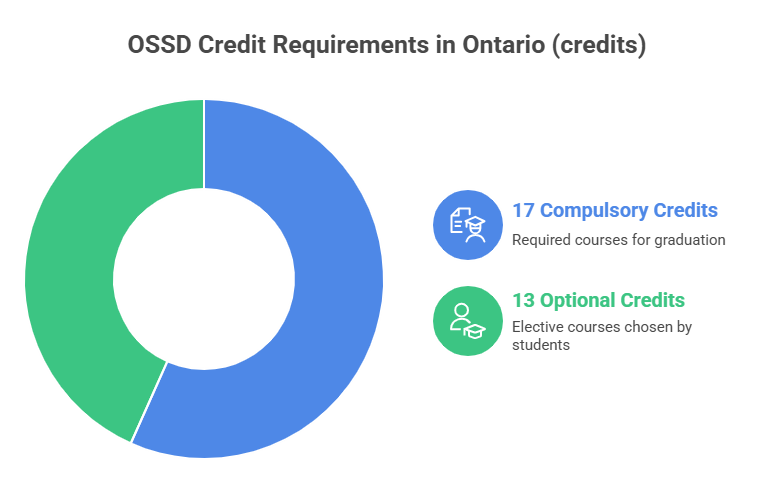
Overview of Ontario Secondary School Diploma (OSSD) Requirements
- To earn your Ontario Secondary School Diploma (OSSD), you need to complete 30 credits, which include both compulsory and optional credits.
- You must also finish 40 hours of community involvement, allowing you to participate in your community and learn new things.
- Finally, you need to meet the provincial literacy requirement to graduate; for details on which courses you can take, check your school’s course calendar.
Why Credit Requirements Matter for Students and Parents
Knowing about the credit requirements including Canadian and world studies is key to doing well in school. These rules are not just a list you need to check off. They help you get a good mix of skills and let you learn about what you like.
Compulsory credits make sure you learn main things like English, including a compulsory English course, math, and science. Optional credits let you try new things and find out what you enjoy or what job could be right for you. This way, you can shape your own learning to fit your needs.
It is important to meet these needs. When you want to get into college or another school’s program, they often ask for certain entrance requirements and courses. The ones you pick for your credits can change if you get into the school you want. Planning what you take keeps doors open for your future.
Compulsory Credits Needed for OSSD Graduation
A big part of your high school years is given to compulsory credits, including computer studies. These are the classes all students in Ontario have to pass to meet the graduation requirement set by the province. The compulsory credit rule helps make sure that every student leaves school with a strong base of knowledge and skills. These credits include core subjects, such as your English and mathematics course, Canadian history, and science. This prepares you for what’s ahead. Here’s what subjects you need to study.
Subjects Covered
The compulsory credits cover many subjects, including the Inuit Voices course, so you get a good mix in your education. The number of credits you need to get can change based on when you started Grade 9, but the core subjects stay the same. When you take these courses, you build important skills in reading, math, and thinking.
If you started Grade 9 before fall 2024, there is a set list of subjects. These areas are important for your learning and are part of the new requirement for compulsory credits.
These subjects include:
- English
- Mathematics
- Science
- Canadian History and Canadian Geography
- The Arts
- Health and Physical Education
- French as a Second Language
- Career Studies and Civics
If you start Grade 9 in fall 2024 or after, you must also take a class in technological education. This gets you ready for the way the world is changing with new technology.
Minimum Number of Compulsory Credits
For students starting high school in 2023 or earlier, you must earn 18 OSSD compulsory credits to graduate with the Ontario Secondary School Diploma (OSSD). These credits are distributed across key subjects, including one English credit per grade. You’ll also need credits in mathematics, science, Canadian history, Canadian geography, the arts, health and physical education, French, career studies, and civics. In addition, you must complete one credit from each of three groups covering social sciences, business studies, and additional languages. This structure ensures a strong academic foundation. Below is a summary of the compulsory credit requirements:
| Subject | Credits Required |
|---|---|
| French as a Second Language for english language learners | 1 |
| Mathematics | 3 |
| Science | 2 |
| Canadian History | 1 |
| Canadian Geography | 1 |
| The Arts | 1 |
| Health and Physical Education | 1 |
| French as a Second Language for english language learners | 1 |
| Career Studies | 0.5 |
| Civics and Citizenship | 0.5 |
| Group 1, 2, and 3 Courses | 3 (1 from each group) |
Optional Credits and Elective Choices
Besides the required classes at high school, you can pick some optional credits. These choices let you make your elementary school and high school experience your own. Your start year decides if you need 12 or 13 optional credits. This is where you can go after topics you like, try business studies, or learn an international language. There be options like cooperative education and online learning credits. These ways help you get each additional credit and let you have more control over how you learn.
Types of Courses That Count as Optional Credits
You can pick from many high school courses to get your optional credits. Optional credits let you learn more in areas you like or try out new things. Take a look at your school’s course calendar. This is a good way to see which high school classes you can take, because offerings may be different at each school.
You get optional credits in a normal classroom, through cooperative education, or even online. A lot of people earn high school credits online with their school board, or at approved private schools such as USCA Academy, which helps make things more flexible for you.
A few usual types of optional credits are:
- Business studies
- Social science and humanities
- Technological education
- Courses in the arts or sciences
- International and native languages
How Students Can Personalize Their Elective Credits
Your elective credits in high school let you tailor your education to your goals and interests, both for now and for the future. By choosing the right electives, you can prepare for further studies or gain skills for work. Start by considering your plans after high school if you know your field, pick electives that support your path. Here are ways to choose courses that suit you:
- Try career studies or technological education if you want to explore job options.
- Pick courses needed for college or university.
- Choose music, drama, or visual arts if you enjoy them.
- Explore classes like Grade 9 Expressions of First Nations, Métis, and Inuit Cultures.
Community Involvement Hours and Literacy Requirement
Finishing high school in Ontario is not only about passing courses. There are two more things you must do to graduate. First, you need to finish 40 hours of community involvement. This helps you take part in your area and learn how to give back. Second, you need to pass the provincial literacy requirement. Beginning in September 2026, students must also meet the financial literacy requirement as part of their Grade 10 math course. Most students do this by passing the Ontario Secondary School Literacy Test (OSSLT). You need to finish both to get your diploma. Now, let’s look at what each requirement means for you.
Details on Community Service Hours
Every student in Ontario must complete at least 40 community involvement hours as part of your compulsory grade to graduate. These hours help you learn about your community and build citizenship skills. You can start earning hours in the summer before Grade 9. Make sure your chosen activities are approved by your school board. Check their list or talk to your guidance counsellor to confirm your activities will count toward graduation. Proper tracking is important so your hours are recognized.
To get started, you can:
- Look for volunteer work on your school board’s website.
- Speak to your guidance counsellor to get some ideas.
- Ask your parents if they know about any community involvement activities you can do.
- Write down your hours and have your supervisor sign them.
Literacy Skills Requirement (OSSLT and OLC4O Course)
Meeting the provincial literacy requirement, part of the Ontario graduation requirements, is essential for graduating high school in Ontario. This requirement shows that you have the necessary reading and writing skills for future success. Most students satisfy this by taking the Ontario Secondary School Literacy Test (OSSLT), usually in Grade 10. If you don’t pass, you can try again or complete the Ontario Secondary School Literacy Course (OLC4O) instead.
Here’s what you need to know:
- The OSSLT checks your reading and writing skills.
- If you don’t pass, you can retake the test.
- Passing the OLC4O course counts as a credit and meets the English compulsory credit requirement.
- You must pass either the test or the course to graduate.
Conclusion
To sum up, if you are a student or parent, you need to know about credit requirements for graduating from high school in Ontario, specifically how many credits to graduate high school. You must have 30 total credits to earn your Ontario Secondary School Diploma, along with meeting the literacy, community involvement, online learning, and starting in 2026 financial literacy requirements, to get your Ontario Secondary School Diploma. It is important to know how many credits are compulsory and how many are optional credits. You also need to complete things like community involvement and meet the literacy rules.
If you plan your high school courses the right way and know how to earn credits through things like online classes or programs such as USCA Academy, you will have an easier time moving toward graduation. If you want answers or personal help with your school path, contact us today!
Frequently Asked Questions
1. Is it possible to graduate high school early by earning credits faster?
Yes, you can finish school early if you get credits faster than most people do in the usual four years. You can do this in a few ways. You can take extra classes in summer school, night school, or use online learning. It is important to talk with your guidance counselor. This way, you make sure you finish all the graduation requirements. This will include every compulsory and optional credit.
2. Where can I check how many credits I currently have toward graduation in Ontario?
You can find out how many credits you have by asking for your Ontario Student Transcript (OST) from the school’s guidance office or the administration. The OST shows all the courses you finished and the credits you got for them. The guidance counsellor at your school can also give you a summary of your credits. This person can help you figure out which courses you still need to take.
3. Can credits be earned online or in private schools like USCA Academy?
Yes, the Ministry of Education lets students get online learning credits. You can do this through your public school board or at private schools that are approved. Places like USCA Academy offer many OSSD credit courses online. This helps students in an Ontario secondary school finish their graduation work in their own time and way. Online learning makes it easier for students to keep up with secondary school needs.