

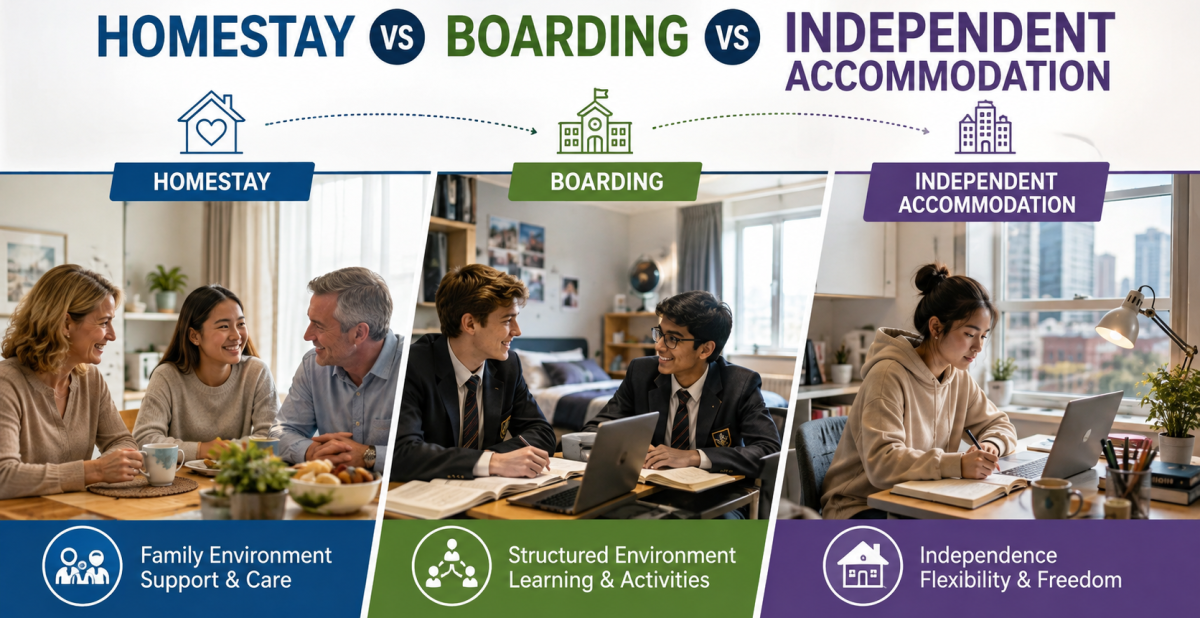
If you are weighing Homestay vs. Boarding vs. Independent Accommodation for your international student, here is the short version. Both options keep a minor supervised in Canada. But they look very different day to day. Homestay places your child with a screened Canadian family in a private home.
Boarding places your child in a school-run residence with staff on-site. Independent living, the third option families often ask about, is not fully available to a minor without a custodian in place. This guide walks through all three, with real numbers from USCA Academy’s own program. If accommodation isn’t a factor for your family, our private schools in Canada guide compares day school and online formats too.
Quick Answer
Homestay places your child with a screened host family for daily supervision, meals, and a private room. Boarding places your child in a school-operated residence with staff supervision. True independent living is not a legal option for a minor without a custodian in place, per Immigration, Refugees and Citizenship Canada (IRCC). USCA Academy’s own homestay program costs roughly $1,000 to $1,500 per month, with background-checked host families and 24-hour coordinator support.
Key Highlights of Homestay vs Boarding vs Independent Accommodation
- Homestay places a student with a screened Canadian family, usually including a private furnished room, meals, and daily supervision.
- Boarding places a student in a school-operated residence, with staff supervision and routines built into the school’s own schedule.
- Independent Accommodation without adult oversight is not permitted for minors under Canadian custodianship rules, no matter the housing type.
- USCA Academy’s homestay program costs roughly $1,000 to $1,500 per month. It includes host family screening, weekly shopping trips, and 24-hour coordinator support.
- Host families in reputable homestay programs undergo police background checks for every adult in the household, plus a home inspection.
- Under-18 students in homestay typically follow a curfew, often around 11 PM, set by the host family or the program.
- All three arrangements still require a custodian on file for a minor, so the housing choice does not remove that legal requirement.
What Homestay Means for an International Student
Homestay places your child in a private Canadian home with a family that agreed to host an international student. The family provides a furnished bedroom, meals, and day-to-day supervision. Most homestay programs also expect the family to help the student adjust to Canadian routines, from grocery shopping to transit.
Screening is the part families should ask about first. Reputable homestay programs run a police background check on every household member aged 18 or older. They also carry out a home inspection before placing a student. Many require the host family to complete some form of training on hosting a minor.
Curfews are common and usually reasonable rather than strict. Homestay program guidelines used across the sector, including those summarized by Canadian custodianship service providers, describe a typical pattern. Students under 18 often have a curfew set around 11 PM on school nights, though the exact time can vary by household.
Homestay works well for students who want a full cultural experience and daily conversation practice in English or French. It usually costs less than boarding. It also gives a student one-on-one attention that a larger residence cannot always provide.
A typical homestay day includes breakfast with the family and a ride or transit trip to school. Dinner together in the evening is common too. Weekends often bring family outings, errands, or a shared grocery trip. This steady contact helps many students settle into Canadian life faster than they expected.
What Boarding Means for an International Student
Boarding means the student lives inside a residence that the school itself operates. Staff members supervise the residence around the clock. Meals are typically built into a school meal plan, and the daily schedule lines up closely with class times and study hours.
Boarding suits students who want more built-in structure and peer contact with other students their own age. It can also simplify communication, since the same institution running the classroom is running the residence.
The tradeoff is less exposure to an actual Canadian household. In many cases, boarding also carries a higher price tag than a homestay placement. Not every private school runs its own residence facility, so families should confirm this directly rather than assuming it is available everywhere.
A boarding day typically follows a fixed schedule, with set wake-up times, meal periods, and supervised study blocks in the evening. Staff usually manage check-in and check-out times closely, especially for younger students. This structure can be reassuring for families who want predictable routines built into the housing itself.
Why True Independent Living Is Not an Option for a Minor
This is the section most families skip, and it is the one that matters most. In Ontario, a minor is anyone under 18, the provincial age of majority. Canadian immigration rules do not allow a minor to study in Canada without a custodian on record, no matter which housing type the family prefers.
A custodian is a Canadian citizen or permanent resident who agrees to take responsibility for a minor’s care. This includes emergency decisions and school-related matters while the parents are abroad. According to IRCC’s guidance on studying in Canada as a minor, this arrangement is documented through a form called the Custodianship Declaration. It is known as IMM 5646, and both the custodian in Canada and the parents abroad must sign it.
Some schools and programs allow a supervised independent arrangement for older teens, commonly students who are 16 or 17. One example is a shared student apartment with regular check-ins from a custodian or school coordinator. This is not the same as true unsupervised independence. A custodian still has to be named, still has to be reachable, and is still legally responsible for that student’s welfare.
The practical takeaway is simple. Do not frame the housing decision as a way to avoid custodianship paperwork. Frame it instead as choosing which supervised environment, homestay or boarding, fits your child best.
For a full breakdown of the custodian requirement, see USCA Academy’s guide to the guardian requirement for international students in Canada. It explains the paperwork side of this in detail.
Homestay vs. Boarding vs. Independent Accommodation: Side-by-Side Comparison
The table below lines up the three arrangements on the factors families ask about most.
| Feature | Homestay | Boarding | Independent-Style Arrangement |
| Day-to-day supervision | Host family, living in the same home | School staff, on-site at the residence | Custodian check-ins, no live-in adult |
| Meals | Usually included, home-prepared | Provided through the school’s meal plan | Student or roommates typically self-manage |
| Typical monthly cost | Roughly $1,000 to $1,500 at USCA Academy | Varies by school, often higher than homestay | Varies, plus ongoing custodian coordination |
| Custodian still required for a minor | Yes | Yes | Yes |
| Curfew | Common, often around 11 PM for under-18 students | Set by the school’s residence schedule | Set out in the custodian agreement |
| Cultural immersion | High, daily contact with a Canadian household | Moderate, mostly with school peers and staff | Low, mostly self-directed |
| Best suited for | Most international minors, especially younger students | Students who want structured, peer-heavy routines | Older teens, generally 16 to 17, with an approved custodian plan |
Use this table as a starting point, not the final word. Every family’s situation is different, and school-specific rules can add extra conditions on top of the general pattern shown here.
Homestay vs Boarding: Which One Actually Fits Your Child
Age plays a large role in this decision. Younger students, especially those in Grades 1 through 9, generally do better with the close, family-style supervision that homestay provides. Older students in Grades 11 and 12 sometimes prefer boarding for the peer community. Some may qualify for a supervised independent-style arrangement if their custodian and school agree.
Personality matters just as much as age. A student who gets homesick easily usually benefits from the daily contact a homestay family provides. A more independent student might find a school residence’s structured routine easier to adapt to than a new family’s household rules.
Neither option is objectively better. The right choice depends on your child specifically, and it is worth discussing openly with them before you commit to a placement.
Inside USCA Academy’s Homestay Program
USCA Academy is an Ontario Ministry-inspected private school in Mississauga, serving Grades 1 through 12. It runs its own accommodation program for international students. Instead of leaving families to search for housing on their own, the school places students with screened host families as part of its enrollment process.
Cost typically runs $1,000 to $1,500 per month. This covers a private furnished room, meals, and guardian support built into the placement. That price range sits at the center of what most Ontario homestay programs charge, based on general homestay program overviews used across the sector. Exact pricing still depends on location and household.
Screening is not a checkbox exercise. Host families go through background checks, home inspections, and training before they are approved to host a student. USCA’s Student Residence Coordinators are available 24 hours a day. This matters for a family managing a time difference from overseas who needs to reach someone quickly.
Beyond the placement itself, coordinators arrange a weekly shopping trip so students can stock up on groceries and essentials. They also coordinate pickup and drop-off for students who prefer to live in the Toronto area. USCA maintains a separate meal plan page that lays out the food service side of accommodation. It is worth reading alongside the accommodation page itself.
USCA describes its housing options as dorm and homestay residence arrangements managed by school administration for student safety. If your family is comparing this against a boarding-only school, ask directly through USCA’s international students page. You can also reach out through the contact information page to discuss which arrangement fits your child’s age and comfort level.
Placement usually gets arranged as part of the broader application process, alongside course selection and custodianship paperwork. Starting the accommodation conversation early gives the school more time to find a strong household match. Families applying for the 2026-27 school year should raise housing preferences during their initial application discussions, not closer to arrival.
Tradeoffs and What to Consider Before You Choose
No housing arrangement is perfect for every student. An honest comparison has to name the real limitations of each one.
Homestay depends heavily on the match between your child and the host family. A student who struggles with a household’s rules, food, or personality may need a placement change. That change takes time and coordination. Ask in advance what the process looks like if a homestay match does not work out.
Boarding, where it is available, usually costs more and gives a student less daily exposure to a Canadian family setting. It can also mean less flexibility around meal choices, since students eat on the school’s schedule rather than a host family’s.
Independent-style arrangements for older teens carry their own tradeoffs. A 16 or 17-year-old managing groceries, laundry, and a schedule with only periodic custodian check-ins needs real maturity. Families should be honest about whether their child is ready for that level of self-management before requesting it.
Cost is a factor across the board. Homestay in the $1,000 to $1,500 per month range is a real, recurring expense on top of tuition. Families should budget for it the same way they budget for tuition and course fees. Boarding fees, where available, should be confirmed directly with the specific school.
Language and cultural adjustment take time regardless of housing type. A student may feel homesick in the first few weeks even with a warm host family or a supportive residence team. Give the adjustment period a few months before deciding a placement is truly not working.
Finally, remember that none of these three options removes the custodian requirement. Whichever housing type you choose, you still need a Canadian custodian on file who meets IRCC’s requirements. Review USCA’s application process page early. Custodianship paperwork and housing placement often need to be arranged around the same time.
How to Decide Between Homestay and Boarding
A few practical questions can help narrow the choice faster than reading general pros and cons.
Ask how independent your child already is at home. A student used to managing their own schedule may adjust well to boarding’s structure or an approved independent-style arrangement. A student who thrives with close daily guidance usually does better in a homestay.
Ask about budget. Homestay in the $1,000 to $1,500 monthly range at USCA Academy is a known, predictable cost. Confirm boarding costs directly with any school offering it, since they can vary significantly.
Ask what support exists if something goes wrong. USCA’s 24-hour Student Residence Coordinator availability is a concrete answer to this question. Any program you consider should be able to answer it just as clearly.
If you are still deciding between homestay and boarding for your child’s move to Canada, USCA Academy’s team can help. They can walk you through what fits best for your child’s age and needs. Visit the accommodation page to see current homestay details, or reach out through the contact information page to start the conversation before you apply.
Frequently Asked Questions
1.Can international students choose which housing type they want at USCA Academy?
Families can discuss preferences with USCA’s admissions and accommodation team. Final placement depends on availability, the student’s age, and what the school and custodian agree is appropriate. Contact USCA directly through its contact information page to discuss options before applying.
2.Is homestay actually safe for a teenager living far from home?
Reputable homestay programs run background checks on every adult in the household. They also inspect the home before placement, following standard homestay program guidelines used across Ontario providers. USCA Academy follows this same screening approach and pairs it with 24-hour coordinator support.
3.What is the real difference between homestay and a boarding school residence?
Homestay places a student inside a private family’s home, with that family providing meals and supervision. Boarding places a student inside a residence run directly by the school, with staff supervision instead of a host family.
4.Can a 17-year-old international student live alone in Canada without a custodian?
No. A custodian is required for a minor studying in Canada. Ontario’s age of majority is 18, per IRCC’s guidance on minors studying in Canada. An officer may use some discretion for students close to 18, but this should never be assumed.
5.How much does USCA Academy’s homestay program actually cost per month?
USCA Academy’s homestay placements typically run $1,000 to $1,500 per month. This covers a private furnished room, meals, and guardian support as part of the placement.
6.Who is legally responsible for my child if they live in a homestay in Canada?
The custodian named on the Custodianship Declaration, form IMM 5646, holds legal responsibility for the student’s care and emergency decisions. This is separate from whichever family or residence provides the day-to-day housing. USCA’s guide to the guardian requirement for international students explains exactly how this works.