

Key Highlights of Grade 12 Math
Here is a quick look at what you will see in this guide to the grade 12 math curriculum in Ontario:
- A simple look at the main university-track courses. These are Advanced Functions (MHF4U), Calculus and Vectors (MCV4U), and Data Management (MDM4U).
- Tips for picking the right math course. It depends on what you want to do after high school, like university, college, or work.
- A list of good study tools. This has textbooks, online sites, and practice work.
- A sample 8–10 week math study plan for grade 12. It is made to help you keep up and be ready.
- Easy exam tricks to help you do well on your last tests and get your Ontario credit math grade 12.
Introduction
Welcome to your guide for Grade 12 math! This is your last year in high school math. It is an important time if you want to go to college or start on the way to your job. These courses add to what you already know of math. You also learn new and harder ideas. This makes you better at solving problems.
If you have a strong understanding of mathematics at this level, you will be ready for many college and university programs. Topics like advanced functions are important. This guide will take you through the course. It will help you pick the path that is best for you and give you the help you need to do well.
Grade 12 Math Ontario: Course Overview and Options
The grade 12 math curriculum in Ontario gives you a few different courses to pick from, based on what you want to do after high school. If you want to get into science and engineering or something in the social sciences, the team made a math course that will help you get ready for that. Knowing what your choices are helps you plan smarter for your last year.
Picking the right grade 12 math course matters, because a lot of university programs need you to have certain ones first. Take some time to look over all the Ontario high school math courses, then match them to what you want out of a job and what schools ask you to have before they let you in.
Types of Grade 12 Math Courses (MHF4U, MCV4U, MDM4U, MBF3C)
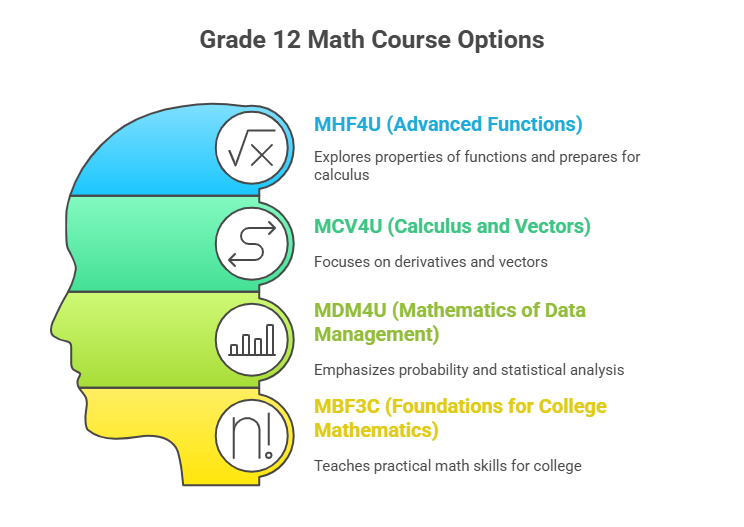
- Ontario Grade 12 math offers several paths: MHF4U (Advanced Functions), MCV4U (Calculus and Vectors), and MDM4U (Mathematics of Data Management) for university-bound students.
- MHF4U and MCV4U cover functions, calculus, and vectors, key for STEM, engineering, and business degrees; MDM4U focuses on statistics and probability, useful for business and social sciences.
- College-bound students often take MBF3C, followed by MAP4C, which teaches practical math skills for careers in business, health sciences, or trades. Choose the course best suited for your goals.
Main Topics in the Grade 12 Math Curriculum
The topics you study in Grade 12 Math depend on the course you choose. In MHF4U (Advanced Functions), you explore properties of different functions and prepare for calculus. You study:
- Polynomial and rational functions
- Exponential functions and logarithmic functions
- Trigonometric functions, including radian measure
- Combining functions and rates of change
In MCV4U, you focus on derivatives and vectors. MDM4U emphasizes probability and statistical analysis instead of the function types covered in the other courses. Each course is designed to help you develop strong problem-solving skills and prepare for further studies in mathematics or related fields.
Choosing the Right Grade 12 Mathematics Course
Choosing your Grade 12 math course is an important step that can significantly influence your options after high school. The grade 12 math curriculum in Ontario allows students to select courses that best suit their goals. Take time to review the university math prerequisites in Ontario and explore programs that interest you, including those offered by USCA Academy.
Many students feel pressured to select the most challenging courses, but it’s crucial to choose one where you can excel and achieve your personal objectives. Whether aiming for a college diploma or exploring a variety of university programs, careful planning now potentially with guidance from USCA Academy will pave the way for future success.
University Preparation vs. College/Workplace Pathways
The main difference in the Grade 12 Ontario math curriculum is between university (U) and college/workplace (C/M) courses. University courses like MHF4U and MCV4U are more abstract and theory-based, preparing you for STEM and other degree programs. College courses such as MAP4C (Foundations for College Mathematics) and MCT4C (Mathematics for College Technology) focus on practical, real-life math skills. These help prepare you for:
- Business and human services
- Health sciences
- Skilled trades
Some university programs in social sciences or humanities may only require MDM4U (Data Management) or no math at all. Always check your program requirements.
Prerequisites and Course Planning Tips
- Passing MCR3U (Grade 11 Functions) is essential before enrolling in most Grade 12 university-level math courses, such as MHF4U (Advanced Functions).
- For MCV4U (Calculus and Vectors), you must take MHF4U either beforehand or at the same time, so plan your timetable carefully to avoid missing prerequisites that might impact college applications.
- Meet with your school’s guidance counselor to review university prerequisites and ensure your course selections and grades meet Ontario’s post-secondary admission requirements.
Study Resources for Grade 12 Math Success
To do well in Grade 12 math, you need to work hard and have the best study resources. It is not enough to just be in class. You have to practice and go over what you learned. There are many tools out there to help you make a good math study plan for grade 12.
You can use official textbooks, online video lessons, practice worksheets, and old tests. Using these tools will help you understand the material better and get a better grade. The main thing is to find what helps you the most and keep using it. Here are some of the best resources for your grade 12 math exam tips and daily study time.
Best Online Tools, Textbooks, and Worksheets (with Table)
A range of study resources can help you excel in Grade 12 Math. Start with your school-issued textbook it is closely aligned with the Ontario curriculum and contains essential explanations, examples, and practice problems. Use it for both homework and reviewing tough concepts. Online, explore resources like Khan Academy for free video lessons, and visit the Ontario Ministry of Education website for official curriculum documents. These tools support your learning and help you meet course expectations. For extra practice, try free printable worksheets or consider math tutoring for personalized help.
Here is a summary of helpful resources:
| Resource Type | Description |
|---|---|
| School Textbook | Your main source for lessons, examples, and homework problems aligned with your course. |
| Ontario Curriculum Documents | Official documents from the Ministry outlining all learning expectations for each course. |
| Online Video Tutorials | Websites like Khan Academy offer detailed video lessons on specific topics (e.g., trigonometric functions). |
| Practice Worksheet Sites | Websites offer free, printable worksheets with answer keys to drill specific skills. |
| Math Tutoring | Personalized support from a tutor can provide one-on-one help with difficult concepts. |
Sample 8–10 Week Grade 12 Math Study Plan
A good math study plan for grade 12 helps make a tough subject easier. If you give a few hours every week to regular review, you will understand more and not have to cram before a test. This is very helpful for a calculus grade 12 review. In this course, the ideas build on each other.
It can help to use an 8 to 10 week plan. You can split up the big sections, like functions or rates of change, into smaller and easier parts. This kind of routine helps you keep up and feel less stressed before your exams. The next sections will show a sample plan and give you tips on how to stay organized.
Weekly Breakdown & Tips for Organizing Study Sessions
Creating a weekly math study plan for grade 12 means staying consistent. For the 8-week MHF4U course, spend two weeks per main unit start with Polynomial and Rational Functions (Weeks 1–2), then Exponential and Logarithmic Functions (Weeks 3–4), and continue similarly. When organizing study sessions, focus on active learning: redo class examples, try extra practice problems, or explain concepts aloud.
Here are a few tips for good study sessions:
- Schedule It: Pick 2-3 days a week and add study times to your calendar.
- Set a Goal: Have a clear goal each session.
- Minimize Distractions: Study somewhere quiet and keep your phone away.
- Review and Practice: Split time between reviewing notes and practice questions.
Practice Tests and Past Exam Resources
- One good grade 12 math exam tip is to use practice tests and past exam resources. These can help you get used to how the questions look, how much time you will have, and what type of thinking you need during the real test. It is not just about knowing the subject, but also about how to answer questions when there is pressure.
- You can begin by asking your teacher if they have any practice tests or old exams from past years. These are the most useful, since they are made by the teacher. If that is not possible, check your textbook for review packages. You can also search online for practice questions that follow the Ontario curriculum.
- When you take a practice test, try to act like it is the real exam. Use a timer, put your notes away, and do it all in one go. After you finish, look over your answers to see where you made mistakes. This helps you know which topics you should work on before your final review.
Grade 12 Math Exams and Assessment Guide
Your final grade in grade 12 math consists of two components: your work throughout the semester and your final exam. Approximately 70% of your grade comes from assignments, quizzes, and tests completed during the term, while the remaining 30% is based on your final exam score. It’s crucial to maintain consistent effort throughout the semester and prepare adequately for the final exam. Understanding the exam structure and developing strong study habits will enhance your performance. The following sections will outline essential information and strategies to help you effectively prepare for the grade 12 math exam.
Final Exam Structure and OSSD Requirements
The final exam for Grade 12 math at USCA Academy covers everything you have learned during the semester. You will see both multiple-choice questions and questions where you need to show all your work. These full-solution questions matter a lot, as you can get good marks by showing how you think and solve each part. Do not skip these questions; always try to answer them.
To get your Ontario Secondary School Diploma (OSSD), you need to pass your math course. When you pass a Grade 12 course, you earn a credit. You need 30 credits to get your diploma. Here are two main things to remember:
- The final exam counts for 30% of your final grade.
- If you pass the course, you get one Ontario credit math grade 12.
At USCA Academy, teachers guide students through the requirements to help them succeed in Grade 12 math and earn the OSSD. The OSSLT, which is the Ontario Secondary School Literacy Test, is also needed to graduate, but the way you do in each subject is just as important. Doing well in Grade 12 math helps your application for university and moves you closer to finishing school.
Exam Strategies and Mindset for Success
- Start your exam by scanning all questions and tackling the ones you know first to build confidence and momentum.
- Manage your time carefully; don’t get stuck on tough questions move on and return if time allows.
- Clearly show all mathematical steps, even if unsure about the final answer, as partial marks are often awarded for correct methods.
- Stay calm and trust your preparation; read questions fully and double-check your work before submitting to maximize your score.
Going into your Grade 12 math exam with these strategies and a positive mindset will help you perform your best under pressure.
Conclusion
To do well in Grade 12 math, you need to understand the work and find ways that help you study better. Make sure you know what is in the course and which topics are covered. Use tips to help you study and choose the right tools to get ready for exams. This can help you feel sure about yourself as you learn. Keep in mind, it’s not just about passing tests. It’s about learning math to help you later on. If you have questions or you want help just for you, feel free to ask. You can do well in Grade 12 math!
Frequently Asked Questions
1. Can I complete grade 12 math online and earn an Ontario high school credit?
Yes, you can. Many online schools have courses like MHF4U and MCV4U. The provider needs to be checked by the Ontario Ministry of Education. If you finish the course, you will get an ontario credit math grade 12 that counts just like a course from a regular day school.
2. How do Ontario grade 12 math courses compare to other provinces?
The grade 12 math curriculum in Ontario stands out because of its special course codes and pathways. These include U, M, and C. In Canada, all students learn basic topics like calculus and functions. However, different places do things in their own way. For example, British Columbia offers Pre-calculus 12 and Calculus 12. These look a lot like the Ontario courses. Still, what students learn can change a bit from one province to the next.
3. What essential skills will I develop in grade 12 math?
As you move forward at USCA Academy, you will build strong thinking and problem-solving skills. You will deepen your understanding of mathematics by using different mathematical processes. You will learn how to work with equivalent algebraic expressions. You will also learn how to explain complex ideas clearly and in the right way. These skills can help you in many jobs later on.