
Key Highlights of GED Canada
- The GED test in Canada has now changed to the new Canadian Adult Education Credential (CAEC) starting May 2024.
- This high school equivalency credential shows your level of educational achievement as an adult in Canada.
- The CAEC has five subject tests. You need to take tests in Reading, Writing, Mathematics, Science, and Social Studies.
- If you are an adult who already passed some GED tests, you may use those credits toward the new CAEC. You can do this until May 2027.
- The CAEC brings more job options and helps with career growth. It also lets you continue your education, same as a secondary school diploma.
- You can find preparation support for getting this education credential. The USCA Academy GED program is one way to help you succeed.
Introduction
Are you an adult seeking a high school equivalency credential? Obtaining this credential can open up new opportunities for work or further education. Historically, the GED was the primary route for achieving this goal, but now there’s a new option tailored for Canadians. In this guide, we will explore recent changes in adult education in Canada, discussing both the updated GED and the new Canadian Adult Education Credential (CAEC). Our aim is to prepare you for success in earning your high school equivalency credential. Your journey towards achieving your GED Canada credential starts here.
GED Canada Overview and Eligibility
The term GED Canada has to do with the General Education Development test. For many years, this test was the main high school equivalency credential for adults. It let people who did not finish high school show their skills and knowledge. This helped people move forward in their work and learning.
The GED program is not offered anymore in Canada. This changed on May 3, 2024. Now, adults must take the new Canadian Adult Education Credential (CAEC) instead. The new assessment is made to fit the needs of Canadian adults. It looks at their differences and local culture in the way the test works.
What GED Canada Means and Its Recognition
- For years, passing the GED tests in Canada earned you a high school equivalency diploma, recognized by employers and schools as equal to a secondary school diploma.
- The new Canadian Adult Education Credential (CAEC) now replaces the GED, offering a high-quality certification tailored for Canadian adults and trusted by colleges and employers.
- If you already hold a GED, it remains recognized. Those still working on their GED have a grace period and can apply their test results toward the CAEC for up to three years.
Who Can Take the GED Exam (Age, Province, and International Criteria)
The GED is no longer offered in Canada; instead, adults and immigrants must meet the requirements for the new CAEC test. The CAEC is designed to help those who need a high school equivalency credential for work, school, or other goals. To qualify:
- You must live in the province where you want to take the test.
- You need to be at least 18 years of age.
- You cannot have finished high school.
- You should not be in a high school program right now.
Some provinces may allow 17-year-olds with special permission. Always check your province’s specific residency and admission rules.
Understanding the GED Test in Canada
The GED test Canada is not the main test now. The CAEC has taken its place. The CAEC is almost the same. It checks what you know in important high school areas. You need to pass subject tests in this system. These are made to see if your educational achievement matches what is expected in high school. If you get through these subject tests, it shows you have the basic skills needed to go to college or get a job.
The team making the new credentials followed strict assessment industry standards. This means it is trusted and seen as a valid credential. Here, you will see which topics are on the CAEC exam and learn about places you can go to take these subject tests.
Subjects Covered and Exam Format
To earn your high school equivalency credential, you must pass tests in five different subject areas. The new CAEC is designed to reflect the knowledge expected of a high school graduate in Canada. The test subjects are tailored to Canadian content and perspectives.
The five GED test subjects (now CAEC subjects) are Reading, Writing, Social Studies, Mathematics, and Science. The Mathematics test is split into two parts: one where a calculator is not permitted and one where it is. This format ensures a comprehensive assessment of your skills in different contexts.
Preparing for these subjects is the key to success. Knowing the format helps you focus your studies. Here is a breakdown of the subjects you will be tested on:
| Subject Area | Key Focus |
|---|---|
| Reading | Measures your ability to read, understand, and interpret various texts. |
| Writing | Assesses your skills in creating clear and effective written communication. |
| Mathematics | Tests your mathematical reasoning, covering both calculator and non-calculator problems. |
| Science | Evaluates your understanding of life science, physical science, and earth and space science. |
| Social Studies | Covers topics in Canadian history, geography, economics, and civics. |
Test Locations and Accessibility Options
Are you wondering where to take your CAEC tests? These exams are held at official provincial testing centres across Canada; home testing is not allowed. You must register in advance and attend an approved test site—walk-ins are not permitted.
The CAEC uses an easy-to-use online platform with built-in supports for all, including:
- Screen color overlays
- Text highlighters and line readers
- Zoom options
If you have a documented disability, you can request extra accommodations such as extra time, a private room, a reader, or a scribe. Request these early, as documentation may be required before approval.
Registration and Preparation for GED Canada
Taking the first step to get your high school equivalency means learning about the registration process and starting your GED exam preparation. The new CAEC process is now handled online. This makes it easy for you to start. Meeting the GED requirements, which are now called CAEC requirements, allows you to open the door to a new academic career entrance.
It is important to get ready before taking the subject tests. When you have a good study plan and the right resources, you can go into exam day feeling sure of yourself. There are sections below that will show you how to register for your exam and give tips for better preparation.
Step-by-Step Registration Process
The registration for the new CAEC exam is done online through your province’s main system. The steps are simple, and you get to choose your own testing schedule. To start, you need to know what to do first.
Here is a step-by-step guide on how to register for the GED test Canada (now called the new CAEC):
- Assess Your Eligibility: First, make sure you meet the admission requirements for your province, like age and residency.
- Create a Candidate Account: Go to your province’s main CAEC website and sign up to get your candidate account.
- Apply for Prior Learning: If you have passed some old ged tests, fill out the Prior Learning Assessment form so you get credit for them.
- Book Your Tests: Log in to your new account so you can pick a testing center, test subjects, and set a day and time to take the test.
- Prepare Your ID: Be sure you have a good, government ID with a photo to use at the test center.
After you book your tests, you will get a confirmation email. Be sure to show up at the center with your ID and get ready to do your best.
Study Tips and USCA Academy’s Preparation Support
Getting ready for the GED exam is more than just reading books it’s about having an effective plan. Good study tips help you feel confident and prepared. With the right approach, you can master what you need and feel ready for test day.
Here are some ways to support your GED preparation:
- Review official test outcomes for each subject to guide your studies.
- Practice with sample tests online to get familiar with question formats.
- Create a steady study plan to cover all five test subjects.
- Identify your harder subject areas and spend extra time on those.
The USCA Academy GED program offers full lesson plans for all subjects, helping you build confidence and prepare to earn your credential.
Benefits and Career Opportunities After the GED
Getting your high school equivalency credential, like the GED or the new CAEC, is a big step in education. This valid credential is more than just a document. It shows to employers and schools that you have skills and knowledge in high school. The high school diploma prepares you for good jobs and more learning.
When you have a GED credential, you can work on your career, go for better work, or think about going to a college. This achievement brings people many chances for job growth and more schooling. The next sections talk about what you can do after reaching this important milestone.
Academic and Employment Pathways
Once you get your CAEC, you can open up many new paths for yourself. The CAEC is an important paper for both your studies and future jobs. It is an academic career entrance document. Many bosses and schools across Canada accept it.
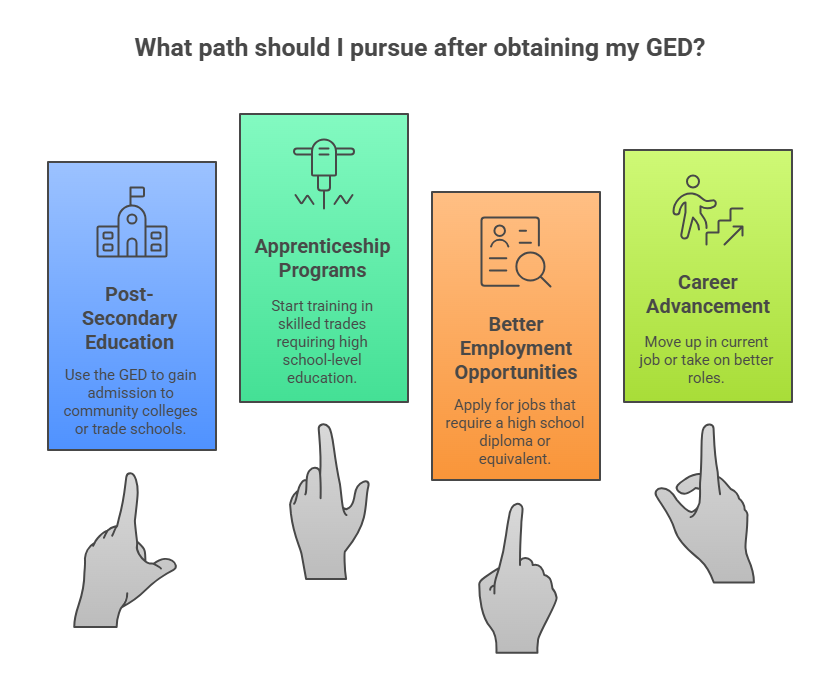
You can see it as your way to a better life. After you earn it, you can do a lot, like:
- Post-Secondary Education: You can use it to get into many community colleges and places where you can learn a trade.
- Apprenticeship Programs: It can help you start training in skilled trades if you need a high school-level background.
- Better Employment Opportunities: You can apply for jobs asking for a high school diploma or something like it.
- Career Advancement: It may help you move up in your job or take on better roles where you work now.
Having a GED credential shows that you can learn and stick with things. This can help you stand out for work, better employment opportunities, or more schooling.
Is the GED Recognized as a High School Diploma Equivalent?
- The GED credential and CAEC are recognized as high school equivalency credentials by the Ministries of Education across Canada, meaning they show you have the skills of a high school graduate.
- While the GED is not identical to an Ontario Secondary School Diploma (OSSD), it is accepted by many employers, community colleges, and apprenticeship programs as proof of high school-level education.
- With a valid GED, you can apply for jobs or further education that require a high school diploma, making it a trusted pathway for those who haven’t completed traditional high school.
Conclusion
To sum up, getting your GED in Canada is a good way to improve the education you can get and open up new employment opportunities. If you know the exam format, what you need to be able to take it, and how to study in the best way, you will feel ready when you take this step. USCA Academy gives help and support during the process so you are ready for success. Your GED helps you go further with learning and also gives you more job choices. If you want answers to your questions or need some help with your GED studying, reach out to us anytime!
Frequently Asked Questions
1. Is the GED still available in Canada after the CAEC change?
No, you can not take the GED tests in Canada after May 2024. Now, you will need the new CAEC (Canadian Adult Education Credential) if you want an education credential. If you have a GED credential, it is still good. Plus, if you started the GED tests but did not finish, your partial credits can be moved to the CAEC tests until May 2027. That way, you can still work toward getting an adult education credential with the new system.
2. Can immigrants or international students apply for the GED Canada test?
Yes, people who have come to live in Canada can take the new CAEC test. This test has taken the place of the old GED. The main GED requirements, now called CAEC admission requirements, are to live in the province, be the right age, and to not have a high school diploma. The test is made for Canadian adults, and that includes newcomers.
3. How long does it take to prepare for the GED Canada exam?
The time you need for GED exam preparation will be different for everyone. It depends on what you already know and how much time you can spend each day. You can use official study tips, take practice GED tests, and join a GED preparation class. All of these can help you get ready for the test in a few weeks or months.
4. Which is better to take, GED or OSSD?
Choosing between GED and OSSD depends on your goals. The GED, or General Educational Development, is a high school equivalency test recognized across Canada, while the OSSD (Ontario Secondary School Diploma) is specific to Ontario. Opt for GED if seeking flexibility; OSSD may better suit traditional educational pathways.