Key Highlights of Education Savings Plan Canada
Here are some important things to keep in mind when you want to save for school in Canada:
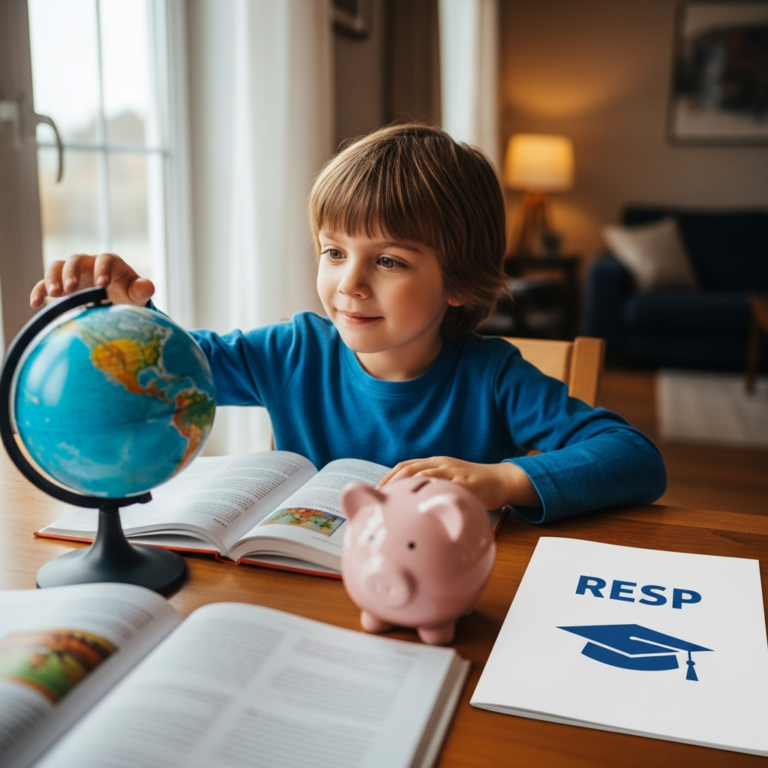
- An RESP (Registered Education Savings Plan) is a type of savings account that helps you save money for a child’s education after high school.
- The government in Canada helps you build your savings faster. It gives you extra money from government grants like the Canada Education Savings Grant (CESG). This grant matches part of what you put into your savings plan.
- Your money in an RESP account grows without you having to pay tax on it. This can help your savings goals a lot.
- There is a lifetime contribution limit of $50,000 for each child, and with government grants, you can get thousands more toward your savings goal.
- RESPs are flexible. You get to use the money for university, college, trade schools, or even some apprenticeship programs.
Introduction
A Registered Education Savings Plan, or RESP, is a special savings account in Canada designed to help you save money for a child’s education after high school. This initiative is part of the Education Savings Plan Canada framework, offering great benefits. The wonderful aspect of this savings plan is that the government contributes extra money through grants.
Additionally, your savings and investments in the account can grow without taxes. Parents, newcomers, and students will find that a registered education savings plan is one of the best ways to prepare for the higher costs of attending university, college, trade school, or even a top private school like USCA Academy.
Understanding Education Savings Plans in Canada
A savings plan for education in Canada, called an RESP, can help you reach your savings goals. It works like an investment account, where the money you put in can grow. While the money stays in the RESP, you do not have to pay tax on what you earn. This is a good way to save for the cost of school after high school. To better estimate expenses, parents should also understand the cost of studying in Canada for high school students before planning long-term savings.
If you want to help your child later on, it’s important to know who can open an RESP account in Canada. This savings plan lets your money grow. It also gives you a way to get government grants, which can help a lot. Now let’s look at what an RESP is and how this investment account works for you.
What is a Registered Education Savings Plan (RESP)?
A Registered Education Savings Plan (RESP) is an investment account designed to help you save for a child’s education after high school. When you open an RESP, you are the “subscriber” who deposits money, while the child is the “beneficiary.” You can invest your contributions in options like mutual funds, stocks, or ETFs, allowing your savings to grow tax-free within the account.
RESPs are offered by banks, credit unions, and scholarship providers who help you set up the plan and access government grants. This makes it easier for Canadian families to save for their children’s future education costs.
Types of RESPs: Individual, Family, and Group Options
When selecting an RESP, you have three main options, each with its own features. Understanding these types helps you choose the best fit for your family’s needs. The main difference between individual and family RESPs is the number of beneficiaries.
Here are the different types of RESPs:
- Individual RESP: Set up for one beneficiary. Anyone can open it for a child, with flexible contributions.
- Family RESP: Allows multiple beneficiaries, but they must be related. Grants and savings can be shared among siblings.
- Group RESP: Pools your savings with others, managed by scholarship providers, with set payment schedules and lower-risk investments.
How to Open an RESP for Your Child in Canada
Opening a resp account for your child in Canada is one good way to start planning for their school needs. You only need a few things to get going. The most important is your social insurance number, and your child’s social insurance number. If you do not have these, you will not be able to open a resp or get any government grants.
You can open a resp account at many places. These include banks, credit unions, or other places where people put money. Each place will show you how to open an account with them. But the things you need for a resp, like your social insurance number, stay the same for all. By doing this, you help your child and make good use of what canada offers.
Step-by-Step Guide to Setting Up an RESP
Setting up an RESP account in Canada is straightforward and can be done in a few steps. Make sure you have all necessary documents for both you and your child before starting. Here’s a simple guide:
- Gather Your Documents: You’ll need your social insurance number and your child’s social insurance number.
- Choose a Provider: Open the account at a bank, credit union, or similar financial institution. USCA Academy can help new families find reliable partners.
- Select Your Plan Type: Decide between individual, family, or group RESP plans.
- Complete the Application: Fill out the provider’s forms; they usually handle government grant applications.
Once your RESP is active, you can start making contributions.
Eligibility Requirements for Parents, Students, and Newcomers
To open an Education Savings Plan Canada (RESP), both the account holder (subscriber) and the student (beneficiary) must be Canadian residents with valid Social Insurance Numbers (SINs). Parents, grandparents, or relatives can easily open an Education Savings Plan Canada RESP for a child if they meet the residency and SIN requirements. Newcomers to Canada can start an Education Savings Plan Canada RESP after gaining residency and obtaining SINs, allowing access to government grants and tax-advantaged savings.
- Both subscriber and beneficiary must be Canadian residents with a valid SIN
- Parents, relatives, or friends can open an Education Savings Plan Canada RESP for a child
- Newcomers can open an Education Savings Plan Canada RESP after residency and SINs are obtained. For families moving to Canada, this study in Canada for international students guide can help you understand the full education journey.
Main Benefits of Education Savings Plans Canada
The main benefits of setting up a savings plan for education in Canada are the strong money advantages it gives you. Your RESP savings grow without you having to pay taxes on what you earn each year. This means your money can build up faster in the investment account.
Also, when you use an RESP, you get extra money from the government through grants. This helps you reach your savings goals much quicker. To sum up, the mix of no taxes on growth and the help from government contributions makes the RESP one of the best ways to save money for going to school after high school. We will check out these benefits in more detail.
Tax Advantages and Growth Potential
One major benefit of a RESP account in Canada is tax-free growth. The earnings from investments inside a RESP are not taxed as long as they stay in the plan, allowing your savings to grow faster than in a regular taxable account. When funds are withdrawn for education, taxes are paid by the student, who usually pays little or no tax due to low income. This is more tax-efficient than using your own investment account. RESPs offer various investment options, such as:
- Mutual funds
- Exchange-Traded Funds (ETFs)
- Stocks and bonds
This flexibility helps you grow your savings effectively. As your savings grow, it’s equally important to know how to choose the right high school in Canada for your child’s success.
Real-Life Scenarios: Early Planning vs. Late Starters
Starting an education savings plan in Canada early gives your savings more time to grow and maximizes government grants. Early contributions, even if small, can add up to a substantial education fund thanks to compounding and more years to receive the CESG. Late starters can still benefit catch-up contributions and available grants help reduce future student debt, though they’ll have less time for growth. Even if you begin when your child is older, every dollar saved counts. If the plan is closed, unused earnings withdrawn as an Accumulated Income Payment (AIP) are taxed.
Here’s a comparison to illustrate the impact:
| Feature | Early Planner (Starts at birth) | Late Starter (Starts at age 10) |
|---|---|---|
| Annual Contribution | $2,500 | $2,500 (plus catch-up contributions) |
| Total CESG Grant | Reaches the $7,200 lifetime maximum easily | May need larger contributions to maximize grants |
| Growth Potential | 18 years of tax-deferred growth | 8 years of tax-deferred growth |
| Final Savings | Substantially higher due to longer compounding | Lower, but still a significant help |
Government Grants and Incentives for RESP
The Canadian government gives the canada education savings grant and other resp grants to help you save for your child’s education with an resp account. These programs are here to make it easier for people to put money toward school costs and to help more kids go to college or university. The main one is the cesg. With this, the government puts extra money right into your resp account.
Some provincial governments in canada also have their own grants. These can help you build up your child’s education savings even more. RESP grants act like free money, so your child’s education fund can grow a lot faster than just your own savings. Now let’s look closer at these different grants.
Canada Education Savings Grant (CESG) Explained
The Canada Education Savings Grant (CESG) helps boost your child’s RESP with federal support. For every dollar you contribute, the government adds 20%, up to an annual and lifetime limit. This means you get extra funds to help cover post-secondary education costs. Understanding Ontario Secondary School Diploma (OSSD) requirements can also help you plan your child’s education timeline effectively.
Here’s how the CESG Canada program works:
- Annual Grant: Receive up to $500 in grant money each year when you contribute $2,500 to the RESP.
- Lifetime Limit: A maximum of $7,200 in CESG can be received per child.
- Catching Up: Unused grant room can be used, allowing up to $1,000 in CESG with a $5,000 contribution.
Canada Learning Bond (CLB): Who Qualifies and How To Apply
The Canada Learning Bond (CLB) is a government grant designed to help lower-income families save for their child’s education without needing to contribute their own money first. The CLB provides funds directly into a child’s RESP if they qualify.
Here are the top things you should know about the Canada Learning Bond:
- Initial Payment: The government puts $500 into an RESP for a child who can get the grant.
- Additional Payments: Each year your child stays eligible, they can get $100, up to the age of 15.
- Lifetime Maximum: The most a child can get from the CLB is $2,000.
To qualify, your family must have a low income (based on family size and income) and open an RESP. Most banks and financial institutions can help you apply for the CLB when you open the account. This is an easy way to get extra help for your child’s education savings. Families looking for budget-friendly options can also explore affordable private schools in Canada
Conclusion
In short, an Education Savings Plan (RESP) in Canada is a good way to save for your child’s schooling after high school. When you know about the different types of RESPs, the government grants you can get, and the tax benefits, you can choose what is good for your family. It does not matter if you start early or start late. The RESP will still work for you, and it is for all families, even those who are new to Canada. Try to start your savings plan as soon as you can so you get the most out of these RESP benefits. If you have any questions or if you want help with your RESP, reach out to us today!
Frequently Asked Questions
1. What are the contribution limits for RESPs in Canada?
The lifetime contribution limit for an RESP is $50,000 for each beneficiary. There are no yearly limits on how much you can put in. But if you go over the lifetime maximum, there will be penalty taxes. To get the most out of RESP grants, the best way is to put in $2,500 each year. This way, you can get the full $500 CESG.
2. Are RESP withdrawals taxed in Canada?
Yes, some of it gets taxed. You can take out the money you put in without paying tax. But the earnings and government grants, called Educational Assistance Payments (EAPs), are taxed when the student takes them. Most students have low income, so they pay little or no tax.
3. What happens if my child doesn’t attend post-secondary education?
If your child does not go for higher education, you still have choices with your savings plan. You can get your own money back without paying any tax. But you will have to give back any government grants that were added. If there is any money you earned from your savings, which is called accumulated income payment or AIP, you can take it out, but you may need to pay tax. You can also move this AIP into your registered retirement savings plan (RRSP), if you still have room to add more money there.