
Key Highlights of Diploma vs Advanced Diploma
Here are the key takeaways when comparing a diploma and an advanced diploma:
- A diploma program will take about two years to finish. An advanced diploma program will usually take three years.
- An advanced diploma gives more detailed and focused knowledge than what you get in a diploma, which covers the basics.
- Admission requirements mostly are the same, but the advanced diploma program might ask for a few more things.
- Both will teach practical skills. The advanced diploma program will teach you to handle harder and less routine tasks.
- You should choose the diploma or advanced diploma program based on your career goals and how fast you want to start working.
- International students can find good chances in both diploma and advanced diploma programs, depending on their plans for the future.
Introduction
It can be hard to know what to do after finishing high school. There are many choices, and the names of the programs can sound almost the same. If you are looking at what you want to do next, you may see the words diploma and advanced diploma come up. A diploma program and an advanced diploma program are both good ways to start work, but each one is at a different level.
They give you different results and can lead you to different jobs, including a bachelor degree in your field. Knowing what makes a diploma and an advanced diploma different can help you pick the best one for your field of study. This will help you reach what you want to do and get ready for your future.
Understanding Diplomas and Advanced Diplomas in Canada
In Canada, especially at Ontario colleges, both the diploma and advanced diploma are well-respected in higher education from an interdisciplinary perspective. These programs are made to help you learn the practical skills and knowledge needed for work.
A diploma program lets you start learning in a field and gives you a good base. An advanced diploma builds on the same base and takes your learning further, potentially leading towards a doctoral degree. Both are strong choices and can help you find a job or go on to study more. Let’s look at what you get from each.
What Is a Diploma?
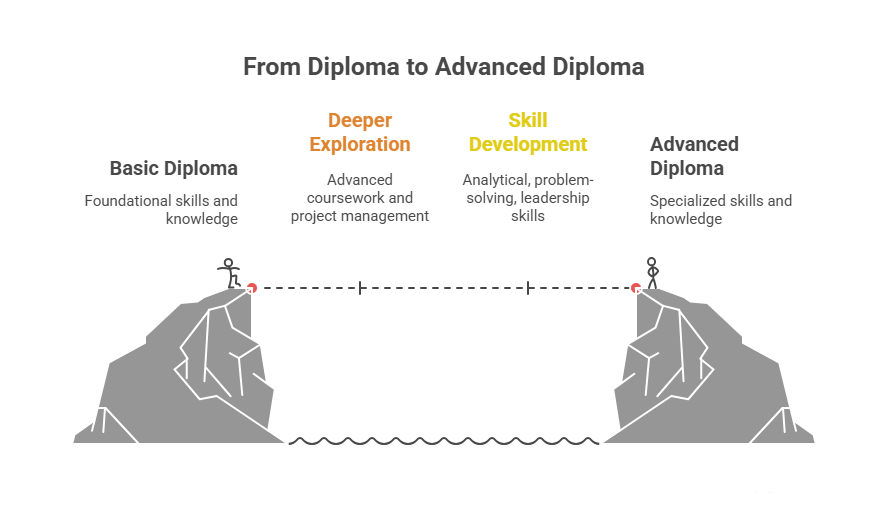
A diploma is awarded by a college after completing a program, usually lasting two years or four semesters. Diploma programs focus on providing essential knowledge and practical skills needed to start a career in a specific field. These vocational programs emphasize hands-on learning, preparing you for technical or management roles by teaching you how to apply your knowledge to real-world situations. The main difference between a diploma and an advanced diploma is the depth and length of study. While a diploma offers a solid foundation for various jobs, an advanced diploma provides more in-depth and specialized education in your chosen field.
What Is an Advanced Diploma?
An advanced diploma is a higher-level credential than a regular diploma, usually taking about three years or six semesters to complete. This extra year allows for a deeper exploration of the subject, with coursework focused on advanced application of project management knowledge. You’ll develop strong analytical, problem-solving, and leadership skills, preparing you to handle complex tasks in your field not just basic or routine work.
While the program covers foundational topics like a regular diploma, it also delves into more advanced material. Additionally, some credits from an advanced diploma may transfer toward a bachelor’s degree, making it a good option for further study.
Core Differences Between Diploma and Advanced Diploma Programs
There are several key differences between diploma and advanced diploma programs, which are summarized in the table below:
| Aspect | Diploma | Advanced Diploma |
|---|---|---|
| Diploma Course Duration | 1 to 2 years | 2 to 3 years |
| Focus | Basic and practical skills | Specialized education in a particular field |
| Depth of Knowledge | General knowledge | In-depth knowledge |
| Admission Requirements | Generally less stringent | May require minimum average or specific criteria |
| Career Opportunities | Entry-level jobs | Improved job prospects and higher education opportunities |
| Skill Development | Develops basic skills | Develops specialized skills matching industry needs |
Admission Requirements for Each Credential
Getting into a diploma or advanced diploma program starts with meeting the right admission requirements. Entry requirements for both the diploma program and advanced diploma program can seem almost the same at first, but they encompass a range of skills that you need to know. However, there are some key differences that you need to know.
Before you apply, you should learn about these entry requirements. Most programs will ask you to have your high school diploma first. But when it comes to an advanced diploma, especially at the advanced level, you may need more than that, including knowledge in the development of strategic initiatives. Let’s talk about what you will need for each type.
Prerequisites for Diploma Programs
- Diploma programs typically require an Ontario Secondary School Diploma (OSSD) or an equivalent secondary school diploma, making admission accessible to many applicants.
- Mature students (usually aged 19 or older) without a high school diploma can also apply, as colleges recognize that work and life experience can prepare individuals for further study.
- Entry requirements for diploma programs are generally straightforward, focusing on readiness for college rather than subject mastery, allowing people from diverse backgrounds to begin their education.
Advanced Diploma Entry Standards
- To enter an advanced diploma program, you typically need an Ontario Secondary School Diploma (OSSD) or status as a mature student.
- Advanced diploma programs often require extra prerequisites, such as specific Grade 12 courses (e.g., math or science) and sometimes a minimum average in those subjects.
- Meeting these additional requirements is essential; schools like USCA Academy offer the necessary high school courses to prepare you for your chosen advanced diploma program.
Program Structure and Coursework Comparison
The day-to-day kind of experience in a diploma program and in an advanced diploma program is shaped by how each program works and what you learn. Both the diploma program and the advanced diploma program give practical, job-focused training in the planning of skills. But, their learning objectives are not the same. Because of this, you will have a different education in each.
A diploma will teach you the main things you need to know for your job, including understanding the subject matter. An advanced diploma program gives more time to specialized education. Let’s look at the curriculum for each. This way, you can see how they help you build your skills and knowledge.
Typical Diploma Curriculum Overview
- A typical diploma program lasts two years (four semesters) with at least 1,200 class hours, focusing on practical, real-world skills in your chosen field.
- The curriculum is designed to prepare you for entry-level jobs, teaching essential daily skills plus knowledge for handling new or uncommon challenges.
- The shorter duration allows you to quickly enter the workforce, graduating ready to contribute effectively in technical or management roles and meeting employer needs.
Specialized Content in Advanced Diplomas
The advanced diploma program offers specialized content designed to deepen your skills and knowledge in a specific field of study. Spanning three years and over 1,800 instructional hours, it covers complex topics beyond a standard diploma. Here’s what sets it apart:
- Advanced Coursework: Focuses on complex, analytical, and problem-solving tasks, utilizing a systematic approach to prepare you for higher technical or management roles.
- Specialized Curriculum: Encourages creative thinking by applying knowledge in innovative ways and examining current industry practices.
- Career Readiness: Graduates gain a deeper understanding of their field, equipping them for leadership, planning, and critical decision-making responsibilities.
Duration: How Long Does Each Take?
One of the most significant differences between a diploma and an advanced diploma is the time commitment. The difference between diploma and advanced diploma programs is that a diploma program is designed to get you into the workforce in less time, while an advanced diploma requires an additional year of study for deeper specialization. These standard timeframes are a key factor when planning your educational and career path. Understanding the duration of each can help you decide which credential best fits your personal and professional timeline.
The table below outlines the typical completion periods for each program.
| Credential | Typical Duration | Semesters | Instructional Hours |
|---|---|---|---|
| Ontario College Diploma | 2 Years | 4 Semesters | 1,200+ hours |
| Ontario College Advanced Diploma | 3 Years | 6 Semesters | 1,800+ hours |
Practical Experience and Training Opportunities
Both diploma and advanced diploma programs prioritize practical experience, offering hands-on skills that employers seek in a variety of fields. These programs bridge classroom learning with real-world application through co-op terms and projects with companies. However, the type and amount of practical experience can vary between the two. Let’s explore the work placement options available in both diploma and advanced diploma courses.
Work Placement and Co-op in Diplomas
A key feature of many diploma programs is the opportunity for work placement or co-op terms, which provide valuable hands-on experience before graduation and ensure the successful completion of your education. These experiences let you apply classroom learning in real job settings, build professional connections, and boost your confidence in your skills. Employers value this practical experience because it means you not only have the diploma but also the workplace skills needed from day one. The main ways to gain this experience include:
- Co-op work terms
- Field placements
- Internships
- Community involvement projects
Completing a work placement gives you a strong advantage when entering the job market.
Enhanced Industry Engagement in Advanced Diplomas
An advanced diploma offers more industry engagement due to its extended duration and advanced curriculum, which can significantly enhance your advanced diploma career scope. Both diplomas provide practical experience, but the third year in an advanced diploma includes bigger, more challenging projects. You may take on tasks with greater responsibility, working on projects that require strong problem-solving and management skills, giving insight into higher-level roles. This deeper real-world experience helps you stand out for specialized jobs. Enhanced industry engagement may include:
- Leading team-based industry projects
- Advanced co-op placements with more responsibility
- Specialized case studies and simulations
Applying your practical knowledge in these settings builds a strong portfolio and improves career prospects.
Tuition Fees and Financial Factors
Cost is a big thing to think about when you choose a post-secondary program. When you look at a diploma program and an advanced diploma program, the cost for both is different because of how long you study. If you go for the advanced diploma program, you will gain knowledge about various management functions while being in school for more time, so the total cost will be more.
But you should see this cost as money put into your future. Both the diploma and the advanced diploma can be good for you. It helps to know about every can, like tuition and any funding you might get, as this knowledge contributes to a sophisticated body of knowledge. This way, you can plan well for your education.
Average Costs for Diplomas
- Diploma programs are generally more affordable than longer programs, as most take only two years to complete, resulting in lower tuition fees compared to three-year advanced diplomas or four-year degrees.
- The total cost varies by college and program, but the shorter duration means you pay less overall and can enter the workforce sooner, helping to minimize student debt.
- Choosing a diploma allows you to gain a recognized qualification quickly, save money, and start earning faster, making it a practical financial decision for many students.
Funding and Fees for Advanced Diplomas
- Advanced diploma programs typically have higher tuition fees than regular diplomas because they last three years instead of two, resulting in increased overall costs.
- While you invest more money, the extra year helps you gain more skills and can improve your job prospects and future salary, making the higher cost worthwhile for many students.
- Financial aid options like government student loans, scholarships, and bursaries are available for advanced diplomas, so be sure to research and apply for these to help manage expenses.
Career Pathways After Graduation
After you finish school, your credential helps you start your career. If you go for a diploma program, you can get many entry-level jobs fast, offering a broad range of opportunities. This is good if you want to start working right away in your industry. If you have an advanced diploma, you may get jobs that need more skill or you can start at a higher position.
Both options can give good careers, especially if you choose to find the nearest train station for easier access. But the way you start and where you end up can change. You can decide to get a job now or you can look at more school, like a graduate diploma. The credential you get first is the one that gets you going.
Job Opportunities for Diploma Graduates
Diploma qualifications graduates are valued across many industries for their practical skills, making it easier to secure entry-level positions. With a diploma, you are prepared to take on roles that require hands-on abilities and foundational knowledge in your chosen field. The type of job you can get depends on your area of study, but most roles involve daily operational tasks, using tools or systems, or handling office duties. Some jobs you can get with a diploma include:
- Technician roles in engineering or IT
- Administrative and office management positions
- Early childhood educator assistants
- Junior marketing or communications coordinators
A diploma is a strong starting point for your career.
Expanded Roles with Advanced Diplomas
One of the key benefits of an advanced diploma is the wider career options you have after graduation, highlighting the advanced diploma benefits you can leverage. With stronger skills and critical thinking, you can apply for jobs that require more expertise. Advanced diplomas often lead to paraprofessional roles where you work alongside experts and handle tasks independently. You may also qualify for positions that fall between technical and expert levels, such as:
- Senior Technologist or Specialist roles
- Junior Project Manager or Team Lead
- Paraprofessional positions in fields like law or engineering
This qualification prepares you for greater responsibility and can result in higher starting salaries.
Options for International Students
For international students who want to study in Canada, there are two good options. The diploma and advanced diploma are both good choices, along with the Ontario College Graduate Certificate. You can get a high-quality, practical education from them. They also help you start a career in Canada. But, which one to pick will depend on what you want for yourself and your work life.
You need to look at things like your school history, what job you want, and your future plans for living in Canada. If you know about the rules to get into each program and what you get from it at the VIE campuses, you will be able to pick the one that matches what you want to do.
Accessibility and Eligibility Considerations
- Both the Ontario College Diploma and Advanced Diploma are accessible to international students who have completed secondary school, equivalent to the Ontario Secondary School Diploma.
- Proof of English language proficiency is required if your previous education was not in English. The entry requirements focus more on readiness for practical learning and hands-on work, rather than just academic grades.
- These programs are popular among international students due to their clear, straightforward eligibility criteria and simpler application process compared to university degrees, making it easier to start a career in Canada if you meet the school and language requirements.
Which Option Suits International Goals?
- A diploma is ideal for international students seeking quick entry into the Canadian workforce, finishing in two years with lower costs and faster job opportunities beneficial for immigration.
- An advanced diploma suits those with long-term goals, offering deeper knowledge in three years, access to higher-level jobs, and easier pathways to university for a bachelor’s degree. Choose based on your current priorities and future plans.
Conclusion
To sum up, knowing how a diploma vs advanced diploma are different is key when you pick what to study, especially if you consider pursuing a Certificate. Both give you useful skills and knowledge, but an advanced diploma covers more topics and goes deeper. This can help you get better jobs later. The entry requirements, how long they take, and how they are seen in different jobs are not the same.
These factors shape your future at work. Think about what you want maybe you wish to start working soon, or you plan to get bigger roles that need more skill. Every option gives you its own chance. If you want help or want to ask anything about your study choices, reach out to us today!
Frequently Asked Questions
1. Can You Transfer from a Diploma to an Advanced Diploma Program?
Yes, in many cases, you can move from a diploma program to an advanced diploma program. The college, under the authority of the board of governors, may offer ways to use the credits you get to keep going with your further study. You have to meet the entry requirements for the advanced diploma program. The school will look at your diploma and check if you can get credit for your courses.
2. Are Job Prospects Better with an Advanced Diploma?
Having an advanced diploma doesn’t always mean you get better jobs, but it might let you try for different kinds of work. With an advanced diploma, you may have the chance to go for jobs that ask for more specialised knowledge or come with more things the worker has to do right away. This could help someone move up faster in their field. Still, people who finish a diploma program are wanted by many companies for jobs that start at the entry level. Both an advanced diploma and a diploma can help you get work
3. Which Credential Is Recommended for International Students in Canada?
The choice between a diploma program and an advanced diploma for international students at the Victorian Institute of Education depends on what they want to do. If you want to start working fast, a diploma program is a good pick. If you plan to study more in the future or want to focus on a specific area, an advanced diploma can be better. Both types have about the same entry requirements and offer learning outcomes that are respected by Canadian employers.