
Key Highlights of Advanced Diploma
- An advanced diploma is a post-secondary program that offers specialized knowledge beyond a regular diploma.
- These Advanced Diploma programs focus heavily on developing practical skills to make you job-ready upon graduation.
- Typically lasting three years, an advanced diploma is shorter and more affordable than a four-year degree.
- Graduates have strong career opportunities in technical and management roles.
- It serves as a pathway to further education, with options to transfer credits toward a university degree.
- These programs are a popular choice for both domestic and international students seeking career-focused training.
Introduction
It can be hard to choose what to do in higher education. You may know about diplomas and degrees, but you might not know a lot about advanced diplomas. An advanced diploma sits between a regular diploma and a degree. It gives you deep knowledge and teaches you helpful, practical skills. If you want to get ready for a job in your field of study and step straight into work, an advanced diploma could be just right for you.
What Is an Advanced Diploma?
An advanced diploma is a college diploma you can get after finishing high school. It is a higher level of education than a normal two-year Ontario College Diploma. This type of diploma focuses more on practical skills than a four-year undergraduate degree. Think of it as choosing a career-focused diploma where you learn more about one area of study.
These advanced diploma programs train you well in a special subject. You need to do one more year of study than regular diploma programs. This means you get a more in-depth curriculum in that area. This qualification is good for people who want to get advanced skills. It helps you stand out in the job market.
Definition and Academic Level
An advanced diploma is a formal qualification that demonstrates strong skills and knowledge in a specific field. It sits academically above a two-year diploma but below a four-year bachelor’s degree. The curriculum is more complex, preparing graduates for technical and management jobs. Most programs in Canada take three years (six semesters) to complete, with entry requiring an Ontario Secondary School Diploma or equivalent; mature students aged 19+ are also accepted.
The key difference from a regular diploma is the depth of study and length of the program. Advanced diploma holders can access better career opportunities and may use credits to pursue further education, such as a bachelor’s degree.
How It Differs from a Diploma or Degree
Choosing the right program depends on your career goals. A degree, diploma, and advanced diploma each offer unique benefits. Degree programs usually take four years and focus on theory and research. Diplomas are shorter, about two years, and focus on job training. An advanced diploma blends both, offering deeper knowledge and more practical experience than a regular diploma. It is more specialized and takes about three years. Certificate programs are the shortest, usually one year, covering just the basics.
Here is a quick look at how they compare:
- Duration: A diploma is about two years, an advanced diploma is three years, and a bachelor’s degree is four years.
- Focus: Degrees often be about theory and academics. Diplomas and advanced diplomas are aimed at careers and give you more practical training.
- Depth: An advanced diploma lets you learn more detailed and complex things than a regular diploma.
Key Benefits of an Advanced Diploma
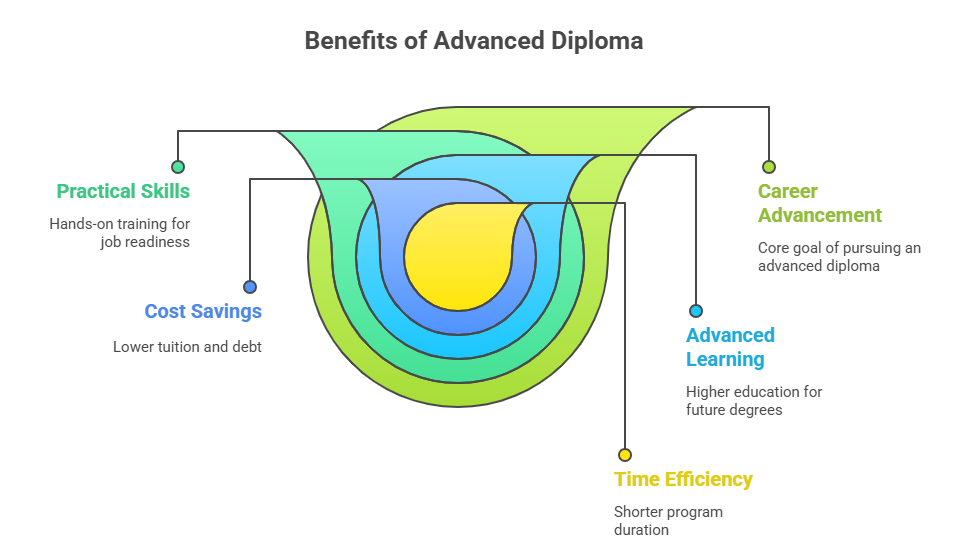
Getting an advanced diploma gives you a lot of important benefits for your career. One big advantage is that these courses help you build practical skills. They get you ready to work in the job market now. Advanced diploma courses give you practical knowledge that you need to do well at work.
Professional diploma programs also offer an advanced level of learning. This makes you a strong candidate when employers are hiring. You can use what you learn to go into further education if you want to get a degree in the future. The next parts will talk more about these benefits, like hands-on learning and saving money.
Practical Skills & Job Readiness
One of the main benefits of an advanced diploma is its focus on practical skills and job readiness. These programs emphasize hands-on training, so you learn not only the theory but also how to apply it in real situations. Instructors are often industry professionals who bring valuable, up-to-date knowledge to the classroom. Their structured teaching helps you develop problem-solving abilities and prepares you for real-world challenges. This approach ensures you are ready to enter various industries, such as skilled trades, technology, or management, and make a quick impact. Your advanced diploma shows employers you have:
- Built up special technical skills.
- Gained practical knowledge by working on hands-on projects.
- Learned good problem-solving and communication skills.
Cost and Time Advantages
Besides the practical training, going for an advanced diploma can save you time and money compared to a usual university degree. You finish your program in three years instead of four. That means you spend less time in school and get into work faster. You also start earning a salary earlier, and that helps you cut tuition costs.
The overall cost for an advanced diploma is much lower than what people pay for a bachelor’s degree. Tuition fees are more affordable, letting you have less student debt as you reach your career goals. And with less money owed, it is easier for many students to get good education without paying the high price you see at universities.
Because the advanced diploma needs less time and costs less, it becomes a smart way to invest in your future. You get specialized skills with a strong qualification in less time. The faster return on what you spent for school means you can still have the chance for further study later, if you want.
Career Opportunities After an Advanced Diploma
Getting an advanced diploma can help you get many jobs in different areas. These programs are made for the job market. You will have the practical skills and important information that managers like to see. You get training for jobs in skilled trades, technology, healthcare, and business. You can work in both hands-on and management jobs in your field of study.
If you want to work in skilled trades, business, technology, or healthcare, an advanced diploma helps you stand out. You will also find out which job titles you can go for and the money you could get.
Roles and Job Titles You Can Pursue
With an advanced diploma, you can get many jobs in your field of study. These jobs need you to use both practical experience and knowledge from your classes. Your training is not general. It gets you ready for a specific area, so you can handle hard tasks. People with this diploma are wanted for paraprofessional jobs and technologist spots.
These jobs usually give you more responsibility than those for regular diploma holders. You will be able to take on many technical and management tasks. You will use your skills to solve problems and help with plans in the company.
Here are some job titles you could look for after you meet the advanced diploma eligibility:
- Engineering Technologist
- Senior Graphic Designer
- Project Coordinator
- Network Administrator
- Marketing Manager
- Early Childhood Education Supervisor
Salary Expectations & Growth Potential
Your salary expectations after earning an advanced diploma will vary depending on your field of study, location, and work experience. However, the specialized practical skills you gain often lead to competitive starting salaries and strong career growth potential. In the early career stages, you may find your earning potential is similar to or even exceeds that of some university graduates, as employers value your job-ready expertise.
As you gain more work experience, your opportunities for advancement and higher pay will increase. Advanced diploma programs are designed to build a foundation for leadership and management roles, allowing you to climb the career ladder. Many graduates find that their qualification opens doors to senior technical or supervisory positions over time.
Here is a sample table of potential salary ranges for roles that an advanced diploma can lead to. Note that these are averages and can change based on many factors.
| Job Title | Average Early Career Salary Range (CAD) |
|---|---|
| Engineering Technologist | $55,000 – $75,000 |
| Marketing Manager | $60,000 – $80,000 |
| Network Administrator | $50,000 – $70,000 |
Source: Government of Canada Job Bank
How to Select the Right Advanced Diploma Program
Picking the right diploma program can help you reach your career goals. There are many choices out there. You need to find the one that matches what you like and what you want to do for work. First, know which field of study you are interested in. Then, search for schools that have good diploma programs in that field.
Think about the admission requirements, the classes you will take, and the type of institution offering the program. If you get the right fit, you will be able to learn practical skills and important information that helps you do well in your career. The next sections will give ideas on what things you should look for.
Factors to Consider (Accreditation, Faculty, Curriculum)
When you look at advanced diploma courses, start by checking the quality of the program. The most important thing is to see if the program has accreditation. That shows it meets the standards set by a top group, like the Ministry of Colleges and Universities in Ontario. Ontario is home to many good colleges that offer advanced diploma programs, so it’s best to take your time with research.
The people who teach in the program are also important. Are these instructors known for their work in the field? Instructors who have worked in real jobs are able to share what they know and help you meet people in the industry. A strong teaching team can make your learning better and get you ready for the job market. Their help could be the boost you need.
Take some time to look over the curriculum. See if the courses match what you want to do in your career. The right curriculum will give you both theory and hands-on learning. You need practical skills to do well at work. Here are things to look for:
- Accreditation: Is the program officially recognized?
- Faculty Expertise: Do instructors have industry experience?
- Curriculum: Does it cover the skills you need for your desired career?
- Co-op/Internship Options: Does the program offer work-integrated learning?
Online vs. In-Person Options
Online Programs:
- Offer flexibility to study from anywhere.
- Ideal for working professionals or international students balancing commitments.
- Usually more affordable and self-paced.
In-Person Programs:
- Provide hands-on training, labs, and real classroom interaction.
- Better for students who need structured learning.
- Offer campus resources like libraries, labs, and peer networking.
Conclusion
An Advanced Diploma gives you real-world skills and know-how that help you move forward in your job. When you know how it compares with diplomas and degrees, you can choose the best learning path for you. Getting an Advanced Diploma comes with many good things. You get ready for jobs, and save money too. This program is a smart pick if you want the skills needed for the best career opportunities or if you want to add to your qualifications. An Advanced Diploma Programs can help you get in the door for many roles. If you want help or need to know more about which program is best for you, reach out to USCA Academy today!
Frequently Asked Questions
1. Are financial aid and scholarships available for advanced diploma students in Ontario?
Students who join an advanced diploma program at an Ontario college can get help paying for school. There are government student loans, like the Ontario Student Assistance Program (OSAP). Some schools also give out scholarships and bursaries. These programs are to help students with costs.
2. Can I pursue a university degree after an advanced diploma in Canada?
Yes, many colleges let you use your academic credit from an advanced diploma for a university degree. They have credit transfer deals with universities. This pathway in further education can help you join a degree program in a later semester. It can save you both time and money.
3. Is an advanced diploma recognized outside of Canada?
A Canadian advanced diploma is known to have a good name and get respect in many countries. Both employers and educational institutions often see Canadian education as high quality. This makes it easier for people to find career opportunities all over the world and to continue with further study in other countries.