
Key Highlights of ics4u curriculum
Here is a quick look at what the ICS4U curriculum covers:
- This course builds on what you learned in Grade 11. It focuses on new programming concepts and more advanced software development.
- You will make bigger and more complex programs using modular design principles. These meet real industry standards.
- In this course, you will work with other students as a team on a large software development project. You will start at planning and go through to review.
- You learn about main computer programming languages like Java. This helps get you ready for university computer science courses.
- You are graded through assignments, projects, and a final exam. The focus is on using what you learn in real world situations.
- You will build transferable skills that help with problem-solving, project management, and making choices the right way.
Introduction
Are you thinking about working in the world of technology, software engineering, or data science? If so, you should check out the ICS4U curriculum for Grade 12 Computer Science in Ontario. This computer science course helps you get ready for the tough computer science classes you will see at the university. It builds on what you already know. You get a deeper look at advanced programming. You will learn how people in computer science think and solve problems. The course will help you manage large projects and get set for new challenges as you keep going with your computer science journey in college.
Overview of the ICS4U Curriculum Structure
The ICS4U curriculum follows the expectations set by the Ontario Ministry of Education, guiding students from basic to advanced computer science concepts. It emphasizes modular design principles, teaching you how to break larger problems into manageable parts. This approach lays a solid foundation for mastering Grade 12 computer science before tackling more complex topics. You will explore programming fundamentals, the impact of technology on society, and its applications. Understanding the course structure and topic progression is crucial for your success in this subject.
Course format and learning approach
- The ICS4U course offers diverse learning opportunities in software development, allowing you to work individually and as part of student teams. This teamwork builds essential collaboration, decision making, and problem-solving skills.
- Project management is a key focus. You and your team will plan, develop, and test a major software project, applying classroom concepts to real-world scenarios valuable for both college and future careers.
- For flexible learning, online options like USCA Academy let you study at your own pace and create an individual education plan. Teacher support is always available, ensuring you grasp every concept in the ICS4U curriculum.
How topics progress through the course
The ICS4U course is designed to guide you through computer science concepts step by step, making it easier to build skills and confidence. Here’s how topics progress through the course:
- Foundations: You begin with the basics of a programming language like Java, exploring career choices while learning simple programming concepts before advancing.
- Development: The course then introduces data structures (such as arrays) and hands-on projects like game design, followed by advanced programming topics and the software development life cycle.
- Preparation: The curriculum follows the Ontario 2008 guidelines, building your problem-solving skills and preparing you to meet all major course expectations.
Core Learning Areas in the ICS4U Curriculum
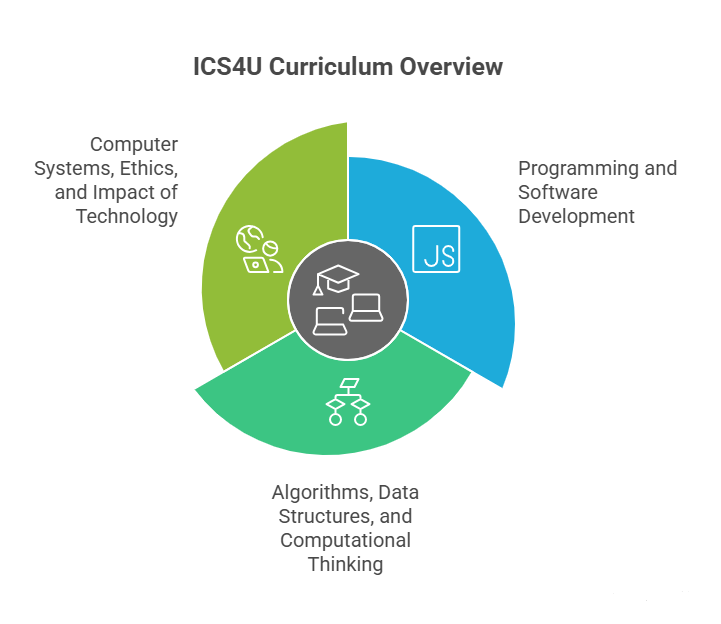
The ICS4U curriculum has many main learning areas and course content. These help you get a good understanding of computer studies, including the English language. You will learn programming concepts that let you work with code and also look at ideas about technology and how people use it. You will not just learn to code, but also learn how to think deeply about technology.
There will be sections about software development, how algorithms work, and the ways technology changes our world. An achievement chart is used to see how well you know these things and your ability levels. It looks at your knowledge, how you think through problems, how you can talk or write about what you know, and how well you use what you learn. Now, let us see what you will study in these main areas.
Programming and Software Development Concepts
This part of the curriculum focuses on hands-on coding, primarily in Java, which is widely used in software development. You’ll learn to write clean, readable code and use modular design principles to break projects into reusable pieces. Emphasis is placed on following industry standards, including code maintenance, throughout your programming tasks. The skills you gain will help you manage software maintenance and scalability. You will also experience the entire software development process, from planning to implementation.
Key skills you will get:
- Use different data types and control structures in your code.
- Build and use subprograms like methods or functions.
- Take care of the whole software development process, from planning to making it work.
Algorithms, Data Structures, and Computational Thinking
ICS4U goes beyond coding, teaching you to think like a computer scientist in the field of OSSD computer science. You’ll learn computational thinking, breaking big problems into smaller, manageable steps for computers. The course covers algorithms and data types, focusing on designing, analyzing, and using algorithms to solve problems efficiently. You’ll explore how to choose and use appropriate data structures, such as one-dimensional arrays, to store and sort data in your programs. Selecting the right tools for each task is emphasized.
This part of the course is about:
- Developing good ways to solve problems by thinking with algorithms.
- Checking if algorithms work well and fast enough.
- Using data structures so you can sort and use information right in your programs.
Computer Systems, Ethics, and Impact of Technology
A modern computer science course is more than building technical skills; ICS4U explores technology’s broader connections to society and the environment, including the importance of financial literacy and understanding economic forces. You’ll discuss ethical issues in computer science and how to be a responsible user and creator of technology. The course also emphasizes environmental stewardship by examining the impacts of making and using computers. You’ll investigate emerging technologies and their effects on the world, economy, and daily life. Through these topics, ICS4U prepares you to be a thoughtful tech professional.
You will cover topics such as:
- Ethical practices related to data privacy and intellectual property.
- Initiatives that promote environmental responsibility in technology.
- Career paths and areas of research in the field of computer science.
Programming Languages and Tools Used in ICS4U
To bring your software development projects to life in ICS4U, you will use certain programming languages and tools, which help in developing crucial problem solving skills. The course is set up to show you the kinds of technologies people use in school and at work. You get real experience with the types of software that developers use every day.
You will also get to use standard productivity tools such as word processing, internet research, and presentation software. These are used to write and show your projects. By learning these technical and practical skills, you will be ready for what comes next. Now, let’s look at the common languages people use and find out why they are picked.
| Feature | Java | Python |
|---|---|---|
| Type | Statically typed (variables checked at compile-time) | Dynamically typed (variables checked at run-time) |
| Primary Use | Enterprise applications, Android apps, web backends, high school courses | Data science, machine learning, web development, scripting |
| Syntax | More verbose, requires more structure (e.g., semicolons, brackets) | Simpler, closer to plain English, emphasizes readability |
| Learning Curve | Steeper for beginners due to its strict rules | Generally considered easier and faster to learn |
Commonly Used Languages (Java, Python, etc.)
While the specific programming language may vary by school, Java is the most common choice for ICS4U. As an object-oriented language widely used in the industry, Java provides excellent preparation for university and real-world coding. You will use an Integrated Development Environment (IDE) such as Eclipse or NetBeans to write and debug your code, both standard industry tools. Java’s prominence in Ontario’s curriculum ensures you gain a strong foundation. Python is also popular for its simplicity and readability. Here is a quick comparison of these two languages:
Reasons Behind the Language Choices
The ICS4U curriculum selects programming languages with purpose. Java, for instance, aligns with industry standards and lays a strong foundation for future computer science studies. Object-oriented languages teach modular design, essential for building large, maintainable programs. Their structure encourages organized thinking, a key developer skill. The main reasons for these language choices are:
- University Preparation: Many university computer science courses use Java or similar languages.
- Industry Relevance: These languages are common in the workforce, giving students a head start.
- Conceptual Depth: They help build understanding of object-oriented programming, data structures, and algorithms core curriculum concepts.
Major Projects and Practical Learning Components
The ICS4U course emphasizes hands-on learning through a significant software development project. This project allows you to apply all the concepts and skills acquired throughout the course. It’s more than just coding; it’s a comprehensive software development experience that you can undertake independently or with a team.
In teams, you will engage in all aspects of project management, including planning, execution, and reviews, particularly focusing on the use of computers. Collaborating on this project provides valuable experience in both technical and interpersonal skills. The following sections will detail various types of software development projects you may encounter and the skills you can develop through teamwork.
Coding assignments and software projects
During the ICS4U course, you will complete various coding assignments that build your skills gradually and enhance student learning. These smaller tasks prepare you for a major software development project at the end of the course, which is a key learning experience. For this project, you will design, code, and document a challenging computer program while managing the entire project lifecycle from defining requirements to final review. Additionally, you will investigate ethical and environmental issues related to computing in this hands-on approach, which teaches you to meet deadlines, use resources effectively, and produce quality work, similar to a real-world job.
Your work on the main software project will typically include:
- Using modular design to make a tough application.
- Writing simple and full documentation for your code.
- Testing and fixing bugs in your program so it works right.
Collaboration, planning, and documentation skills
Success in software development goes beyond coding; it’s also about teamwork and clear communication. In ICS4U, you’ll gain collaboration skills by working in student teams, learning to divide tasks and solve problems together, all while meeting curriculum expectations. You’ll develop planning and documentation abilities by creating project plans, setting goals, and writing technical documents that explain your programs. These skills are valuable not only in software development but in many professional settings, including cooperative education. By working on these team projects, you will learn how to:
- Work with a group as a part of a development team.
- Make project plans with details and set time frames.
- Write pro-level documentation for your software.
How Assessment Works in ICS4U
Assessment in ICS4U is made to help you learn better and support the student’s learning. The primary purpose of assessment, as emphasized by the Ontario Ministry of Education’s guidelines, is to provide evaluation strategies that give you feedback, so you can improve. Your final grade shows how well you meet the overall expectations in the course.
Your grade is usually split. About 70% comes from classwork during the semester. The last 30% comes from the final evaluation. This plan lets your teacher see how you do over time, reflecting the student’s most consistent level of achievement. You also get more than one chance to show what you know using more recent evidence of achievement. Let’s look at the different types of assessments you may have.
Types of Assignments, Projects, and Exams
Your marks in ICS4U will come from different kinds of tasks, contributing to your overall student achievement. You will be doing some regular assignments, quizzes, in-class work, and a big project review. All these things test your skills in the four parts of the achievement chart. These parts are Knowledge and Understanding, Thinking, Communication, and Application.
The final exam is worth 30% of your percentage grade. It will test you on all the big ideas from the whole course. The other 70% is based on your other work. This way, you get a good look at your skills. The marks on your report card will show your most steady performance.
Usually, you will be graded with these types of tasks:
- Coding assignments and quizzes to see what you know about the ideas.
- A large software project done with your team.
- A last, supervised final exam to check your full knowledge.
Key Takeaways from the ICS4U Curriculum
Finishing the ICS4U curriculum equips you with essential skills for your future, including a wide range of skills and knowledge in financial matters. Here are the key takeaways:
- Critical Thinking & Problem-Solving: Develop strong analytical abilities that are in high demand across various fields, including computer science.
- Transferable Skills: Gain valuable skills such as project management and teamwork which are beneficial in university and your career.
- Career Readiness: Build a solid foundation that prepares you for diverse paths, whether as a software developer, data scientist, or entrepreneur.
By the end of the course, you will feel confident and ready to tackle new challenges.
Conclusion
The ICS4U curriculum helps students get a strong start in computer science, especially in the Ontario computer science high school Canada course. It gives you the skills and knowledge you need for what comes next. The course talks about things like programming languages and the right way to use technology. Students learn what to do in the classroom and in the real world.
You will work on real projects and do group work in this computer science course focused on environmental education. This helps you build your critical thinking and problem-solving skills, which are important for understanding the global effects of world technology and life now, as technology keeps moving fast.
If you want to try out this path in ICS4U, get in touch with us. We will tell you more about how you can join the ICS4U curriculum.
Frequently Asked Questions
1. Are Online Options Available for the ICS4U Course?
Yes, you can take the ICS4U Ontario online high school course. There are options at places like USCA Academy. This is a top private school, and it is also one of the best international school choices. It offers an ICS4U online course. You can learn at your own pace with this computer science course. This kind of online course helps if you are working on an individual education plan or want to get your Grade 12 computer science Ontario credit. The flexibility allows you to set your own time and study in a way that fits your needs and education goals.
2. What Skills Will Students Gain by Completing ICS4U?
When you finish ICS4U, you will get advanced programming skills. You will learn ways to solve problems well and know more about modular design principles. You will also pick up important skills that you can use in many jobs, like project management, working with others, and talking clearly, including skills that address special education needs. All of this helps you reach the achievement of the overall expectations and get a strong final grade.
3. Are there any prerequisites or recommended courses before taking ICS4U in Grade 12?
Yes, there are things you need to have done first. To take ICS4U, you have to finish ICS3U, which is the Grade 11 Introduction to Computer Science course. This helps make sure you learn the basic ideas in computer studies and are ready for the harder Grade 12 computer science Ontario curriculum.