
Key Highlights of Grade 11 Biology Curriculum
- The Grade 11 Biology curriculum (SBI3U) in Ontario is used to help students get ready for university.
- You will learn five main parts. These are Diversity of Living Things, Evolution, Genetic Processes, Animal Structure and Function, and Plant Anatomy.
- This course looks at how biological systems work and talks about the theory behind them.
- The main goal is to help you build scientific investigation skills. You will do virtual labs and hands-on labs to practice.
- The Ontario curriculum helps Canadian and international students get ready for further study in science-related fields.
- Learning these grade 11 biology topics gives us a good base for what comes next in school and later for your career.
Introduction
Welcome to Grade 11 Biology! This course will help you learn about how life works within the framework of the grade 11 biology curriculum. You will study everything from cells to big ecosystems. The Ontario curriculum is made for learners like you. It helps you build a good base for learning more science in the future. In this course, you will get to know about the theory of evolution and the importance of plants in our world. The ideas you learn here will help you in your studies and after you finish school, too.
The biology grade 11 course builds a strong foundation for advanced sciences.
What Is the Grade 11 Biology Curriculum in Canada?
The Grade 11 Biology curriculum in Canada, known as SBI3U in Ontario, prepares students for university by providing a deeper understanding of biological systems. This course explores key theories of biology, ensuring students grasp essential scientific concepts. Through a blend of theoretical learning and hands-on activities, students enhance their scientific investigation skills with real-world examples.
For those seeking flexible learning options, institutions like USCA Academy offer online access to Ontario secondary school courses, supporting academic aspirations from anywhere. This curriculum serves as a solid foundation for students interested in pursuing careers in science or health-related fields.
The Purpose and Importance of Grade 11 Biology
- Grade 11 Biology teaches you critical thinking by guiding you through scientific investigations, helping you ask questions and analyze data beyond just memorizing facts.
- You’ll develop practical skills like designing experiments and interpreting results, which are valuable in future science classes and careers, making complex concepts like genetics easier to understand.
- The course covers the importance of plants, animals, and ecosystems, preparing you to understand issues such as climate change and biodiversity loss, and equipping you for further education or science-related opportunities.
Overview of the Grade 11 Biology Syllabus
The Grade 11 Biology course in Canada is split into five key units. These units are Living Things, Evolution, Genetic Processes, Animal Structure and Function, and Plant Anatomy, Growth, and Function. Each part adds new ideas to those before, giving you a strong base in biology.
The course focuses on the theoretical aspects of the topics but teaches you in a variety of ways. You get to use virtual labs, do online simulations, watch videos, and join discussion forums. This mixed style helps many types of learners and makes the hardest ideas easier to get.
Your progress is measured during the whole course. In the end, your report card shows your final grade. About seventy percent of your student’s grade comes from ongoing tests and assignments. The other thirty percent is from the final exam. This helps make sure your grade shows what you know now and over time.
Relevance for Canadian and International Students
The Grade 11 Biology course is important for Canadian and international students. In Canada, it is required for many university programs and is a major part of the Ontario Secondary School Diploma (OSSD). While Ontario’s curriculum is standardized, other provinces may have small differences. For international students, completing SBI3U provides a recognized credit that strengthens university applications and shows readiness for Canadian post-secondary studies. This course also builds science skills useful worldwide and can significantly impact your final grades and academic record. Some key benefits are:
- Earning a credit toward the Ontario Secondary School Diploma.
- Meeting requirements needed for many popular university programs.
- Learning to use the English language in a scientific way.
- Getting to know what is expected in the Canadian education system.
Core Units in Grade 11 Biology
The Grade 11 Biology curriculum has five main units. These units help you learn about the world of living things. You will begin by learning how to group different living things. After that, you will get to know the theory of evolution and how it connects all living things. Then, you will move down to a smaller level and look at genetic processes and cell division.
In the last unit, you study the different biological systems found in animals and plants. All these grade 11 biology topics are put together to help you get a clear and full understanding of life sciences. Here is what each unit is about.
Diversity of Living Things
This unit introduces you to the diversity of life on Earth and the principles of taxonomy the science of classification. You will explore how scientists organize living things into groups, helping you understand relationships among organisms and the planet’s biodiversity. Key features of different kingdoms and domains, from prokaryotes and viruses to complex eukaryotes, are covered. The curriculum emphasizes how plants and animals function within ecosystems and highlights their interdependence. A major focus is the hierarchical system of classification, which organizes living things from domains to species.
| Taxonomic Rank | Example: Human |
|---|---|
| Kingdom | Animalia |
| Phylum | Chordata |
| Class | Mammalia |
| Order | Primates |
| Family | Hominidae |
| Genus | Homo |
| Species | Sapiens |
Genetics and Evolution
- The genetics and evolution unit explores how life changes over time, covering the theory of evolution, natural selection, genetic variation, and supporting evidence.
- You’ll study genetic processes like meiosis and how it creates diversity, artificial selection in breeding, and the impact of genetics on the economy, environment, and ethical issues.
- The unit explains heredity, DNA, genes, and traits, helping you understand species adaptation, extinction, and the diversity of life around us.
Cell Structure and Function
- This unit explores cell biology, showing that cells are the basic units of life and highlighting the differences between plant and animal cells, including how they obtain energy.
- You’ll learn about organelles and their specific functions, as well as two processes of cell division: mitosis (growth and repair) and meiosis (reproduction), with opportunities to observe these under a microscope.
- Understanding cell structure and division forms the foundation for studying larger biological systems, revealing how cellular activities support essential functions like breathing and thinking in living organisms.
Human Systems Overview
In this unit, you will explore the human body’s major internal systems and their roles in keeping us healthy. You’ll study the anatomy and function of each system and see how their structures help them do their jobs. The unit highlights how body systems work together for survival, including how animals get food, move blood, and exchange gases. You’ll gain an overview of animal anatomy and physiology, focusing on:
- The Digestive System: Breaking down food for energy and growth.
- The Respiratory System: Exchanging gases with the environment.
- The Circulatory System: Distributing blood, oxygen, and nutrients.
- System cooperation for homeostasis.
How to Succeed in Grade 11 Biology
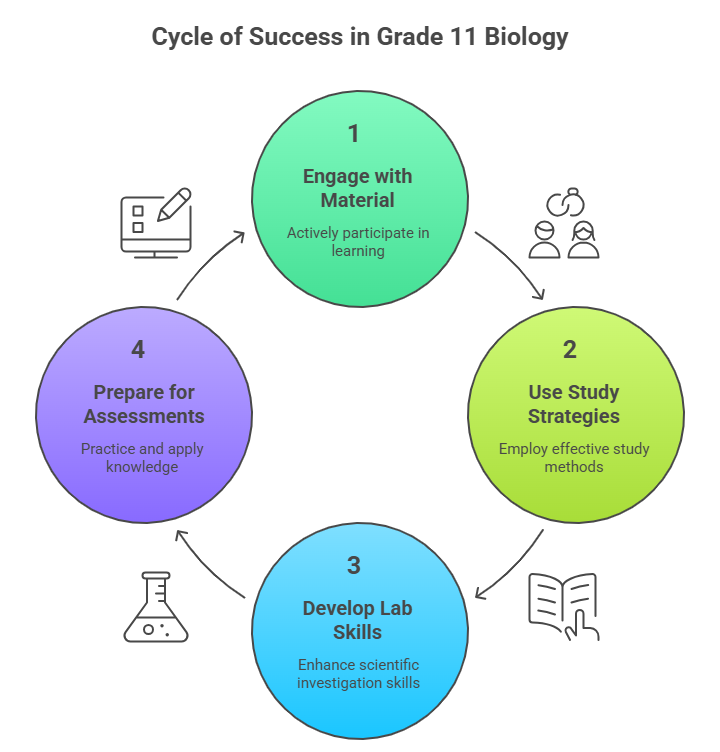
Success in Grade 11 Biology comes from steady work and smart ways to study. The class moves fast, so you need to keep up with the material. Your final grade is based on many checks throughout the year. What you do lately matters a lot for how your achievement is seen.
Having strong scientific investigation skills is just as important as knowing the facts. Picking up some main evaluation strategies and learning methods will help you understand and do better in class. Use these tips to go through the course with more confidence.
Study Tips and Learning Strategies
To do well in Grade 11 Biology, use effective study strategies. Don’t just read engage with the material. Put ideas in your own words and make flashcards for key terms to help move information into long-term memory. Draw diagrams to visualize biological processes. Use digital resources like animations, virtual labs, and forums for active learning.
Here are some things you can do:
- Review your notes after every lesson.
- Make a study group to discuss challenging topics.
- Use online resources and videos for better understanding.
- Practice with old quizzes or sample questions.
- Create concept maps to connect ideas.
- Ask your teacher if you’re confused.
Lab Skills and Assessment Prep
A big part of Grade 11 Biology is developing your scientific investigation skills. You’ll learn how to safely conduct experiments in both real and virtual labs, following procedures, recording observations, and analyzing data to draw conclusions. Assessment preparation goes beyond theory—you must also apply your learning. Practice interpreting graphs, reviewing case studies, and solving problems. Your grade reflects your ability to use knowledge in different scenarios.
To boost your lab skills and prep for assessments, try to do these things:
- Always go through the lab procedure before you start.
- Practice drawing and labeling your biological diagrams so they are clear.
- Know why you are doing each step in an experiment.
- Review all the feedback on your assignments to learn what you can work on.
- Learn to write clear and simple lab reports where you explain your findings.
Resources and Pathways
There are many resources that help you on your learning path. This course often uses textbooks, online labs, and other tools. These are used to help you learn about hard topics. The goal is to support you in reaching the biology 11 learning outcomes and do well in your learning.
When you finish this course, you can choose from a lot of academic and job options. Soon, we will look at some good tools you can use now and what you can get after Grade 11 Biology.
Recommended Tools and Texts
The Grade 11 Biology course uses a mix of print and digital resources. The main textbook is usually “Nelson Biology 11,” but teachers may offer additional materials to support student learning. Online platforms, such as USCA Academy, provide access to useful digital tools, including virtual labs from HHMI’s BioInteractive and McGraw Hill. These online resources let you try experiments that may not be available in your school lab. To help you understand concepts better, here are some key resources commonly used:
- A main textbook, such as Nelson Biology 11.
- Online tools with simulations and animations.
- Virtual labs for interactive experiments.
- Discussion forums for collaborative learning.
- Videos that explain complex ideas.
Career and Academic Pathways After Grade 11 Biology
Finishing Grade 11 Biology is essential for opening up many career and academic pathways. This course prepares you for university and college applications, showing you’re ready for advanced study in science. It’s particularly valuable for students interested in health sciences, environmental studies, or biotechnology, and it helps develop critical thinking and lab skills useful in both school and future jobs. Accommodations are available so everyone has a fair chance to succeed. Completing Grade 11 Biology can lead to further study and careers in:
- Medicine and healthcare (doctor, nurse, pharmacist)
- Scientific research
- Biotechnology and genetics
- Environmental science and conservation
- Veterinary medicine
- Kinesiology and sports science
Conclusion
To sum up, the Grade 11 Biology Curriculum in Canada is a key step for students who want to grow in their studies. It gives learners important facts about many types of living things, genetics, how cells work, and human bodies. This helps students understand biology in a full way. If you are a Canadian student or someone from another country, this curriculum gives you a strong base for what comes next, like getting ready for university.
When you use good study habits and take help from resources, you can do well in knowing and using biology ideas. If you want to know more about the Grade 11 Biology Curriculum and what you can get from it, talk to us today!
Frequently Asked Questions
1. What are the prerequisites for taking 11 Biology in Canada?
The Grade 11 University Preparation Ontario biology course (SBI3U) needs you to complete Grade 10 Science, Academic (SNC2D) first. The Ministry of Education set this rule. This helps make sure you get the important basics you need before moving on to harder Ontario secondary school courses. Having this foundation will help you do well in the Ontario biology course and other subjects after that.
2. Are there online and international options for Grade 11 Biology at USCA Academy?
Yes, USCA Academy lets you take the USCA Academy Biology 11 course online. This way is good for both international and domestic learners who want an Ontario biology course credit. The course gives you all electronic sources you need and accommodations. This means learners from any place get the support they need.
3. How does completing the Grade 11 Biology course support university applications?
Grade 11 Biology at the university level is an important course if you want to study science or health in college. Your final grade in this course matters because many people and programs look at it when you apply through OUAC or OCAS. If you get a good grade, it will help your academic record look strong. It also shows that you can manage hard topics. This makes you a better choice for the programs you want to join.
4. Can I take Grade 11 Biology without Grade 10 Science?
No, you cannot take the Grade 11 University Preparation Ontario biology course if you have not completed Grade 10 Science (SNC2D). The ministry of education in Ontario set this rule. This is because they want all students to be ready for what is taught and the speed of the Ontario biology course.