


Key Highlights of MHF4U Curriculum
- Core Topics: The MHF4U advanced functions curriculum looks at the properties and key features of polynomial functions, rational functions, logarithmic functions, and trigonometric functions. You get to see how each of these work and what makes them special.
- Skill Development: You will build your understanding of rates of change, including the average rate of change, in this course. The grade 12 advanced functions curriculum helps you get better at mathematical processes, like solving problems and using critical thinking to find answers.
- Curriculum Alignment: The Ontario Ministry of Education has built this course to get you ready for studies at a university level. Their goal is to help you be prepared to go further in math.
- Assessment Structure: Your final grade will come from both your work during the term (which is 70% of the total) and your final evaluation (which is 30%) administered at the end of the course. Both parts check your knowledge, how you think, how you communicate, and how you use what you learn.
- University Preparation: The mhf4u advanced functions curriculum is needed for many university programs. Some programs also ask that you take the calculus and vectors course, so this class helps with that path too.
- Learning Support: There are resources that you can use like textbooks, online platforms like USCA academy, and help from your teachers. All these things are there to help you do your best.
Introduction to the MHF4U Curriculum
Welcome to your guide for the Grade 12 Advanced Functions course, also known as MHF4U. This course will help you learn more about rates of change and many different types of functions. The course description says you will look at how functions work, how to put them together, and ways to get a better understanding of mathematics and rates of change.
You will find that MHF4U learning goals and expectations are there to help you get better at math. These goals give you the skills you need and help you feel ready for what comes next after high school. What you learn here will also play a big part in your final grade and the path you take in your future studies.
How MHF4U Fits into the Ontario Curriculum
The MHF4U course is a key part of the Grade 12 University Preparation path for high school students in Ontario, preparing them for the next steps in their mathematics education. It follows the curriculum expectations made by the Ontario Ministry of Education. These rules help you learn what you need for a variety of university programs.
Having this setup from the ministry of education helps with program planning for students who want to go into science, engineering, or business. The Grade 12 Advanced Functions curriculum, which involves the use of the mathematical processes, is important for high school. It often needs to be finished before taking the MCV4U (Calculus and Vectors) course. It helps you build a strong base in math so you are ready for university study.
Understanding Functions and Their Applications
A main goal of MHF4U is to teach you about different types of functions and how they work. You will study polynomial, trigonometric, logarithmic, and rational equations and rational functions by examining their graphs and algebraic properties. You will learn to identify key features like end behavior, axis intercepts, and how transformations affect graphs. The course also covers rates of change, helping you understand both average and instantaneous rates. These skills are foundational for calculus and are useful in real-life situations, such as science and finance. MHF4U prepares you for advanced math questions that require these abilities.
Mathematical Reasoning and Problem-Solving Skills
Besides teaching you about functions, MHF4U helps you improve problem-solving skills using critical thinking, following the Ontario curriculum. The course focuses on how you get an answer, not just what the answer is. You learn to choose and use different methods for various problems.
You practice the seven mathematical processes from the Ontario curriculum in every unit. These help you guess and check, justify choices, organize ideas, make connections, support predictions, and check your answers.
By building higher-order thinking in MHF4U, you gain skills for other subjects and future jobs, like:
- Sticking with tough problems and spotting patterns.
- Using logical thinking for new problems.
- Applying math to real life, like using radians in physics or engineering.
Communication and Representation in Mathematics
In math, getting the right answer is important, but it’s not the only thing you need. You must explain your thoughts in a clear and easy-to-understand way. MHF4U helps you build these skills. You learn how to use the right math words, symbols, and ways of writing. This helps you share your ideas in the best way, whether you are giving a solution, making a graph, or talking in class.
The course asks you to show math ideas in more ways than one. For example, you look at how algebraic representations of the corresponding trigonometric ratios and functions match up with how their graphs look. Knowing how to switch from numbers, graphs, and algebraic representations of the corresponding trigonometric functions helps you understand deeply. It gives you more ways to solve problems.
You will practice good communication and take control of your own learning in this course by:
- Sharing what you know with classmates by talking or writing.
- Thinking about your own learning so you know what you do well and what to get better at.
Curriculum-Based Assessment and Evaluation
Assessment in the MHF4U course adheres to the “Growing Success” document from the Ontario Ministry of Education. The primary aim is to enhance student achievement and your learning rather than merely evaluate your knowledge. Teachers employ fair, transparent, and diverse assessment methods, providing multiple opportunities for you to demonstrate your understanding.
You will receive consistent, descriptive feedback that is straightforward, timely, and aimed at guiding you toward improvement. Your final grade comprises 70% from term work and 30% from a final assessment. These evaluations correspond to the four dimensions of the achievement chart, which will be discussed in detail in the following sections.
Knowledge and Understanding
The “Knowledge and Understanding” part of the achievement chart measures how well you understand the main ideas from the MHF4U course. It is worth 25% of your grade.
You are graded on your ability to recall facts, use correct math terms, and perform standard math procedures across all topics. You need to identify key features of polynomials and apply laws of logarithms to simplify expressions.
Your achievement is based on your performance in quizzes, tests, and assignments, which assess your knowledge of advanced functions. This foundation is necessary for tackling more complex questions later in the course.
Thinking and Inquiry
The “Thinking and Inquiry” category checks how well you use critical and creative thinking skills to solve new or hard problems. It is worth 25% of your term mark. You need to make and follow a plan to solve multi-step problems, connect different math ideas, and justify your choices using math skills. You will be assessed through investigations, open-ended assignment questions, and challenging exam questions. The goal is to show that you can apply your knowledge in new situations and think deeply about math.
Communication
The “Communication” category is worth 25% of your term grade. To do well, you need to clearly explain your math ideas using correct vocabulary, symbols, and formats. Make sure your graphs are labeled and your steps are easy to follow. Teachers look for clear explanations in your homework, discussions, and test answers. Strong communication helps your grades and improves your understanding because you need to make your ideas clear.
Application
The “Application” category is 25% of your term grade and measures how well you use mathematical knowledge to connect concepts within math and with real-world situations. You will be assessed on your ability to apply classroom learning to solve problems outside of school.
To succeed in this category, you need to use math skills to address everyday problems. For example, you might use exponential functions to model population growth or trigonometric functions to solve physics-related challenges. This demonstrates that math is practical and relevant beyond textbooks.
Teachers use strategies like word problems, modeling tasks, and project assignments to evaluate your readiness for university programs that require real-life problem solving in math. In this category, you will be graded on your ability to solve new problems using your mathematical understanding.
Comparing Curriculum Expectations vs. Classroom Learning
Aspect | Curriculum Expectations | Classroom Learning |
|---|---|---|
Purpose | Sets up a way for effective learning and provides a clear guide for teachers during the school year. | Learning can vary daily based on student feedback and classroom dynamics. |
Guidance | Connects lessons with the Ontario curriculum and its goals. | Teachers adapt lessons using observations of students’ needs and responses. |
Critical Thinking | Encourages students to engage with curriculum goals. | Facilitates critical thinking and problem-solving as issues arise in the classroom. |
Learning Experience | Provides a structured set of goals for student learning. | Each student may have a different experience based on learning activities and support. |
Mathematical Processes | Aligns with expectations in understanding polynomial functions and rates of change. | Offers moments for students to better grasp mathematical concepts through practice. |
Overall Alignment | Curriculum expectations guide the learning framework. | Classroom experiences are tailored to foster understanding, matching curriculum goals. |
Resources that Support the MHF4U Curriculum
To succeed in MHF4U, you have access to many resources that help you learn. The ministry of education gives the official curriculum document. This document is the main guide for the course. Still, you can learn more with other tools.
Some resources are books and study guides. Others are online learning and use digital tools. Another important support is the help you get from your teacher and classmates. Talking with them lets you ask questions and feel more sure of yourself. The next sections will look at these support systems in more detail.
Textbooks and Ministry Documents
The main textbooks for the MHF4U course are McGraw-Hill Ryerson Advanced Functions 12 and Nelson Advanced Functions 12. These books follow the Ontario curriculum and are approved by the Ministry of Education. They provide explanations, worked examples, and practice problems for every unit and lesson. Using these textbooks will support your class learning.
The key ministry document for the MHF4U course is The Ontario Curriculum, Grades 11 and 12: Mathematics, published by the Ministry of Education. This document outlines the curriculum expectations, course structure, and assessment guidelines that your teacher uses. While you don’t have to read the whole document, knowing about it helps you understand what you are expected to learn.
Your course outline, usually available on your school’s website or learning portal, gives the schedule, topics, major assignments, and grading breakdown for the term. Using the course outline along with your textbook will help you stay organized and prepared for class.
Online Platforms and Study Guides
Online platforms and digital tools are essential for success in MHF4U. Use the Desmos graphing calculator to visualize and analyze math functions and graphs. For data analysis and working with math functions, use Google Sheets or Microsoft Excel. Use presentation software to share your project findings. To reinforce learning, access extra lessons, practice quizzes, and study guides on educational websites and YouTube channels.
For effective studying:
- Practice Actively: Use online quiz platforms before tests to assess your understanding.
- Visualize Concepts: Use graphing tools to help you better understand math concepts by seeing them in visual form.
Teacher and Peer Support
Support from teachers and friends is very important when you are working through the MHF4U curriculum. USCA Academy gives a lively place where students talk with teachers and each other. These chances to work together help students understand mathematical processes better and develop strong critical thinking skills.
USCA Academy uses different evaluation strategies and gives descriptive feedback. This way, each student gets support that fits their own education plan. This way to learn helps students really understand advanced functions and also helps them feel like they belong and are part of the community.
Practical Tips to Succeed in the MHF4U Curriculum
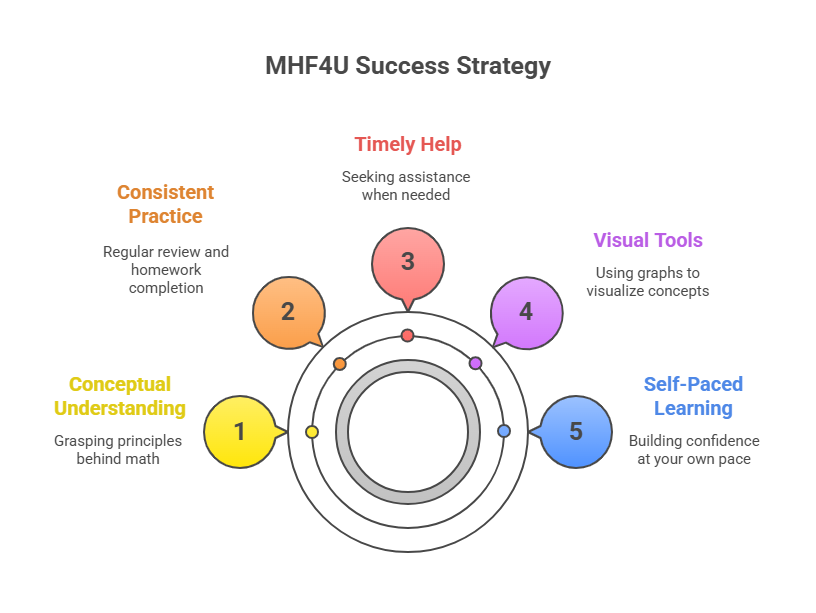
Success in MHF4U comes from steady work and good study habits. To ensure you learn effectively, never fall behind. Review your notes after every class and complete your homework promptly. This practice will enhance your retention and make studying for tests easier. If you encounter difficulties, seek help from your teacher or classmates immediately.
Additionally, strive to understand the reasoning behind mathematical concepts instead of merely memorizing procedures. Focus on grasping the principles that govern the steps or formulas. Utilize graphing tools to visualize how changes in numbers affect functions. This approach promotes effective learning and prepares you for future concepts. By working at your own pace, you will build confidence and perform well in the course.
Conclusion
In the end, MHF4U is an important part of school in Ontario. It teaches students about advanced math and how people use these ideas in real life. The course helps the students think about problems in math and find answers in new ways. This makes them ready to understand harder ideas and do better at school. Knowing how you will be marked and using things like textbooks, online tools, and help from friends, especially for those with special education needs, is key to doing well. Groups like USCA Academy help a lot, too.
They guide people and give one-on-one help so every student can learn what is needed in the course, including preparation for their final exams. Use these tools and tips to get the most out of your time in MHF4U. If you want to do even better, you can book a free talk with the experts now and get help for your study path.
Frequently Asked Questions
1. Is MHF4U Required for University Admission in Ontario?
Yes, MHF4U is needed for a lot of programs. Many university program paths in science, business, and engineering ask for it. You will find it in the Ontario curriculum. You have to take this before you can get into the Calculus and Vectors course (MCV4U). This is true if you want to study these subjects and get into most programs.
2. Where Can I Find a Sample Course Outline for MHF4U?
You can get a course outline on your school board’s website or the website of your school. There is an official document the ministry of education puts out. This has every unit and lesson in it. You can download this from the Ontario Ministry of Education website.
3. Does the curriculum change between in-person and online courses?
No, the curriculum expectations stay the same for both in-person and online courses. The way learning happens, the teaching style, and the kinds of tests may change in an online course. Even with those changes, your report card will still reflect the same standards as required by an individual education plan.
4. How is the MHF4U curriculum different from MCV4U (Calculus & Vectors)?
MHF4U teaches the basics of different types of functions. You will learn about polynomial, logarithmic, and trigonometric functions. This course also shows you what rate of change is.
The vectors course, MCV4U, uses what you learned in MHF4U. In MCV4U, you will study more about differential and integral calculus and rate of change. This course also helps you understand how vectors work in math.