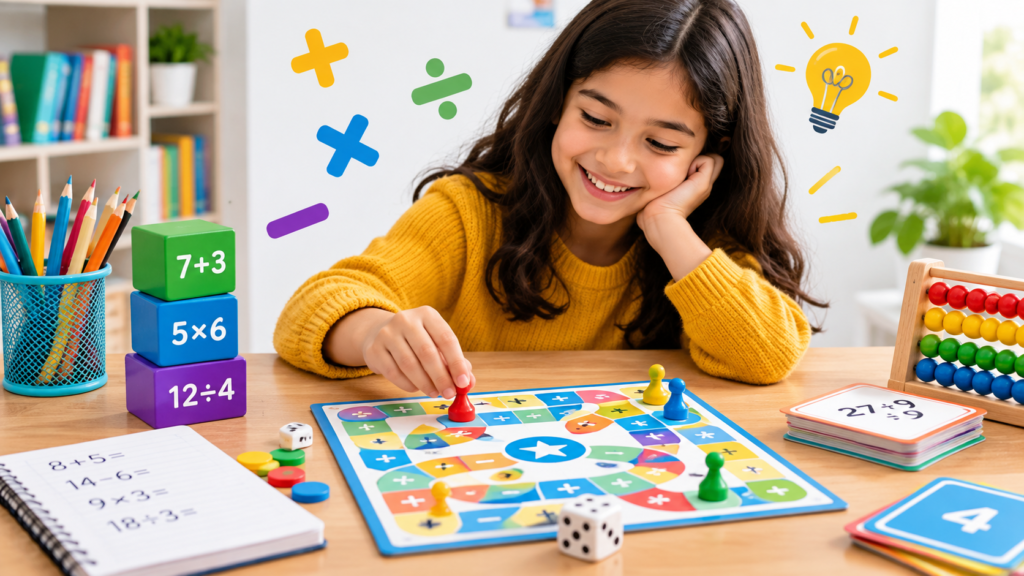

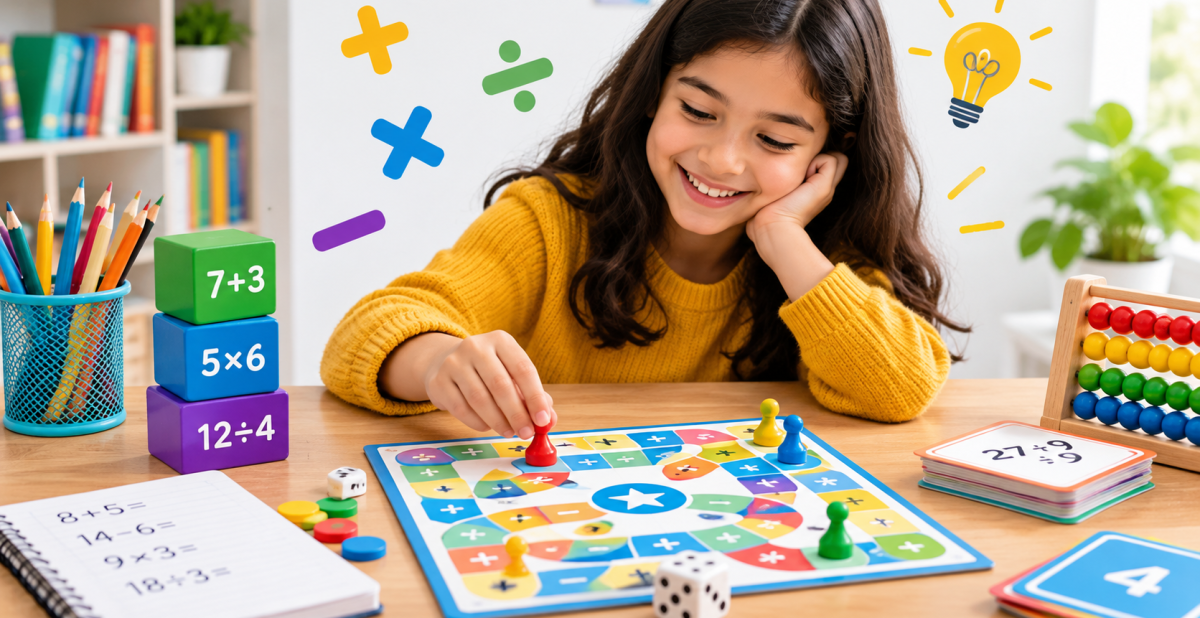
Fun math games help students practise skills like multiplication, fractions, and probability without the boredom of a worksheet. The National Council of Teachers of Mathematics states that meaningful, purposeful practice through games builds fluency better than isolated drilling. Games work best for reinforcing skills students have already been taught, not for introducing brand-new concepts from scratch. A 2022 systematic review in Education and Information Technologies found a small but real positive effect of digital game-based learning on math achievement in K-12 students. The tradeoff is that games alone are not a full replacement for structured lessons and feedback from a teacher.
Key Highlights of Fun Math Games for Students
- The NCTM’s Principles and Standards for School Mathematics states that meaningful practice, not isolated drilling, builds number fluency.
- A 2022 systematic literature review found digital game-based learning produces a measurable, if modest, positive effect on K-12 math achievement.
- Card games like UNO have been formally studied and adapted by university researchers to teach concepts like determinants and probability.
- Games work best as a supplement to, not a replacement for, direct instruction and teacher feedback.
- Board and card games with no screen at all remain some of the most researched and effective math practice tools for younger students.
The fastest way to make math practice less painful is to turn it into a game, because games make repetition feel like play instead of a chore. The National Council of Teachers of Mathematics has stated directly that meaningful, purposeful practice builds real number fluency better than isolated, repetitive drilling.
That distinction matters. A worksheet with 40 identical multiplication problems and a multiplication card game both provide repetition. Only one of them keeps a student engaged long enough to finish the practice at all.
This matters right now because many students lost ground on basic math fluency in recent years, and researchers at institutions like UCSF have specifically studied games as a tool for recovering that unfinished learning without adding more stress to the classroom.
Why Games Actually Work for Math Practice
Games work because they hide repetition inside a goal the student actually cares about, like winning a round or beating a personal score. A 2022 systematic review published in Education and Information Technologies looked at digital game-based learning across K-12 math classrooms and found a measurable, though modest, positive effect on achievement.
What games are good for:
- Reinforcing a skill that has already been taught in class.
- Building speed and automatic recall, like times tables.
- Practising probability, data, or logic concepts through repeated trials.
What games are not good for:
- Introducing a brand-new concept a student has never seen.
- Replacing structured feedback from a teacher on a specific error.
A mistake to avoid: using a game to teach a topic for the first time. Save games for the practice stage, after the initial lesson, when the goal shifts from understanding to fluency.
Games for Elementary Students (Grades 1 to 8)
Younger students benefit most from games that build number sense and basic operations, since these skills form the base for every math course that follows in high school. USCA Academy’s elementary school program builds this kind of hands-on practice into daily Grade 1 to 8 instruction rather than treating it as an extra.
1. Math Bingo (Multiplication and Addition Facts)
Print bingo cards with answers instead of numbers, then call out equations like “7 times 8.” Students find the matching answer on their card. This turns fact recall into a group activity instead of a timed sheet.
2. Around the World (Mental Math Speed)
One student stands next to a seated classmate. The teacher shows a flashcard. Whoever answers first moves to the next seat. This works for addition, subtraction, or multiplication facts and needs zero materials beyond flashcards.
3. UNO Math Variants (Number Recognition and Operations)
Standard UNO already reinforces number matching. Teachers and researchers have created adapted versions where players must state the sum, difference, or product of two cards before playing them. University research has specifically studied card-game adaptations like this for teaching mathematical concepts at multiple age levels.
4. Fraction War (Comparing Fractions)
Deal a deck of cards showing fractions instead of standard suits. Two players flip a card each; whoever has the larger fraction keeps both cards. This makes comparing fractions a fast, repeated skill instead of a one-time worksheet task.
5. Math Jeopardy (Mixed Review)
Build a simple grid of categories and point values covering a unit’s topics. Students choose a category and value, then answer to earn points. This format works well for reviewing an entire unit before a test, since it mixes skill types the way a real test does.
Games for Middle and Early High School (Grades 7 to 10)
At this level, games should start reinforcing algebraic thinking and problem structure, not just arithmetic speed.
6. Algebra Tiles Puzzle Race
Using physical or digital algebra tiles, give students an equation to model and solve using the tiles instead of only symbols. Racing to solve correctly first adds motivation while reinforcing the visual model behind the algebra.
7. Prime Climb (Number Theory and Operations)
This board game uses color-coded numbers to teach factors, multiples, and prime numbers through gameplay rather than a worksheet. It works well for reinforcing MPM1D and MTH1W topics under Ontario’s Grade 9 math curriculum.
8. Set (Pattern Recognition and Logic)
Players find sets of three cards that share or completely differ in every attribute. This builds the same logical reasoning skills used in geometry proofs and probability, without ever mentioning either subject directly.
9. DETerminator-Style Card Games (Matrices and Determinants)
University researchers have designed and tested card games specifically for teaching matrix and determinant calculations to students, finding measurable engagement gains over lecture-only instruction. A simplified classroom version can turn a normally dry MHF4U or first-year university topic into active practice.
Comparison table: choosing a game by goal
| Goal | Best Game Type | Grade Range |
| Fact recall speed | Bingo, Around the World | Grades 1-6 |
| Fraction and decimal comparison | Fraction War, card decks | Grades 4-8 |
| Algebra and equation structure | Algebra Tiles Race | Grades 8-10 |
| Number theory and factors | Prime Climb | Grades 6-9 |
| Logic and pattern recognition | Set | Grades 6-12 |
Games for Senior High School (Grades 11 and 12)
Senior students preparing for MCR3U, MHF4U, or MDM4U benefit from games that simulate real decision-making under uncertainty, since these courses lean heavily on functions, data, and probability.
10. Probability Dice Duels (Data Management, MDM4U)
Students roll dice combinations and bet points on outcomes based on calculated probability, then compare their prediction to the actual result. This reinforces expected value calculations in a way a static worksheet cannot.
11. Function Match Card Game (Functions, MCR3U and MHF4U)
Create cards showing graphs, equations, and tables. Students race to match all three representations of the same function. This directly targets the multiple-representations skill that Ontario’s curriculum lists as a core expectation for functions courses.
12. Compound Interest Simulation Game (Personal Finance Strand)
Give students a starting balance and a set of investment or loan scenarios. Students calculate compound interest over several rounds and compare outcomes. This connects directly to the personal finance strand inside Ontario’s Grade 11 and 12 math curriculum, which is also covered in USCA Academy’s online school courses for students who prefer a flexible schedule.
How to Pick the Right Game for Your Student
Not every game fits every situation. Matching the game to the goal prevents wasted time on an activity that looks fun but does not build the target skill.
A decision framework:
- Identify the exact skill that needs practice, not the general subject.
- Check whether the student has already learned the concept in class.
- Pick a game type from the tables above that matches both the skill and the grade level.
- Set a time limit, since even good games lose value after 20 to 30 minutes without a break.
- Follow up with 3 to 5 written problems to confirm the skill transferred beyond the game.
A tradeoff to know: digital games are easier to source and often self-grading, but board and card games build more discussion and reasoning out loud, which matters for concept retention. Our guide on AI for math learning covers a related tradeoff between AI tools and hands-on practice for building real skill instead of just getting a quick answer.
Common Mistakes When Using Math Games
- Using a game to introduce a topic the student has never seen before class.
- Choosing a game based on entertainment value alone, without checking the skill it targets.
- Letting game time replace all written practice instead of supplementing it.
- Picking a game too far below or above the student’s current skill level, which removes the challenge or the fun.
- Never following up with a few written problems to confirm the skill actually transferred.
Conclusion
Fun math games work best as a targeted tool, not a full curriculum. Match the game to the exact skill your student needs, keep sessions short, and follow up with a few written problems to confirm the practice actually stuck. Research from NCTM and multiple university studies backs this approach for building real fluency, not just short-term entertainment.
If you want games built directly into a structured math curriculum instead of managing this on your own, explore USCA Academy’s elementary school program or our credit courses in Mississauga for high school students. Apply for the current intake to see how our small class sizes fit hands-on practice into every unit.
Frequently Asked Questions
1.Do math games actually improve grades?
Research shows a measurable, though modest, positive effect on math achievement from game-based learning. Games work best as a supplement to direct instruction, not a replacement for it.
2.What age group benefits most from math games?
All age groups benefit, but the type of game should change. Younger students need fact-recall games, while senior students benefit more from games involving functions, probability, and data.
3.Are digital math games better than physical board games?
Neither is universally better. Digital games are easier to source and self-grading, while physical card and board games encourage more verbal reasoning and discussion between players.
4.Can math games replace regular homework?
No. Games work best as a supplement for reinforcing already-taught skills, not as a full replacement for structured practice and teacher feedback on written work.
5.How long should a math game session last?
Most game sessions work best at 20 to 30 minutes. Longer sessions without a break tend to lose their engagement and learning value.
6.What is the best free math game for multiplication facts?
Around the World and Math Bingo both work well for multiplication facts and need no special materials beyond flashcards or printed cards
7.Are card games like UNO actually useful for teaching math?
Yes. Researchers have studied and adapted UNO and similar card games specifically for teaching number operations, probability, and even university-level matrix concepts.
8.How do I know if a math game is working for my child?
Follow every game session with 3 to 5 written problems on the same skill. If the student solves them correctly and explains their steps, the skill has transferred beyond the game