Key Highlights of what is curriculum
- A curriculum is a plan made by officials that shows what students need to learn in every grade and each subject.
- In Canada, each province gets to set the curriculum, and in Ontario, the Ministry of Education looks after it.
- The curriculum has learning goals, subjects, what will be taught in the course, and how students will be checked on what they learn.
- It is not the same as a syllabus. A syllabus is the teacher’s plan for one course.
- The curriculum makes sure all students get the same good level of learning.
- These days, the curriculum also helps students build important skills for this time, like critical thinking and solving problems.
Introduction
Welcome to our guide about the school curriculum. If you want to know what helps a student’s learning path, it is the curriculum. So, what is curriculum? It is a simple guide that schools use to ensure each student acquires the right knowledge and skills for success in a traditional classroom. The education system can seem hard to understand, especially if you are new. This guide will use easy words to explain what the curriculum is. You will learn how the curriculum works in Canada and why it is important for student needs.
What is Curriculum? Meaning and Definition
So, what is the definition of curriculum in education? Think of the curriculum model as the main plan for learning. It is a clear layout that tells what educational content and activities should be for each course or grade level. It helps you know the big things: What should students learn? What skills do they need to get? How do we know they learned it? This setup lets student learning stay fair and makes learning build and connect from one year to the next.
The curriculum is not just a wall of topics. It is what the whole education system wants for all students, mixing both local and world ideas. It explains the educational goals and main values that every school tries to share with its students, creating a supportive classroom environment. In places like Ontario, every school that gets public money uses this official plan. The goal is for all students to have a good and equal chance to learn.
What Does a Curriculum Include?
A curriculum is a document that has many important parts. The curriculum does more than just list what subjects you will have in class. It shares the basic educational objectives that guide the whole learning process, and a major part of the curriculum is to say what learning outcomes you should reach by the end.
The curriculum lets you know what you will study in your course of study, and how they will check your progress. Here are the main parts to know: the learning goals, the subjects and what they cover, and the way teachers will teach and test students.
Learning Goals and Outcomes
One of the most important parts of any curriculum is to have clear learning goals and outcomes for effective curriculum planning. These are statements that show what students need to know and be able to do at the end of a grade or course. They help guide both teaching and learning.
In the Ontario written curriculum, these educational goals are split into two types. The first is “overall expectations.” These say in general what knowledge and skills students need. The second is “specific expectations.” These give more detail about what students must learn.
Course objectives help everyone, like students, parents, and teachers, to understand what is needed for success in each subject. The main learning outcomes often focus on:
- Using knowledge in real life.
- Building specific skills, like writing or problem-solving.
- Knowing key ideas in a subject.
- Showing learning in different ways.
Subjects and Course Content
The curriculum lists the specific subjects and the content you need to cover in higher education. This subject matter is what you learn—the knowledge you get in each area. The curriculum sets up this content by putting it into different subjects and groups.
For each particular subject, the curriculum gives you a clear path to follow. For example, the math curriculum will tell you the topics you study in Grade 9. The science curriculum will also lay out the science concepts for Grade 10. This way, learning happens in steps, and you can grow each year by building on what you learned before.
The curriculum makes the content clear and simple so teachers can use it when planning lessons. It usually has:
- Core subjects like Mathematics, Science, and English.
- Arts and Social Sciences such as History, Geography, and Visual Arts.
- Health and Physical Education.
- Technological Education and other electives.
Teaching Methods and Assessment
A curriculum, which is integral to curriculum theory, guides what to learn and how teachers teach and assess your progress. It provides teaching methods and ways to measure learning. In Ontario, teacher supports like examples and resources help teachers plan lessons, with sample questions and project ideas. Assessment means gathering information on your skills and understanding to help you improve, while evaluation reviews your work to assign grades. Teachers use various assessment strategies to check learning outcomes. Some common methods are:
- Tests and quizzes.
- Projects and presentations.
- Classroom discussions and participation.
- Essays and lab reports.
Types of Curriculum Explained Simply
- The national and provincial curriculum refers to the official educational frameworks set by government authorities, such as the Ontario Ministry of Education curriculum, which outline the subjects, objectives, and standards that students are expected to learn throughout their schooling.
- School-based and classroom curriculum emphasizes the specific educational experiences and instructional strategies implemented by individual schools and teachers, tailored to meet the needs of their unique student populations while adhering to broader educational guidelines, often incorporating a spiral curriculum to enhance learning outcomes.
- The formal curriculum is the official, written plan created by authorities, detailing the subjects, goals, and standards necessary for a basic education that all students receive.
- The hidden curriculum encompasses the unspoken lessons learned at school, such as values and social skills, while informal education includes learning experiences outside of the classroom, like field trips and club meetings, contributing to holistic development. Together, these types of curriculum provide a comprehensive educational experience, addressing both academic knowledge and essential life skills.
Curriculum in Canada and Ontario Schools (Official Overview)
In Canada, education is managed by each province, leading to varying curricula. The Ontario Ministry of Education designs the private school curriculum Ontario for publicly funded schools, which many private institutions, like USCA Academy, also adopt to help students achieve the Ontario Secondary School Diploma (OSSD). The curriculum supports teachers while allowing flexibility in lesson planning.
| Section | Purpose |
|---|---|
| Program Planning | Contains policy information for all subjects, Grades 1-12. |
| Curriculum Context | Provides subject-specific information, like vision and goals. |
| Curriculum Expectations | Mandatory knowledge and skills students must learn. |
| Teacher Supports | Optional examples and resources to help teachers plan. |
Curriculum vs Syllabus vs Lesson Plan
| Aspect | Curriculum | Syllabus | Lesson Plan |
|---|---|---|---|
| Meaning | The overall plan for what students should learn in a school or educational process education system | A detailed outline of topics and expectations for a specific course or subject | A teacher’s daily or weekly plan for teaching a specific lesson |
| Scope | Broad and long-term | Medium and course-specific | Narrow and short-term |
| Covers | Learning goals, subjects, skills, teaching methods, and assessment | Units, topics, timelines, and assessment methods for one subject | Lesson objectives, activities, materials, and teaching steps that may include direct instruction |
| Who Creates It | Education authorities (e.g., Ontario Ministry of Education) or school boards | Schools or teachers based on the curriculum | Individual teachers |
| Time Frame | Several years or an entire grade level | One term or academic year | One class or a few lessons |
| Purpose | Guides what students should learn across grades | Guides what is taught in a particular subject | Guides how a lesson is taught in the classroom |
| Example (Canada) | Ontario school curriculum for Grades 1–12 | Grade 10 Mathematics course outline | A single math lesson on linear equations |
In summary, the curriculum is about “what” students will learn, the syllabus focuses on “how” the course will be taught, and lesson plans describe “how” today’s class will proceed.
Focusing on 21st Century Skills (STEM and Beyond)
Today’s curriculum is about more than just remembering facts. The focus is to help you build 21st-century skills for a world that changes quickly. These skills help you think in sharp ways, fix hard problems, and deal with new issues after you leave school.
The curriculum in Ontario puts skill development right in the lessons within the school environment. For example, when you are in a history class, you will use inquiry to explore different sides of an event from the past. You do more than just say the dates. This way, you join in and think in deeper ways.
The push for lifelong learning makes sure your lessons are useful and part of real life. Here are key 21st-century skills you will find in the curriculum:
- Critical thinking and problem-solving
- Creativity and innovation
- Communication and collaboration
- Digital literacy and global citizenship
Real-World Examples of Curriculum in Action
The curriculum is not just a paper that sits unused. Every day, it comes to life inside the classroom in educational institutions. Teachers use the curriculum for their own work in the curriculum planning process. They turn the big ideas in it into fun tasks and activities. This is what curriculum development looks like for teachers.
How the importance of curriculum is used can change a lot by grade level. The way it is brought to students in elementary school is not the same as in secondary school. Let’s look at some clear examples of these differences.
Elementary School Curriculum Highlights
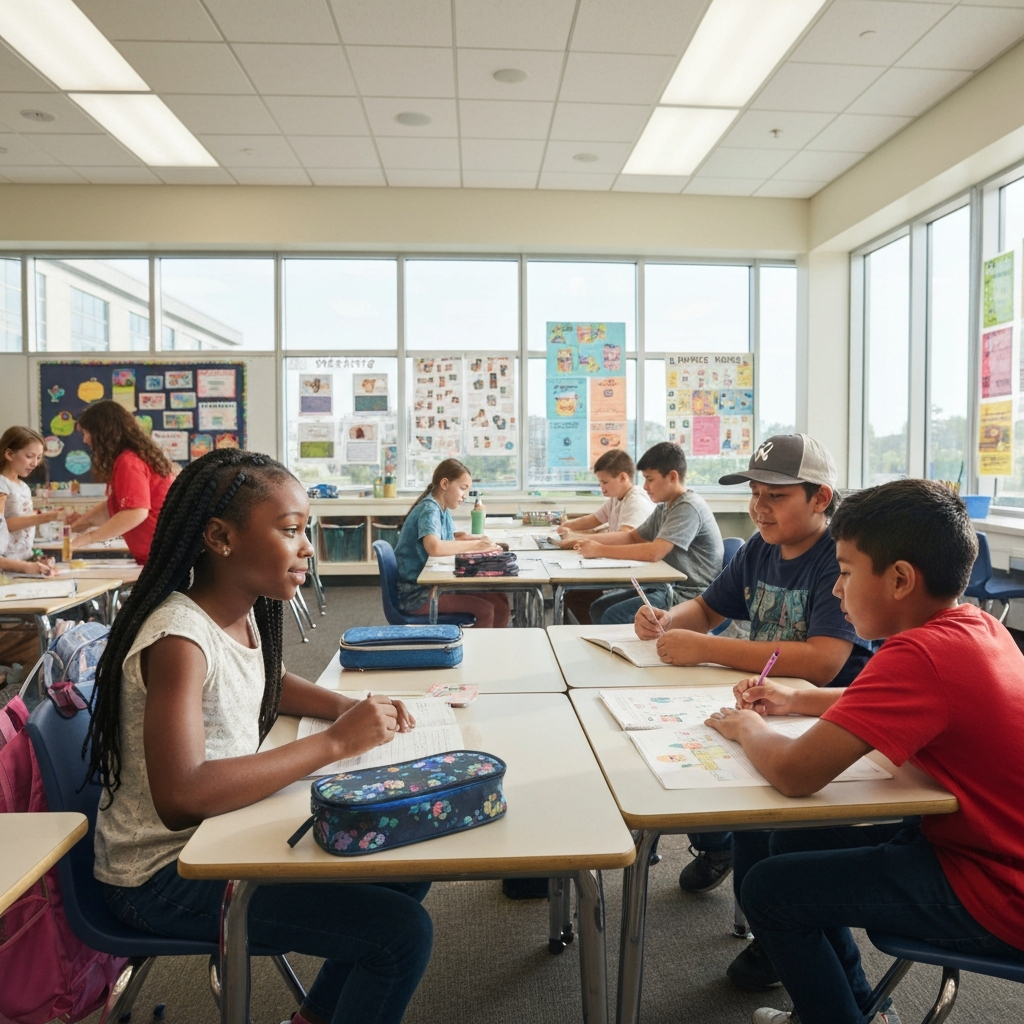
In elementary school, the elementary school curriculum Ontario curriculum works to help you build a strong start. The core curriculum in Ontario is there so all kids can get the literacy and numeracy skills they need. This helps prepare students for new and special learning as they grow up.
Courses of study in elementary school often connect. You can use your reading for a science lesson. You can try out your math skills in an art project. Teachers set up a good learning environment, so you feel supported while you try new things and find what you like.
The elementary curriculum uses holistic learning. Some of the main subjects are:
- Language, which means reading, writing, and oral communication
- Mathematics
- Science and Technology
- Social Studies, History, and Geography
- The Arts, like music, drama, dance, and visual arts
Secondary School Curriculum Structure
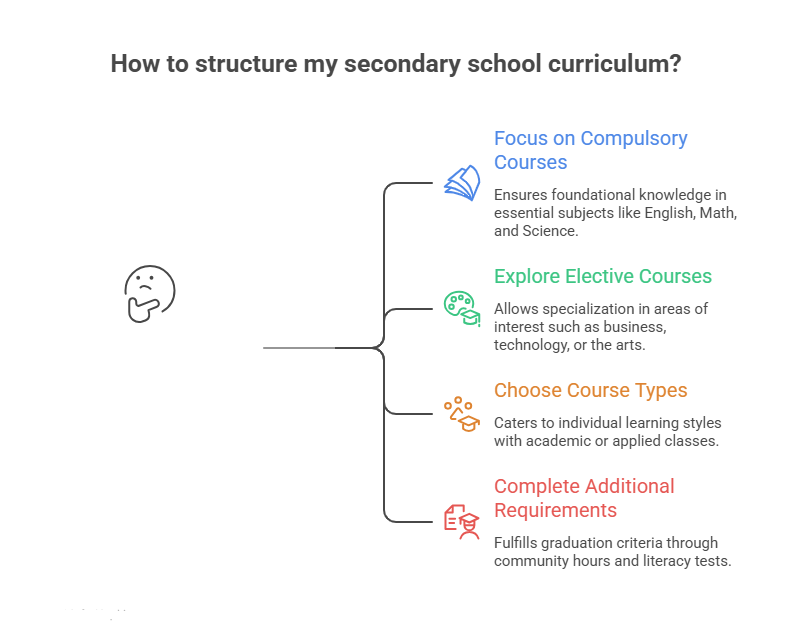
The secondary school curriculum in Ontario is set up in a different way. You do not get all your classes mixed together in the secondary school curriculum Ontario. Instead, you take the curriculum one particular course at a time. If you finish each course and pass, you get a credit for it. You need to get enough credits to graduate. The system lets students focus more on the subjects they like as they get closer to earning their diploma.
The OSSD curriculum is made to help students earn the Ontario Secondary School Diploma (OSSD). To get the OSSD, you have to finish some courses that are required for everyone, plus you can pick some others. A lot of parents look for a good international school or a top private school. They may choose a place like USCA Academy because they do well at helping students get all they need for the OSSD.
The curriculum for secondary school includes:
- Compulsory courses such as English, Math, and Science.
- Elective courses in areas such as business, technology, or the arts.
- Different course types so student learning can fit with what they need or want, like academic classes or applied classes in a particular class.
- Things you also have to do, like community hours and a literacy test.
Special Programs and Electives in Canadian Schools
The curriculum in Canadian schools is set up to be flexible. It aims to support every student in all areas of their life through active participation. Special programs and electives help with this. Electives are classes you pick based on what you like. This lets you try things that may become a job or just be a hobby, like robotics or photography.
For students who need more help, special education programs change the curriculum for them. These programs look at each student’s learning needs in comparison to the existing curriculum. The goal is to make school a place where all students can learn. This can mean using new teaching methods, changing how students are tested, or making the learning environment better for everyone.
The curriculum is about more than just classroom work. It gives students ways to get real-life experiences that help with personal growth. These can be:
- Specialist High Skills Major (SHSM) programs.
- Co-operative education (co-op) placements.
- Educational field trips and guest speakers.
- Extracurricular clubs and sports teams.
Why Curriculum Is Important for Students
- The curriculum provides a clear and structured path for students’ learning, outlining what needs to be accomplished each year and connecting current studies to future plans, creating a cohesive learning experience in their educational journey.
- A well-structured curriculum ensures that all students, regardless of their school, receive the same high-quality educational content and opportunities, promoting fairness and equality in the learning process.
- By addressing student needs, the curriculum opens up pathways for success in further studies and future careers, equipping students with the foundational knowledge required for their aspirations.
Conclusion
To sum up, knowing what the curriculum covers is important for students, parents, and teachers. A good curriculum gives you the steps you need to take for school success. It can also help make sure that students reach their goals and have the skills they need. When you learn about the curriculum in Canada, especially in Ontario, you will be able to go through your learning in a better way. It helps to know the difference between the curriculum and a syllabus, and to find out about the types of curriculum too. Knowing this can guide you to make better choices about school. If you have any questions or need help, you can always reach out!
Frequently Asked Questions
1. How does curriculum differ between provinces in Canada?
In Canada, there is not a national curriculum. The policy makers in each province create their own canadian education curriculum. They do this so they can focus on their local needs. Because of this, educational institutions in Ontario use a different curriculum from the one in Alberta or Quebec. So, classes, what students learn, and graduation rules are not the same across the country.
2. What role do teachers play in developing and implementing a curriculum?
Teachers are the ones who make the curriculum work in the classroom. They do not write the provincial curriculum, but they help bring it to life. They make lesson plans, pick teaching methods, and set up ways to check the process of learning and how well students learn. The work the teachers do and what they say about it can change curriculum development and help with new updates to the curriculum over time.
3. How does the curriculum impact a student’s educational journey and future opportunities?
The curriculum has a big effect on your whole learning path, as it helps to influence curriculum design by setting clear goals for what you need to know. The courses you take and what you learn in them decide if you can move on to other programs or jobs later. A strong curriculum helps with student learning and gives you skills for lifelong learning and success.