Key Highlights of sph4u curriculum grade 11
- The SPH4U curriculum helps you learn more about the main physics concepts and theories.
- In this course, you study five big areas. These are dynamics, energy, fields, the wave nature of light, and modern physics.
- The course focuses on building your scientific investigation skills. You get to do hands-on and analytical tasks.
- You will be graded through different tasks for your term grade. There is also a final summative test.
- If you finish SPH4U, you have a strong base for university science, engineering, and technology classes.
- Your learning experience is made to help you grow your critical thinking and problem-solving skills. These are important for doing well in the future.
Introduction
Welcome to Grade 12 Physics! The SPH4U curriculum gives you a chance to build on what you already know. It helps get you ready for school work that comes after this. In this guide, you will find everything you need to know about the Ontario physics curriculum for the course. It covers the main parts and explains how you will be checked or tested. Knowing what is in the course and what you have to do is a great way for student success. It helps you face and handle the hard parts of physics with confidence. When you understand this, you can work toward your goals.
SPH4U Curriculum Overview and School Comparison
The SPH4U curriculum, structured by the Ontario Ministry of Education, ensures a high-quality learning experience in advanced physics while developing essential analytical and problem-solving skills for post secondary education. Although the core curriculum remains consistent, learning environments vary. For instance, USCA Academy, a private school, offers smaller class sizes and dedicated support, preparing students effectively for university.
| Feature | Public School | Private School (e.g., USCA Academy) |
|---|---|---|
| Class Size | Typically larger, with more students per teacher. | Generally smaller, allowing for more personalized attention. |
| Support | Guidance counsellors and teachers available for support. | Enhanced student support services and dedicated guidance. |
| Flexibility | Follows a standard semester or full-year schedule. | May offer flexible scheduling, including fast-track options. |
| Resources | Standard access to school board-approved resources. | Often provides access to advanced learning tools and modern facilities. |
Core Units in the SPH4U Curriculum
Your Grade 12 Physics path is split into SPH4U units. Each unit covers certain SPH4U topics. The units start with things you know and move up to new, interesting ideas about modern physics. Every part helps you learn the basic rules that run our universe.
You will look at everything, from the forces that change how things move, to the weird ways light and matter act in quantum science. Let’s see what you will find in each of these exciting sph4u units that bring you closer to the fundamental principles of physics.
Unit 1: Motion and Forces in Two Dimensions
This unit builds on Grade 11 knowledge by exploring motion and forces in two directions. You start with vectors and relative motion, using examples like a boat moving in a river’s current. The unit deepens your understanding of dynamics, focusing on kinematics and Newton’s Laws in more complex, non-linear situations. You also learn about uniform circular motion, where objects move in a constant path. In SPH4U, you tackle these problems with more advanced methods, breaking down complex scenarios into manageable parts. This skill is key for future scientists or engineers, as it teaches effective strategies for tackling challenging problems.
Unit 2: Energy Transformations and Momentum
This unit explores motion, energy, and momentum. You will learn how work and energy are connected, including elastic potential energy in springs, to understand how energy moves and is stored. The principles of conservation of energy and conservation of momentum are key: in a closed system, total energy and momentum remain constant, even if their forms change. The unit examines energy transformations, impulse, and momentum in one and two dimensions. Real-life examples, like pool games and car crashes, show how these laws apply. Through activities and problems, you’ll see how conservation laws explain motion and interactions in everyday life.
Unit 3: Electric, Gravitational, and Magnetic Fields
In this unit, you will explore forces that act without contact, using invisible fields: gravitational, electric, and magnetic. You’ll learn how these fields are created, how they push or pull objects, and how they explain motions from planets to tiny particles. The unit covers electric fields, electric potential, and potential difference key concepts for understanding electricity. You’ll also study how magnetic fields relate to moving charges, introducing electromagnetism. These concepts apply to real life, such as how electric fields are involved in nerve function and how magnetic fields are used in MRI machines, showing the practical value of physics.
Unit 4: The Wave Nature of Light
Have you ever wondered what light truly is? In this unit, you’ll explore light as a wave, not just particles. You’ll learn about wave properties like frequency, wavelength, and interference, and see how they relate to light. Key topics include diffraction and polarization, which provide strong evidence that light behaves as a wave. Understanding these concepts explains phenomena like colorful oil puddles and how polarized sunglasses reduce glare. You’ll also study the electromagnetic spectrum, discovering that visible light is just a small part of a much larger range of energy that influences how we perceive and interact with the world.
Unit 5: Modern Physics Concepts
Get ready to see the world differently as you explore modern physics in this unit. You will learn about two major ideas from the 20th century: special relativity and quantum mechanics. Einstein’s theory of relativity shows how time can move differently for different observers and how energy and mass are connected by E=mc². Quantum mechanics introduces you to particles behaving as both waves and particles, and the limits of measuring their properties. This unit prepares you for further science studies, showing how new conceptual models and theories shape modern technology and our understanding of the universe.
Unit 6: Scientific Investigation Skills
Physics is not just about learning facts it’s about applying them. Unit 6 focuses on developing your scientific investigation skills. Here, you’ll design experiments, collect and analyze data, and interpret your findings. Emphasis is placed on effective data analysis and communication, both in writing and speaking. You’ll also strengthen your information literacy by learning to verify facts and use research properly. These skills are essential for any science-related career. Throughout SPH4U, you are expected to: formulate questions and hypotheses, use equipment safely, analyze data for trends, and clearly communicate your scientific findings using proper terminology.
Assessment Methods and Grading in SPH4U
Knowing how you will be checked is important to do well in SPH4U. Your final grade will show your level of achievement in the whole course. The SPH4U assessment plan checks what you know and what skills you have in different ways. This plan makes sure the grade is fair for everyone.
The final grade is not just from one huge test. You will get your grade from your work during the term and the final check at the end. Let me show you how your final grade is figured out and what the different parts of the SPH4U assessment mean for you.
How Your Final Grade is Calculated
The final grade in SPH4U is determined according to Ontario Ministry of Education guidelines. Seventy percent of your grade is based on term work, including tests, quizzes, lab reports, assignments, and presentations, reflecting your progress throughout the semester. The remaining thirty percent comes from a final summative evaluation, usually a comprehensive exam covering all key course concepts. This system ensures your overall achievement and understanding are fairly assessed. Your final percentage is then converted to a letter grade.
| Component | Weighting |
|---|---|
| Term Work (Tests, Labs, Assignments) | 70% |
| Final Summative Evaluation (Final Exam) | 30% |
| Final Grade | 100% |
Four Assessment Categories Explained
Your term work in SPH4U is assessed in four main categories, each focusing on different learning skills and achievement levels. Understanding these categories helps you target your efforts and showcase your abilities more effectively. Every assignment, test, or lab is graded using these four areas, and you receive feedback on your performance in each. This approach highlights your strengths and areas for improvement.
The four categories are:
- Knowledge and Understanding: Recall and explain physics concepts, ideas, and laws.
- Thinking: Use thinking skills like problem-solving and analysis.
- Communication: Express information clearly with appropriate formats.
- Application: Apply physics concepts to new situations and real-life contexts.
University Preparation and Career Pathways
SPH4U is more than a high school credit. It is a way for students at USCA Academy to get ready for college and many career opportunities. This course helps you learn what you need for programs in science, technology, engineering, and math (STEM). The skills you get in SPH4U are useful in a lot of fields.
People at USCA Academy use what they learn here in engineering, medicine, and the business environment. The thinking and problem-solving you do in physics will help you everywhere. This course gives you a strong start. It opens the door to a future where you can make a difference.
Why SPH4U Matters for STEM Programs
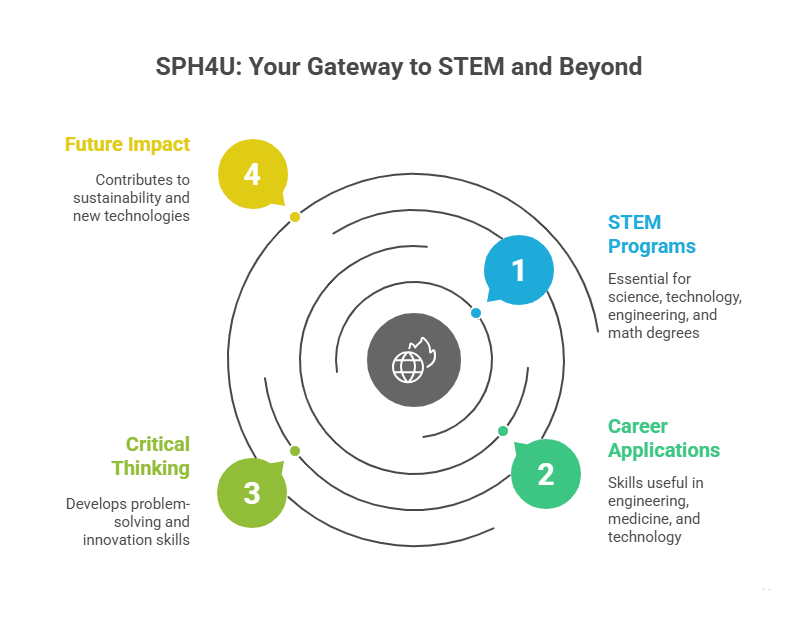
- SPH4U is essential for students aiming for STEM programs, as it is often required or highly recommended; excelling in this course signals readiness for challenging university degrees.
- The curriculum covers key topics like energy transformations and modern physics, aligning with first-year university engineering and science courses, giving students a strong foundation for further study.
- Beyond factual learning, SPH4U develops critical thinking and scientific inquiry skills, helping students prepare for future studies and careers where innovation and problem-solving are highly valued.
Future Career Applications in Physics
The SPH4U course gives you valuable skills and knowledge that open doors to many careers. Physics is vital in today’s industries, driving innovation and solving major challenges. With a strong understanding of physics, you can contribute to a sustainable future and explore new technologies, conduct important research, or analyze complex systems. Physics teaches both logic and creativity, which are highly valued by employers. Possible career paths include:
- Engineering: Building structures, electronics, or space systems.
- Medicine: Working with medical imaging or medical physics research.
- Technology: Software, data science, or renewable energy.
- Research: Physics or astronomy.
Conclusion
The SPH4U curriculum for Grade 12 helps students learn important physics concepts. This course helps you think in new ways and solve problems. You will study key areas like Motion and Forces, Energy Changes, and newer ideas in physics. By going through these units, you get ready for college and can even find good career opportunities in STEM fields. The curriculum also helps you feel sure about your studies and gives you a strong base for future goals in science or technology. If you want to join or want to know more about how SPH4U can help you, get in touch for more information!
Frequently Asked Questions
1. Are there any prerequisites needed before enrolling in the SPH4U course?
Yes, you need to finish SPH3U, Grade 11 University Preparation Physics before you can take SPH4U. This is needed so you have the basics to learn more in SPH4U. Some schools may ask for more, so the best thing is to ask your guidance counsellor.
2. Are there any recommended resources or textbooks to supplement learning in the SPH4U curriculum?
Yes, that’s right. Besides your textbook, there are many online resources you can use. These can be things like video tutorials and simulations. Your teacher will give you a list of resources that may help. You can also use computer programs for data analysis. Doing internet research for your projects is a good way to get better at the material.
3. What types of assessments and evaluations can students expect in the SPH4U course?
Students will take different types of tests to show their learning skills. You will do unit tests, quizzes, lab work, research projects, and other assignments. At the end, there is a final exam which goes over the big ideas from every unit. This final exam helps decide your final grade.