Key Highlights of ministry of education
Here are the key takeaways about the Ministry of Education in Ontario:
- The ministry oversees publicly funded education from kindergarten to Grade 12, including the delivery of core services.
- It sets policies for child care and early years programs to ensure children get a strong start.
- Education governance in Canada is a provincial responsibility, making the Ontario ministry the key authority in the province.
- It provides resources and support for all learners, including students with special needs and those from First Nations communities.
- The ministry develops curriculum, sets graduation requirements, and inspects private schools.
- It funds various education programs and manages the public library plan to support lifelong learning.
Introduction
Welcome to our guide about the Ministry of Education in Ontario. If you are a parent, a student, or a teacher, knowing about this group can help you with the Canadian education system. The Ministry of Education Ontario is in charge of how students learn, starting from their first day in kindergarten up to when they finish their secondary education. In this article, we will talk about how it is set up, what help it gives, and ways it makes sure every student gets a good education.
Understanding the Ministry of Education in Canada
The term “Ministry of Education Canada” can be confusing. There is not one federal group that runs all the schools in the country. In Canada, each province and territory manages its own schools. They do this through their own ministry of education.
This setup is not the same as having just a single “department of education vs ministry of education” for the whole country. The power to set rules stays with the provinces. For example, in Ontario, the ministry works under the Education Act. This guide tells the ministry what to do for things like curriculum and money for schools.
Let’s see how this system works in each part of the country. We will also look at a council that helps the provinces and territories work together.
Who is responsible for education policy across Canada?
- In Canada, provincial and territorial governments are mainly responsible for setting education policy, not the federal government. This means schools in Ontario may have different rules, curriculums, and graduation requirements than those in other provinces like Alberta or Saskatchewan.
- Each province manages its own curriculum, teacher certification, and school funding, allowing local areas to decide what works best for them. As a result, the school year, required subjects, and public school funding can vary depending on where you live.
- Provinces also work with teachers’ unions to create collective agreements and oversee local school boards, helping ensure schools reflect the needs and wishes of their communities and allowing each region to support its schools in the most effective way.
The role of the Council of Ministers of Education, Canada
- Each province runs its own education system, but they work together through the Council of Ministers of Education, Canada (CMEC), which brings education ministers from every province and territory to discuss important needs.
- The CMEC provides a space for ministers to collaborate on developing education policy, addressing common challenges, and ensuring quality and consistency across Canada, making it easier for students to move between provinces. It also represents Canada’s educational goals internationally.
- Ministers share best practices, launch nationwide education projects, and create strong plans for areas such as literacy, student assessment, and online learning, all of which help improve the Canadian education system for everyone.
How the Ministry of Education Is Structured in Ontario
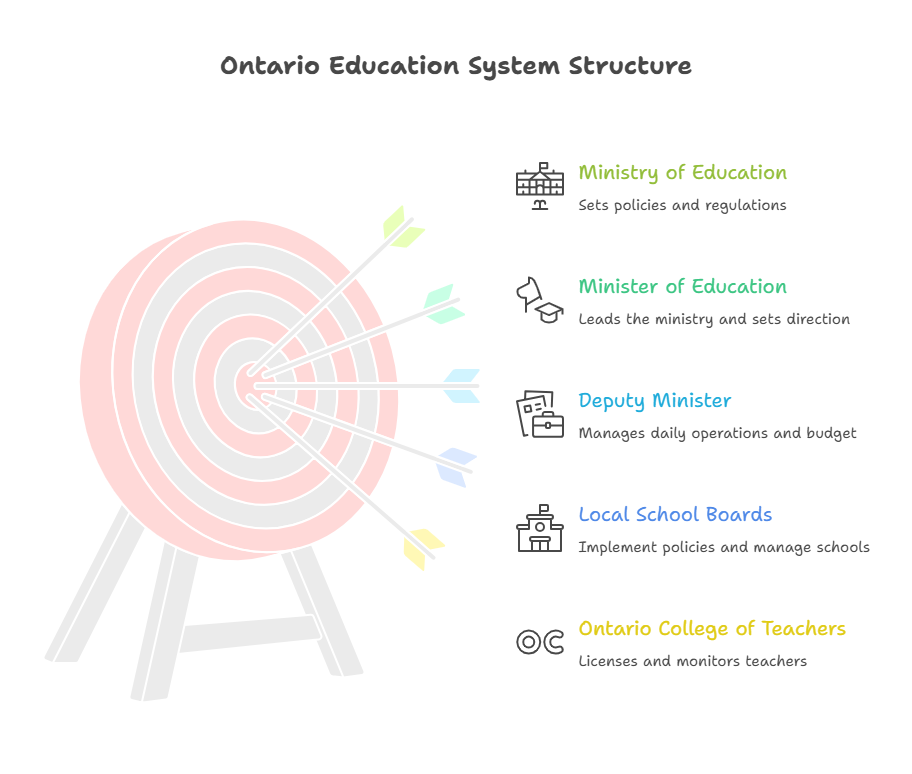
In Ontario, the Ministry of Education oversees the public education system, from child care to high school graduation. Its primary responsibilities include establishing regulations, distributing funding, and ensuring compliance with provincial standards in schools. This structured approach guarantees a consistent and quality learning experience for every student, regardless of their location in Ontario. The ministry comprises leaders with specific roles and collaborates closely with local school boards to implement its initiatives effectively. In the following sections, we will discuss the key figures within the ministry and the functions of local school boards in supporting education.
Leadership roles and who the Minister of Education is
- At the top of the ministry’s structure is the minister of education, an elected member of the provincial parliament chosen by the premier of Ontario. The minister serves as the face of the ministry and sets the direction for education policy in Ontario.
- The minister is supported by the deputy minister, a non-political public servant who manages the day-to-day operations of the ministry, oversees staff, handles the budget, and ensures programs and services work well across Ontario.
- Together, the minister, deputy minister, and their team support students, teachers, and schools by implementing government education plans, developing new curriculum rules, and launching projects focused on student well-being.
Local school boards and their responsibilities
- While the Ministry of Education sets the main guidelines, local school boards are responsible for putting these plans into action in their communities. Each region in Ontario has a school board (sometimes called school divisions in other parts of Canada), which manages all the public elementary and high schools in their area.
- Local school boards hire teachers and staff, maintain school buildings, manage ministry funding, and aim to keep schools safe and welcoming. They focus on providing good resources for student success and are led by elected trustees who listen to the community and help guide the schools.
- School boards work with other groups in education, such as the Ontario College of Teachers. This group gives out teaching licenses and checks on teachers to make sure they meet the right standards, ensuring that every teacher in the province is well-trained so students receive a good education.
Key Services Provided by the Ministry of Education
The Ministry of Education offers many key services that help learners at every age. The work it does is guided by the Education Act, which makes sure the delivery of core services supports every school in Ontario. The goal is to make things open, easy to use, and good for all people.
The ministry does many things. It gives money for special education and builds new education programs. These services touch your child’s school life each day. All the education programs, and special education too, are made to fit the needs of people in Ontario. Now, let’s talk more about the support for families and the school stages the ministry looks after.
Support for students, parents, and newcomers
The Ministry of Education wants to help every learner do well in school. It gives special programs and resources to students, parents, and families who are new to the province. This is to make sure they have what they need to do well in the Ontario school system. For people new to Canada, it is very important to learn how the school system works. The right help will make things much easier.
The ministry gives support in the following ways:
- Special Education: The ministry gives money and tools to support students with special needs. This helps make sure they get the help that is right for them.
- Indigenous Education: There are special programs to help First Nations, Métis, and Inuit students. The ministry also puts more Indigenous views into what students learn.
- Newcomer Resources: The ministry has information and programs to help new families understand schools in Canada.
- Parent Involvement: There are materials in different languages. These materials make it easier for parents to take part in their children’s education.
- Child Care Support: The ministry shares money and info for parents who want to find good child care providers.
These services show that the ministry is serious about fairness and including everyone. Their goal is to open doors to learning for all students in Ontario by breaking down barriers.
Early childhood education, elementary, and secondary programs
The Ministry of Education in Ontario plays a key role from early childhood to secondary school. It develops and funds early childhood education and full-day kindergarten to build a strong learning foundation. The ministry then sets curriculum standards and graduation requirements for elementary Schools (Grades 1–8) and secondary schools (Grades 9–12), including oversight of private schools like USCA Academy. This ensures students receive quality education and are prepared for academic success.
| Educational Stage | Description |
|---|---|
| Early Childhood Education | Focuses on play-based learning in early years programs and kindergarten. |
| Elementary School | Covers Grades 1 to 8, building foundational skills in literacy, math, and other core subjects. |
| Secondary School | Includes Grades 9 to 12, where students work toward their Ontario Secondary School Diploma (OSSD). |
Conclusion
To sum up, the Ministry of Education has a big job in shaping how people learn in Ontario. It gives a lot of support and the things needed for students, parents, and teachers. This helps everyone be able to get a good education that fits what they need. If you know how the ministry works and what it offers, it can help you and your family get through the school system in a better way. The Ministry helps from early childhood education to high school programs. The goal is to give every student a place where they can do well. If you have questions or want more help with education in Ontario, you can reach out anytime!
Frequently Asked Questions
1. What does the Ministry of Education oversee in Ontario?
The Ministry of Education Ontario is in charge of publicly funded education in Ontario, Canada. It looks after kids from early child care all the way to Grade 12. The Ministry makes the curriculum, gives money for education programs, and sets rules under the Education Act. It also gives out licenses for child care. Its main job is to make sure all students in schools are safe and get a good education.
2. How is USCA Academy connected to Ontario’s education pathway?
USCA Academy is a private school that is checked by the Ministry of Education. The school can give credits for the Ontario Secondary School Diploma (OSSD). This means students have a clear path to get their diploma in Ontario. The school’s education programs follow the rules set by the province, so families can count on it.
3. Where can I find the latest updates from the Ministry of Education in Ontario?
The top place to get new updates is the Ministry of Education Ontario website. You will find news, any changes in rules, and info on the school year there. The site shares tools and guides from the Ontario Educational Communications Authority (TVO) as well. You can go to public libraries in Ontario for more help and resources too.