

Key Highlights of College vs University
- In the college vs university in Canada discussion, colleges give you hands-on, job-focused training. Universities spend more time on academic ideas and theories.
- The key differences are about how long the program is, how teaching is done, and what kinds of jobs you can get later.
- Canadian colleges vs universities have different rules for getting in. Colleges are usually easier to get into for international students.
- Colleges hand out diplomas and certificates. Universities let you earn bachelor’s, master’s, and doctoral degree programs.
- You need to pick a path in higher education that matches your personal career goals and the way you like to learn.
Introduction
Are you thinking about your higher education in Canada? If you are an international student, you may hear people use the words “college vs university for international students in Canada” like they mean the same thing. But in the Canadian education system, they do not mean the same. Canadian colleges and universities are two different paths. Knowing the difference between Canadian colleges and universities is a key step. It will help you make a good choice for your school and job plans. This guide will give you all the information you need, so you can pick what is best for you.
College vs University in Canada: Key Differences
The main difference between a college and a university in Canada, especially when considering a university degree vs college diploma, lies in their educational focus. Colleges are career-oriented higher education institutions that provide hands-on training and practical skills for specific jobs. They offer diplomas, certificates, and associate degrees. In contrast, universities are primarily academic institutions focused on research and theory. They offer undergraduate and graduate degrees, such as bachelor’s, master’s, and PhDs, preparing you for professional fields that require in-depth theoretical knowledge.
Below is a comparison of the key Aspects of colleges and universities in Canada:
| Aspect | Colleges in Canada | Universities in Canada |
|---|---|---|
| Main Focus | Practical, skills-based, career-oriented training | Academic, theoretical, and research-based education |
| Credentials | Certificates, Diplomas, Advanced Diplomas, Graduate Certificates | Usually 3–4 years (undergraduate programs) |
| Program Length | Typically 1–3 years | Usually 3–4 years (undergraduate) |
| Teaching Style | Hands-on learning, labs, projects, co-op | Lectures, exams, research, independent study |
| Admission Flexibility in private universities | More accessible entry requirements | Competitive academic requirements |
| Tuition Cost | Generally lower and more affordable | Higher tuition compared to colleges |
| Class Size | Smaller, interactive classes | Larger lecture-style classes |
| Career Outcome | Faster job readiness, industry-specific roles | Broad career options, professional pathways |
| Research Opportunities | Limited | Extensive research opportunities |
| PGWP & PR Eligibility | Eligible (program & institution dependent) | Eligible (program & institution dependent) |
| Best Suited For | Students seeking quicker workforce entry | Students aiming for academic or professional careers |
Admission Requirements and Application Processes
Getting started with applying to Canadian colleges and universities may seem challenging, but it follows a straightforward path. To apply, you need to demonstrate that you have completed high school or secondary education, and most institutions require your high school students transcripts. As an international student, you must also provide proof of English proficiency. Each school has its own admission criteria for undergraduate and bachelor’s degree programs, which can vary significantly. Therefore, it is essential to research the specific requirements of the schools you are interested in. The following sections will further explore the differences in admission expectations between colleges and universities.
Entry Criteria for Colleges (Ontario and Canada)
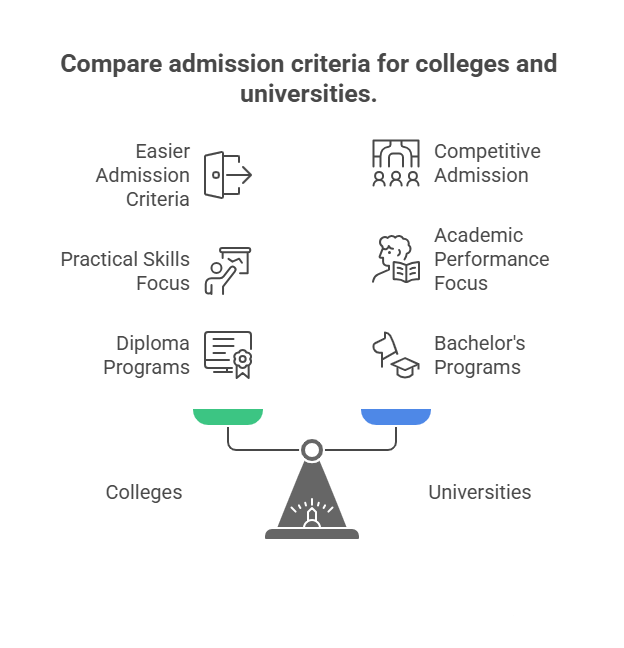
- Admission to Canadian colleges, including those in Ontario, is generally easier than university, often requiring only a high school diploma or its equivalent.
- Colleges focus less on strict academic grades and more on practical skills and readiness for hands-on programs, making entry accessible for many international students.
- Most college programs are diploma or associate degree courses, with straightforward admission criteria aimed at preparing students for employment, and entry requirements are typically not difficult to meet.
University Admissions Requirements for International Students
- Admission to Canadian universities is competitive, especially for international students applying to popular bachelor’s programs.
- You must have an excellent academic record in secondary school, with strong grades in relevant subjects for your chosen degree.
- Universities focus mainly on your academic performance to ensure you can handle theory-based coursework, so meeting only the minimum requirements might not be enough aim for high grades and a strong application.
English Language and Academic Preparation (USCA Academy Pathways)
Showing proof of English language skills is a key requirement for admission to Canadian colleges and universities. International students often need test scores like IELTS or TOEFL, along with a strong academic background from primary school or high school. Joining a preparatory pathway, such as attending a private high school in Canada, can help you adjust and meet admission goals. Schools like USCA Academy specialize in helping international students prepare for success. USCA Academy offers:
- Strong academic classes for the Ontario Secondary School Diploma (OSSD).
- Support to improve your English skills for admission requirements.
- Tips on applying to schools and colleges across Canada.
Career Outcomes and Employability After Graduation
What you pick between college or university which is better will shape your job options later. College is good for career training. It helps you learn the skills you need right away to work after you graduate. This is a good choice if you have clear career goals and want a job-focused path.
University education gives you a wider base. You can use this to get many types of jobs or to move on to graduate programs later, such as at prestigious institutions like Yale University. If you are one of the international students, it is important to know about these different paths. It will help you make better choices for your future, like finding ways to stay long-term or get permanent residency.
Graduate Success from Colleges: Job-Readiness and Co-ops
Colleges help students become job-ready by designing programs with input from industry partners, ensuring graduates have practical skills employers seek. Many college programs include co-operative education (co-ops), offering paid work placements that provide real-world experience and valuable networking opportunities. This hands-on training often leads to jobs soon after graduation, especially in technical and skilled fields, as well as social sciences. Employers appreciate that college graduates require less additional training. Common college program areas include:
- Skilled trades, such as electrician or culinary arts.
- Technology, including software development or animation.
- Business and healthcare, covering accounting or practical nursing.
College graduates are highly valued in these sectors.
University Degrees: Employment Pathways & Networking
- A university degree is required for careers in fields like medicine, law, engineering, or scientific research, and is a stepping stone to graduate studies such as master’s or PhD programs.
- University programs focus on theoretical knowledge and critical thinking, while providing valuable networking opportunities with experts and peers who may become future colleagues.
- Employers often prefer university graduates for their strong research and problem-solving abilities, making them suitable for leadership and professional roles that demand complex analytical skills.
Choosing the Right Fit: How to Decide
Choosing between a college and a college of law or university is something you have to do for yourself. It depends on your needs and where you are in life. There is not one “best” answer for everyone. You need to pick what matches your academic goals, your field of study, and how you like to learn.
Think about what you want to get from school, like the possibility of attending The Wharton School of Business. Do you want to get ready for a job fast, or do you want a wide education so you can try many options? Knowing this will help you learn more about the types of institutions and find the one that is good for you.
Academic Goals, Career Plans, and Personal Preferences
If you’re deciding between college or university in Canada, start by thinking about your academic goals and preferred learning style. Understanding the difference between college and university is crucial; universities focus on research and broad knowledge, while colleges emphasize practical, hands-on skills. Consider your career plans: some jobs require a university degree, while others value a college diploma. Research what’s needed in your chosen field.
Ask yourself:
- Do I want to start work in two years, or am I okay with going to school for four years or more?
- Does my dream job need a license or a higher degree?
- Do I want small, hands-on classes, or big lecture rooms?
Being honest with your answers will help you choose the right path for your future.
The Role of Private High Schools like USCA Academy in Academic Preparation
- Choosing the right private high school, such as USCA Academy, is key for international students preparing for higher education in Canada.
- These schools offer focused academics and support, helping students earn the Ontario Secondary School Diploma (OSSD) credits needed for college or university entry.
- Attending a strong school introduces students to the Canadian secondary education system, building study habits and confidence.
- Investing time and effort in a reputable high school ensures readiness and a competitive edge when applying to colleges or universities across Canada.
Conclusion
To sum up, it is important for international students to know the difference between college vs university Canada. You need this info to choose the right path. Colleges teach more practical skills and help you get ready for work. Universities in Canada focus more on studies and research. Think about things like the rules for getting in, what jobs you want after school, and what you want for your future. This will help you pick a place that works for you. Finding the right school matters for your studies and getting a good job later. If you have any questions or want help, reach out to us. We are here to give you support just for you.
Frequently Asked Questions
1. Can you transfer credits from a college to a university in Canada?
Yes, a lot of Canadian colleges and universities offer a range of academic programs and have something called “articulation agreements.” These let you transfer your college classes to a university program. It means the classes you take at college can count for your university program. You can often start your bachelor’s degree in the second or third year. This is a popular way to save money.
2. Do Canadian employers value college and university credentials differently?
Yes, the value of these skills can change depending on the industry. For hands-on or skilled jobs, many employers like to hire college graduates because they have job-ready skills, which is especially crucial for pursuing a successful career after college in Canada. In roles where there is a lot of research, theory, or a need for more learning, employers usually look for people from Canadian universities who finished degree programs.
3. Is it easier to get admission in a college or a university in Canada?
It is usually easier for international students to get into a college in Canada, including private schools. Colleges often only ask that you finish secondary school. They are more flexible with what they need. But universities look for higher grades and have strict rules. Getting into a university can be much harder, especially if you apply to popular programs.