
Key Highlights of Chemistry Grade 11 Study Strategies
Here is a quick look at what you get in this guide for Chemistry Grade 11:
- You will find an overview of the main topics in chemistry Grade 11 . This goes from ideas about matter and bonding to chemical reactions.
- There is a simple breakdown of important ideas. This covers the basics of atomic structure and the properties of matter.
- You will get easy ways to understand common experiments and lab safety.
- See the impact of some common chemical reactions on the world and on us.
- There is a section about the study of the properties of chemicals and how they can react with each other.
- Find good ways to study, use time well, and know what resources may help you do better.
Introduction
Welcome to Grade 11 Chemistry! In this course, you will step into a whole new world. Here, you get to start learning about the parts that make up everything around us. We will begin with the tiniest bits, like atoms, and move on to big ideas, like chemical reactions and how they work. Understanding chemistry can open the door to many great jobs and fields in science.
This guide gives easy and clear help with chemistry concepts for students. It will help you learn the basics about matter, chemical bonding, the air around us, and more. With this information, you will build a solid understanding of chemistry Grade 11.
Grade 11 Chemistry Curriculum in Canada
The Grade 11 Chemistry program in Canada follows guidelines from each province, including the Ontario Ministry of Education. This course focuses on understanding chemistry’s core concepts, exploring why substances behave as they do. It enhances analytical skills through the study of the quantitative properties of matter and examines the impact of chemical reactions on individuals and the environment. The curriculum prepares students for advanced studies and highlights chemistry’s relevance in everyday life.
The chemistry grade 11 course prepares students for advanced science studies.
Key topics and concepts you will learn
Your Grade 11 Chemistry class introduces you to key concepts in chemistry. You’ll start by learning about the properties of matter, chemical trends in the periodic table, and chemical bonding essential for understanding reactions and element combinations. The course covers stoichiometry, teaching you to calculate amounts of reactants and products in chemical reactions. You’ll also study:
- Atomic Structure: Components of atoms electrons, protons, and neutrons.
- The Periodic Table: Element trends and organization.
- Solutions and Solubility: How substances dissolve and factors affecting solubility.
- Gases and Atmospheric Chemistry: Gas behavior and roles in the atmosphere.
- Introduction to Organic Chemistry: Carbon-based compounds.
You’ll build a solid chemistry foundation.
How the curriculum varies between Canadian provinces
While core chemistry principles are universal, Grade 11 curriculum details differ across Canadian provinces. Each Ministry of Education sets guidelines, causing variations in topic emphasis and unit order. For instance, Ontario’s SCH3U curriculum may structure units differently than Alberta or British Columbia. All provinces teach fundamentals like matter, atomic theory, bonding, and stoichiometry, but some may focus more on atmospheric chemistry or organic chemistry, reflecting regional priorities. This ensures students receive a comprehensive foundation suited to their province. The table below compares Ontario’s SCH3U curriculum with a general structure, highlighting similarities and differences.
| Ontario (SCH3U) Unit | General Curriculum Equivalent |
|---|---|
| Matter, Chemical Trends, and Bonding | Matter and Atomic Structure |
| Quantities in Chemical Reactions (Stoichiometry) | Chemical Reactions and Calculations |
| Solutions and Solubility | Properties of Solutions |
| Gases and Atmospheric Chemistry | The Behavior of Gases |
Understanding Atomic Structure and Chemical Bonding
Chemistry revolves around two key concepts: atomic structure and chemical bonding. Understanding what an atom is essential to grasp how elements behave. The arrangement of electrons, protons, and neutrons defines the atom’s characteristics and its interactions with other atoms. Chemical bonds, formed by valence electrons, connect atoms to create molecules and compounds. By studying atomic structure and bonding, you can comprehend how new substances are formed. In the following sections, we will explore the atom’s structure and the various types of bonding between atoms, deepening your understanding of these fundamental concepts in chemistry.
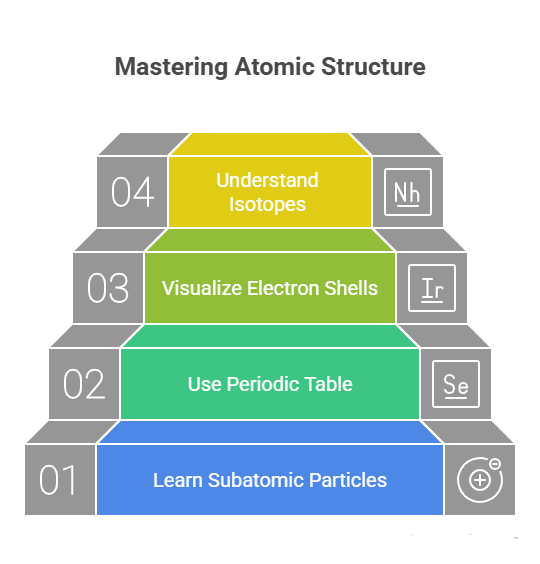
Simple steps to mastering atomic structure in grade 11 chemistry
Understanding atomic structure becomes easier if you break it into simple steps. In Grade 11, you’ll learn that atoms have a nucleus at the center, made of protons and neutrons, with electrons moving around in energy levels or shells. Think of the nucleus as the sun and electrons as planets. The number of protons identifies the element, while the arrangement of electrons, especially in the outer shell, affects chemical reactions. Focus on these basics:
- Learn the Subatomic Particles: Protons (+), neutrons (0), and electrons (–).
- Use the Periodic Table: It shows atomic numbers and helps with electron arrangements.
- Visualize Electron Shells: Draw Bohr models for the first 20 elements.
- Understand Isotopes:
Introduction to chemical bonding with clear examples
When you understand how atoms are built, the next step is chemical bonding—how atoms link to form substances. Atoms bond to achieve a stable, full set of valence electrons in their outer shell. The two main types are ionic and covalent bonds. Ionic bonds involve one atom giving electrons to another, creating charged ions (like sodium giving an electron to chlorine in NaCl). Covalent bonds involve atoms sharing electrons (such as hydrogen and oxygen in H2O).
To get better at bonding, try these steps:
- Identify Valence Electrons: Use the periodic table to count how many valence electrons an element has.
- Distinguish Bond Types: Know that ionic bonds are usually found between metals and nonmetals, but covalent bonds are between nonmetals.
- Draw Lewis Structures: Draw diagrams that help you see how atoms share or move electrons.
- Connect to Properties: Think about how the type of chemical bonds changes things like melting point or solubility.
Chemical bonding knowledge prepares you for understanding reactions.
Students often benefit from a chemistry tutor for better understanding.
Common Grade 11 Chemistry Experiments Explained
Chemistry is a hands-on subject that goes beyond reading and memorization. In Grade 11, experiments help clarify concepts like stoichiometry and solubility. These labs allow you to measure accurately, observe chemical reactions, and analyze data to understand results. Engaging in these activities is crucial for developing your scientific skills, as they bridge textbook knowledge with real-world applications. You’ll learn how to apply chemistry to solve practical problems. The following sections will outline popular lab tasks and emphasize essential safety precautions to follow during experiments.
Popular lab activities and what you learn from them
In Grade 11 Chemistry labs, you’ll do experiments that make classroom concepts clearer. For example, titration labs let you add a base to an acid to find the acid’s strength, using stoichiometry and solution chemistry. You’ll also explore solubility by seeing how different salts dissolve in water, learning about solubility rules and chemical reactions. These labs use both your observation and problem-solving skills. Through these hands-on activities, you’ll understand:
- The law of conservation of mass in reactions.
- Using stoichiometry to predict products.
- Measuring quantitative properties carefully.
- How temperature and concentration affect reaction rates.
- Observing chemical changes like color or solids.
These skills prepare you for advanced studies.
Safety tips and best practices for chemistry labs at USCA Academy
Safety is the top priority in every chemistry lab. Always follow strict safety rules to protect yourself and others. At USCA Academy, you learn lab safety from the very beginning, even before handling equipment. Listening to your teacher and never trying experiments alone reduces risks. Keep your workspace clean and always stay alert to prevent accidents.
Here are some basic safety tips you should always follow:
- Wear Appropriate Personal Protective Equipment (PPE): Safety goggles, a lab coat, and closed-toe shoes are essential.
- Know the Location of Safety Equipment: Be aware of where safety items are kept.
- Handle Chemicals with Care: Never taste or directly smell chemicals.
- Dispose of Waste Properly: Follow instructions for disposing of chemical waste.
- Report All Accidents: Promptly inform your teacher about any spills or injuries.
Study Strategies That Work for Grade 11 Chemistry
To excel in Grade 11 Chemistry, active engagement is key. Don’t just read through materials; practice problem-solving, especially with challenging topics. Utilize textbooks or online resources, and create a structured study plan. Incorporating practice tests can identify your strengths and areas for improvement. Follow the upcoming steps and tips to enhance your study efficiency, allowing you to grasp complex concepts without wasting time.
Effective study methods and time management tips
To succeed in Grade 11 Chemistry, create a clear study plan and review your notes the same day after class. Studying regularly in short sessions helps you remember more, while cramming is less effective. Manage your time by scheduling study sessions in a calendar, breaking big topics into smaller parts, and using the Pomodoro Method study 25 minutes, then take a 5-minute break.
Here are more helpful tips:
- Form a Study Group: Discussing ideas helps you understand topics better.
- Practice, Practice, Practice: Solve many problems, especially stoichiometry and equations.
- Use Visual Aids: Make flashcards or diagrams for concepts.
- Seek Help Early: Ask your teacher or find resources if you’re stuck.
Using textbooks, online resources, and practice tests
Your textbook is essential for studying, but use other resources too. Read the textbook chapter before class to understand main ideas and ask better questions. Online resources like websites, videos, and interactive simulations can explain tough topics in different ways. These tools, including animations and online labs, make concepts clearer and more engaging. Practice tests are also important. They let you:
- Identify Weaknesses: Find out what you need to study before the big test.
- Get Used to the Format: Learn what kind of questions to expect.
- Manage Your Time: Practice answering on a timer so you get faster.
- Reduce Test Anxiety: When you know what is coming, you can feel calm and sure of yourself during the exam.
Conclusion
To do well in grade 11 chemistry, you need to know the work for the year and have good ways to study. You also need to do many experiments to see how things work in real life. Start with the main topics, like atomic structure and bonding. Use your books and tools to help you learn. Try hands-on lab work to make the ideas more clear. It’s not just about remembering facts. It’s about understanding and using them. Be sure to reach out for help if you need it. If you have questions about grade 11 chemistry, or want more tips on atomic structure, bonding, and work in the lab, get in touch with us. We are here to help you do your best.
Frequently Asked Questions
1. Which textbooks or resources are best for grade 11 chemistry?
The best way to learn is to use the government-approved textbook along with some online tools. You can go to Khan Academy. There are also good educational YouTube channels online. Many places have online courses that help, too. If you read your textbook for key ideas, then use online resources and practice tests, you will get a better handle on grade 11 chemistry.
2. What skills are developed in grade 11 chemistry?
Grade 11 Chemistry helps you build solid analytical skills and teaches you how to solve problems. It can also help you get better at reading and understanding scientific ideas. When you do experiments and study chemical reactions in the classroom, you will improve your ability to think clearly and break down data. The study tips you use and your understanding of chemistry will be useful if you want to work in any science field later on.
3. Where can I find free practice tests for grade 11 chemistry?
You can get free practice tests for grade 11 chemistry on many educational websites. A lot of online courses give quizzes and sample exams, too. Look at your textbook’s website, or ask your teacher for a list of resources that match how you want to study.